What Does That Mean in a Will or LPA? Plain-English Estate Planning Questions

Last verified: July 2026 (England and Wales)
If you have looked at a Will, Lasting Power of Attorney, trust document or probate letter and wondered what a word means, you are not alone.
Estate planning uses a lot of old-fashioned language. Words like testator, residue, donor, attorney, trustee, life tenant, ademption and intestacy can sound more complicated than they need to.
This guide gives short, plain-English answers to common questions people search for when they are trying to understand Wills, LPAs, trusts, probate and inheritance tax.
This is a quick orientation guide, not legal, tax or financial advice. A word can have a different effect depending on the exact document, the family circumstances and the assets involved.
For broader decision-making questions, you may also find these helpful:
Why a professionally written Will matters
What is the 7-year inheritance tax rule?
Quick-read summary
• This guide explains common estate planning terms in plain English.
• It is written for people who have seen a word in a Will, LPA, trust or probate document and want a quick explanation.
• It deliberately simplifies technical terms.
• Do not use a short definition to diagnose your own position.
• If a word affects who inherits, who can act, how property is owned, or how tax may apply, ask before relying on it.
Wills: words people often see in a Will
What does testator mean in a Will?
The testator is the person making the Will.
You may still see this word in formal Will wording. In everyday conversation, it simply means “the person whose Will this is”.
What does testatrix mean in a Will?
Testatrix is an older term for a female person making a Will.
Modern documents usually use testator for any person making a Will, or avoid the old term altogether.
What is a Will?
A Will is a legal document that says what should happen to your estate after you die.
It usually appoints executors, names beneficiaries, deals with gifts, and may include trusts, guardianship wording or funeral wishes.
What is a codicil?
A codicil is a formal document that changes an existing Will without replacing the whole Will.
In practice, a new Will is often clearer than adding a codicil, especially if several changes are needed.
What does executor mean in a Will?
An executor is the person appointed in your Will to deal with your estate after you die.
Executors may need to locate the Will, apply for probate, collect assets, pay debts and tax, keep records and distribute the estate.
Can an executor also be a beneficiary?
Yes, an executor can usually also be a beneficiary.
This is common. The important point is that the executor must still act properly, keep records and follow the Will.
What is a trustee in a Will?
A trustee is someone who holds or manages assets under a trust.
Executors and trustees are often the same people, but the roles are not identical. Executors deal with the estate administration. Trustees manage trust assets according to the trust wording.
What is a beneficiary?
A beneficiary is someone who receives something from a Will, trust, pension nomination, life policy or estate.
In a Will, beneficiaries may receive a specific item, a fixed sum of money, a share of the residue, or a benefit under a trust.
What is a guardian in a Will?
A guardian is someone named in a Will to care for your children if they are under 18 and both parents have died or no parent with parental responsibility can act.
A guardianship appointment is one of the most important reasons younger parents should make a Will.
What is an estate?
Your estate is the money, property, possessions and other assets you leave when you die, after allowing for debts and liabilities.
Some assets may not pass under your Will, for example certain jointly owned assets, pensions or life policies written in trust.
What does residue mean in a Will?
Residue means what is left after debts, funeral costs, tax, expenses and specific gifts have been dealt with.
The residue is often the most important part of the Will because it usually covers everything not separately named.
What is a residuary beneficiary?
A residuary beneficiary is someone who receives all or part of the residue of the estate.
If the Will says “I leave the residue of my estate to my children equally”, the children are the residuary beneficiaries.
What is a legacy in a Will?
A legacy is a gift in a Will.
It might be a fixed sum of money, a particular item, a share of the estate, or a gift to a charity.
What is a bequest?
A bequest is another word for a gift left in a Will.
People often use “legacy” and “bequest” in similar ways.
What is a specific gift in a Will?
A specific gift is a gift of a particular item or asset.
Examples include a wedding ring, a car, a painting, shares in a named company, or a particular property.
What is a pecuniary gift?
A pecuniary gift is a gift of money.
For example, “I give £5,000 to my niece” is a pecuniary gift.
What are chattels in a Will?
Chattels usually means personal possessions.
This can include furniture, jewellery, artwork, vehicles and household items, but the exact meaning can depend on the Will wording.
What is a Letter of Wishes?
A Letter of Wishes is a separate guidance document that sits alongside a Will, trust or LPA. it is also known as a memorandum of wishes or statement of wishes.
It is usually not legally binding, but it helps executors, trustees, attorneys or guardians understand your reasoning and priorities. You can read more in our Letter of Wishes guide.
Are funeral wishes legally binding in a Will?
Usually, funeral wishes are guidance rather than binding instructions.
They can still be useful, but it is sensible to tell the people who will arrange the funeral, because the Will may not be found until after the funeral has taken place.
When gifts in Wills go wrong
What does it mean if a gift in a Will fails?
A gift fails if it does not take effect.
This might happen because the beneficiary has died, the item no longer exists, the beneficiary refuses the gift, the gift is unclear, or a condition in the Will is not met.The result depends on the Will. The gift might pass to a substitute beneficiary, fall into the residue, pass to other people in a group, or create a partial intestacy.
What does lapse mean in a Will?
Lapse usually means a gift fails because the beneficiary died before the person who made the Will.
There are exceptions, especially where the gift is to a child or other descendant and the Will does not say something different. This is why the exact wording matters.
What does ademption mean in a Will?
Ademption can happen when a Will gives a specific item, but the person no longer owns that item when they die.
For example, if a Will leaves “my Ford Fiesta to Alex”, but the car was sold before death, that specific gift may fail.
What does abatement mean in a Will?
Abatement is the process of reducing gifts where the estate does not have enough money or assets to pay everything in full.
It matters where a Will leaves several gifts but the estate is smaller than expected.
What is a disclaimer?
A disclaimer is when a beneficiary refuses to accept a gift.
This can have legal and tax consequences, so it should not be done casually or without advice.
What is a substitute beneficiary?
A substitute beneficiary is a backup beneficiary.
For example, a Will might say, “I leave this gift to Sarah, but if Sarah dies before me, to her children.” The children are substitute beneficiaries.
What is a class gift?
A class gift is a gift to a group of people rather than named individuals.
Examples include “my children”, “my grandchildren” or “my nieces and nephews”. The exact wording matters because it decides who is included and when the class is fixed.
What is a survivorship clause?
A survivorship clause says that a beneficiary must survive the person making the Will by a set period before inheriting.
Common periods include 28 or 30 days. These clauses can help avoid assets passing twice in quick succession, but they need careful drafting.
What is partial intestacy?
Partial intestacy happens when part of an estate is not effectively dealt with by the Will.
This can happen if a residuary gift fails, if a Will is badly drafted, or if the Will does not cover all assets properly.
What does per stirpes mean?
Per stirpes is a technical phrase meaning that a deceased beneficiary’s share passes down their family line.
In plain English, it often means children step into their deceased parent’s place. The wording should always be checked carefully.
What does per capita mean?
Per capita means by head.
If a gift is divided per capita, each person in the relevant group usually receives an equal share in their own right, rather than inheriting through a family branch.
LPAs and capacity: words people see in
Powers of Attorney
LPA stands for Lasting Power of Attorney.
It is a legal document that lets you appoint trusted people to make, or help with, decisions for you. There are two types: Property and Financial Affairs, and Health and Welfare.
For broader questions, see our LPA FAQ Guide
What is an Enduring Power of Attorney?
An Enduring Power of Attorney (EPA) is an older type of Power of Attorney covering property and financial affairs.
An EPA made and signed before 1 October 2007 may still be valid. It may need to be registered with the Office of the Public Guardian if the donor starts to lose, or has lost, mental capacity.
For more information, see our Enduring Power of Attorney guide.
What is a donor in an LPA?
The donor is the person who makes the LPA and chooses the attorney or attorneys.
In this context, donor does not mean someone donating to charity or giving a medical donation. It describes the person giving legal authority through the LPA.
What is an attorney in an LPA?
An attorney is a trusted person appointed by the donor to make, or help with, decisions within the authority given by the LPA.
In this context, attorney does not mean an American lawyer. Most attorneys are relatives or friends.
Attorneys must follow the LPA, stay within their authority, keep appropriate records and follow the Mental Capacity Act 2005 when making decisions.
For more information about choosing attorneys and deciding how they should act, see Appointing Attorneys in a Lasting Power of Attorney.
What is a replacement attorney?
A replacement attorney is a backup attorney.
They may step in if an original attorney can no longer act, for example because they have died, lost capacity, disclaimed their appointment or become unable to continue.
Whether a replacement can act depends on the wording of the LPA and what has happened to the original attorney.
What is a certificate provider?
A certificate provider is the person who confirms that the donor understands the LPA, understands the authority being given and is making the LPA freely.
This is an important safeguard against misunderstanding, pressure and fraud.
What does jointly mean in an LPA?
Jointly means the attorneys must make the relevant decisions together.
This can provide additional control, but it can also cause practical difficulties if one attorney becomes unavailable or can no longer act.
What does jointly and severally mean in an LPA?
Jointly and severally means the attorneys can usually act together or separately.
This is often more practical, but it also means that each attorney may have considerable authority to act alone.
What does jointly for some decisions and jointly and severally for others mean?
This means the attorneys must make certain specified decisions together but can make other decisions separately.
The distinction must be clearly expressed in the LPA. Unclear or unworkable wording may create registration or practical problems.
What is a preference in an LPA?
A preference is guidance about what the donor would like.
Preferences are not normally legally binding, but attorneys should consider them when making decisions.
What is an instruction in an LPA?
An instruction is wording that attorneys must follow.
Instructions must be clear, lawful and workable. Poorly drafted instructions can make an LPA difficult to register or use.
What is the Mental Capacity Act 2005?
The Mental Capacity Act 2005 is the main legal framework in England and Wales for supporting people to make their own decisions and for making decisions on behalf of someone who lacks capacity for a particular matter.
It includes important principles about mental capacity, best interests and using the least restrictive option.
What is mental capacity?
Mental capacity means the ability to make a particular decision at the time it needs to be made.
Capacity is decision-specific and time-specific. Someone may be able to make one decision but not another, and their capacity may change.
A diagnosis or disability does not automatically mean that someone lacks capacity.
What does best interests mean?
Where a decision is made for someone who lacks capacity, it must be made in their best interests.
This does not simply mean doing what is easiest. The decision-maker should consider the person’s wishes, feelings, beliefs, values and individual circumstances, together with the views of appropriate people involved in their life.
What does least restrictive option mean?
The least restrictive option is the approach that achieves the necessary purpose while interfering as little as reasonably possible with the person’s rights and freedom.
Before acting for someone who lacks capacity, the decision-maker should consider whether there is a less restrictive way to deal with the matter.
What is the Office of the Public Guardian?
The Office of the Public Guardian (OPG) registers Lasting Powers of Attorney and Enduring Powers of Attorney.
It also supervises deputies and can investigate concerns about the conduct of attorneys or deputies.
After the first mention, it is usually shortened to OPG.
What is the Court of Protection?
The Court of Protection deals with decisions and disputes involving people who may lack mental capacity.
It can decide whether someone has capacity for a particular matter, make one-off decisions, appoint deputies and decide questions involving LPAs and EPAs.
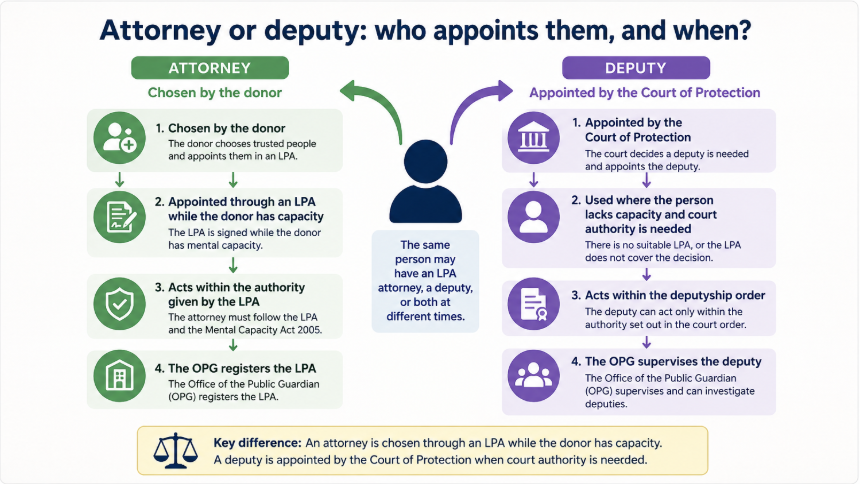
What is a deputy?
A deputy is someone appointed by the Court of Protection to make specified decisions for a person who lacks capacity.
Unlike an attorney, a deputy is appointed by the court rather than chosen by the person through an LPA. A deputy can act only within the authority given by the court.
What is a deputyship order?
A deputyship order is the court order appointing the deputy.
It sets out the decisions the deputy is authorised to make and may also contain restrictions, requirements or limits on that authority.
What does “P” mean in Court of Protection documents?
“P” is the letter commonly used in Court of Protection proceedings for the person whose capacity, welfare or affairs are being considered.
You may see it in court papers, professional correspondence or a deputyship order. It is simply court shorthand for the person at the centre of the matter.
What is a Property and Financial Affairs LPA?
A Property and Financial Affairs LPA covers money, property and financial decisions.
It can cover matters such as bank accounts, bills, pensions, investments and property. Depending on the wording and the donor’s permission, it may be used while the donor still has capacity.
For more information, see our Property and Financial Affairs LPA guide
What is a Health and Welfare LPA?
A Health and Welfare LPA covers care, medical treatment and personal welfare decisions.
It can only be used when the donor lacks capacity to make the relevant health or welfare decision.
For more information, see our Health and Welfare LPA guide.
What is an activation key for an LPA?
An activation key is a code used by a donor or attorney to add an eligible registered LPA to their online Use an LPA account.
It is not the code given to a bank, utility company or other organisation.
https://www.fernwills.com/articles/activate-lpa
What is an LPA access code?
An access code is generated through the online Use an LPA service and given to an organisation that needs to view the LPA.
The code has 13 characters and begins with the letter V. A screenshot or printout of the online summary is not normally evidence by itself. The organisation needs the access code so it can verify the LPA through the official service.
What is a certified copy of an LPA?
A certified copy is a paper copy that has been certified in the legally required way so that it can be used instead of sending the registered original.
The correct certification, signature and date must appear on every page. An official office copy supplied by the OPG is a separate form of official copy.
For practical guidance about using an LPA with organisations, see What is the best way to activate and use your LPA online?
What do remission and exemption mean for an LPA fee?
A remission is a reduction in the OPG registration fee.
An exemption means that no registration fee is payable.
Eligibility depends on the donor’s current income or qualifying benefits and the current OPG rules. Fern checks the applicable fee position as part of preparing and registering an LPA.
Official terminology source: Office of the Public Guardian, Tackling our terminology.
Trust terms people often hear in Will planning
What is a trust?
A trust is a legal arrangement where trustees hold or manage assets for beneficiaries.
In estate planning, trusts are often used to control how assets are used after death, especially where there are children, vulnerable beneficiaries, second marriages, property concerns or blended families.
For a fuller explanation, see What is a Will Trust?.
What is a Will trust?
A Will trust is a trust created by a Will.
It usually only starts after death. It is not normally a separate lifetime trust created while the person is alive.
What is a settlor?
A settlor is the person who creates a trust or provides assets for it.
In a Will trust, people often use simpler language and refer to the person making the Will.
What is a trustee?
A trustee is someone responsible for managing trust assets and following the trust wording.
Trustees must act carefully, keep records, consider the beneficiaries and stay within their powers.
What is a beneficiary of a trust?
A beneficiary is someone who can benefit from the trust.
Some beneficiaries have fixed rights. Others may only be potential beneficiaries where trustees have discretion.
What is a life tenant?
A life tenant is someone who has a right to benefit from trust property during their lifetime.
In Will planning, this often means a surviving spouse or partner can live in a property or receive income, while the underlying capital is protected for others later.
What is an ultimate beneficiary?
An ultimate beneficiary is someone who is intended to benefit after an earlier interest has ended.
For example, children may be the ultimate beneficiaries after a surviving spouse’s life interest has ended.
What does remainderman mean?
Remainderman is an older technical word for someone who receives trust property after an earlier interest ends.
We usually prefer clearer language such as ultimate beneficiary.
What is a discretionary beneficiary?
A discretionary beneficiary is someone who may benefit from a trust, but does not have an automatic fixed entitlement.
The trustees decide whether, when and how to help them, within the trust wording.
What is a life interest trust?
A life interest trust gives one person a right to benefit during their lifetime, while preserving the underlying asset for others later.
It is often used to balance protection for a surviving spouse or partner with longer-term inheritance for children.
What is a Property Life Interest Trust?
A Property Life Interest Trust is a Will trust often used to protect a share of a home.
It can allow a surviving spouse or partner to live in the property while ring-fencing the first person’s share for chosen beneficiaries later.
What is a Flexible Life Interest Trust?
A Flexible Life Interest Trust gives a life tenant rights, but may also give trustees additional flexibility.
It can be useful where the family needs both structure and adaptability.
What is a discretionary trust?
A discretionary trust gives trustees discretion over who benefits, when and how.
This can help where beneficiaries are young, vulnerable, financially unstable, going through divorce, or where flexibility is important.
What is a vulnerable person trust?
A vulnerable person trust is a trust designed to support a vulnerable beneficiary.
The tax and legal rules can be technical, so this should be planned carefully rather than added casually.
What is a right to occupy trust?
A right to occupy trust can give someone the right to live in a property without necessarily giving them full ownership.
This may be used where someone should have housing security, but the property should ultimately pass elsewhere.
What is the Trust Registration Service?
The Trust Registration Service is the system used to register certain trusts with HMRC.
Not every trust needs registration immediately, but trustees should check the position when a trust is created, becomes active or changes.
Do Will trusts avoid care fees?
Planning primarily to avoid care fees is risky and can be treated as deliberate deprivation. Many clients are willing to pay a fair contribution and typically use Will trusts mainly for survivor protection and keeping inheritance on track; any care-fees impact is secondary and never guaranteed.
Probate and estate administration terms
What is probate?
Probate is the legal authority that may be needed so executors can deal with certain assets after someone dies.
Not every estate needs probate, but banks, investment providers or property transactions often require it. For practical support, see our Probate Executor Support guide.
What is a grant of probate?
A grant of probate is the official document confirming the validity of the Will and the executor’s authority to deal with the estate.
It is usually needed where institutions require formal proof before releasing assets.
What are letters of administration?
Letters of administration are similar to probate, but usually apply where there is no valid Will.
They give administrators authority to deal with the estate.
What are letters of administration with Will annexed?
This applies where there is a Will, but there is no executor able or willing to act.The grant gives authority to an administrator to deal with the estate under the Will.
What is a personal representative?
A personal representative is a general term for the person responsible for administering an estate.
Executors and administrators are both types of personal representative.
What is an administrator?
An administrator is someone appointed to deal with an estate where there is no executor able to act.
This often happens where there is no Will, or where the Will does not effectively appoint an executor.
What is intestacy?
Intestacy means someone has died without a valid Will dealing with their estate.
The intestacy rules then decide who inherits. This may not match what the person would have chosen.
What is partial intestacy?
Partial intestacy means the Will deals with some of the estate, but not all of it.
This can happen if the residue clause fails or if the Will does not properly cover all assets.
What are estate accounts?
Estate accounts are records showing what came into the estate, what was paid out, and how the final balance was distributed.
They help executors show beneficiaries that the estate has been administered properly.
What is the executor’s year?
The executor’s year is a common phrase referring to the first year after death.
It does not mean executors can ignore everything for a year. It recognises that estate administration can take time.
What is a Deed of Variation?
A Deed of Variation is a document that changes how an estate is distributed after death, usually with the agreement of the affected beneficiaries.
It can have tax and family consequences, so it should be handled carefully.
What is a caveat in probate?
A caveat can be used to stop a grant of probate being issued while there is a dispute or concern.
It is not something to use lightly, because it can delay estate administration and may escalate conflict.
Property ownership terms in Wills and trusts
What are beneficial joint tenants?
Beneficial joint tenants own the property together as a whole.
When one owner dies, the property usually passes automatically to the survivor outside the Will. This is called the right of survivorship.
What are tenants in common?
Tenants in common each own a defined share of the property.
That share can usually pass under the owner’s Will, which is why tenants in common ownership is often important for Will trusts.
What does severance of tenancy mean?
Severance of tenancy changes ownership from beneficial joint tenants to tenants in common.
This is often needed where someone wants their share of a home to pass under their Will or into a Will trust. See our Severance of Tenancy guide.
What is a Form A restriction?
A Form A restriction is a Land Registry entry that usually indicates the property is held as tenants in common.
It is not the trust itself. It is a title restriction that affects how the property can be dealt with.
What is the right of survivorship?
The right of survivorship means that when one joint owner dies, the property passes automatically to the surviving joint owner.
This can override what the Will says about that property share.
What is a declaration of trust?
A declaration of trust records beneficial ownership of an asset, often a property.
It can show who owns what share, especially where contributions are unequal or ownership needs to be clarified.
What is a title register?
The title register is the Land Registry record for a registered property.
It shows key details such as the legal owner, title number, restrictions and charges.
What is a legal owner?
A legal owner is the person registered as owning the property at Land Registry.
Legal ownership and beneficial ownership are connected, but they are not always the same thing.
What is a beneficial owner?
A beneficial owner is the person who is entitled to the value or benefit of the asset.
For example, someone may be a legal owner on the title, but beneficial ownership may be split in specific shares.
Inheritance tax and gifting
terms people often search for
What is inheritance tax?
Inheritance tax is a tax that may be paid when someone dies, depending on the value of their estate, available allowances, exemptions and reliefs.
Not every estate pays inheritance tax.
What is IHT?
IHT is short for inheritance tax.
You may see both terms used in articles, letters and professional notes.
What is the nil-rate band?
The nil-rate band is the amount that can usually pass free of inheritance tax before tax is charged.
The standard nil-rate band is currently £325,000, but the actual tax position depends on the estate, lifetime gifts, exemptions and transferable allowances.
What is the residence nil-rate band?
The residence nil-rate band is an additional inheritance tax allowance that may apply where a qualifying home passes to direct descendants.
It is not automatic in every estate, and the rules can be affected by trusts, estate size and who inherits.
What is the transferable nil-rate band?
The transferable nil-rate band allows unused inheritance tax allowance from a late spouse or civil partner to be transferred to the survivor’s estate in appropriate cases.
This can significantly affect the inheritance tax position for married couples and civil partners.
What is the transferable residence nil-rate band?
This is the transfer of unused residence nil-rate band from a late spouse or civil partner to the survivor’s estate.
It may apply even if the first death happened before the residence nil-rate band existed, but the rules still need checking.
What is a potentially exempt transfer?
A potentially exempt transfer, often shortened to PET, is usually a lifetime gift to an individual that may fall outside inheritance tax if the donor survives seven years.
If the donor dies within seven years, the gift may still need to be considered.
What is the 7-year rule?
The 7-year rule is the common shorthand for how many lifetime gifts are treated for inheritance tax.
If you survive seven years after making a gift, it may fall outside your estate for inheritance tax. There are exceptions and traps, so record-keeping matters. See our guide to the 7-year inheritance tax rule.
What is taper relief?
Taper relief can reduce the inheritance tax rate on certain gifts made more than three years before death.
It does not reduce the value of the gift itself, and it usually only helps where tax is actually due on the gift.
What is a gift with reservation of benefit?
A gift with reservation of benefit is a gift where the giver keeps benefiting from what they have given away.
A common example is giving away a house but continuing to live in it rent-free. In many cases, the asset may still be treated as part of the estate for inheritance tax.
What are gifts out of surplus income?
These are regular gifts made from income, not capital, where the donor can still maintain their normal standard of living.
This can be a valuable inheritance tax exemption, but evidence is crucial. Executors may need clear records of income, spending and the pattern of gifts.
What is the annual exemption for gifts?
The annual exemption is the amount you can give away each tax year without it being added back into your estate for inheritance tax.
The standard annual exemption is currently £3,000, but gifting rules depend on the facts and should be recorded properly.
What is a small gifts exemption?
The small gifts exemption allows small gifts of up to a certain amount per person each tax year, provided the rules are met.
It is often useful for modest gifts, but it should not be confused with larger lifetime gifting.
What is a charitable gift in a Will?
A charitable gift is a gift to charity in your Will.
Charitable gifts are generally exempt from inheritance tax and can sometimes affect the overall inheritance tax rate, depending on the size of the gift and estate.
What is business property relief?
Business property relief is an inheritance tax relief that may apply to certain business assets or business interests.
The rules are detailed and changing areas of tax should always be checked carefully before relying on the relief.
What is agricultural property relief?
Agricultural property relief is an inheritance tax relief that may apply to qualifying agricultural property.
It is specialist and fact-sensitive, so it should not be assumed just because land or buildings are rural.
Common phrases people misunderstand
Does “my trustees” mean I have a trust?
Not always.
Many Wills use “my trustees” to refer to the executors and trustees named in the Will, even if no active long-term trust is expected. The wording needs to be read in context.
Does “issue” mean a problem?
No. In Wills and trusts, issue usually means a person’s descendants.
This can include children, grandchildren and further descendants, depending on the wording.
Does “children” include stepchildren?
Not automatically.
In estate planning, stepchildren may need to be named or included clearly if you want them to benefit. Do not assume the word “children” covers every family relationship.
Does “spouse” include an unmarried partner?
No. A spouse is a husband, wife or civil partner.
An unmarried partner does not usually have the same automatic status, which is one reason unmarried couples should take proper advice when making Wills.
Does marriage affect a Will?
Marriage or civil partnership can affect an existing Will and may revoke it unless the Will was made in anticipation of that marriage or civil partnership.
If you marry, separate, divorce or enter a civil partnership, you should review your Will.
Does divorce cancel a Will?
Divorce does not simply delete the whole Will.
It can affect gifts and appointments involving the former spouse or civil partner. The safer approach is to review the Will rather than assume it still works.
Does an LPA override a Will?
No.
An LPA is for decisions during lifetime. A Will deals with the estate after death. Attorneys cannot use an LPA to rewrite the donor’s Will.
Does a Will override jointly owned property?
Not usually where property is owned as beneficial joint tenants.
The right of survivorship can mean the property passes automatically to the survivor, regardless of what the Will says about that share.
Does a Will control pensions?
Not usually directly.
Many pensions pass by nomination or trustee discretion rather than under the Will. Pension nominations should be reviewed alongside the Will.
Does a Will control life insurance?
It depends how the policy is set up.
A life policy may pass under the Will, by nomination, or through a trust. The paperwork should be checked.
When should you ask for help?
A short definition is useful if you simply want to understand a word.
You should ask for help before relying on a definition if:
• the term affects who inherits;
• the term affects who can make decisions;
• property ownership is involved;
• a trust is involved;• inheritance tax may be relevant;
• someone has died and probate may be needed;
• a beneficiary has died, refused a gift, or cannot be found;
• family relationships are complicated;• the document uses old-fashioned or technical wording.
The meaning of a word is only part of the answer. The effect of that word depends on the document around it.
Next steps
If you have seen a word or phrase in a Will, LPA, trust, Land Registry title or probate document and you are not sure what it means, the safest next step is to ask before acting on it.
Fern Wills & LPAs can help translate the wording, explain the practical effect, and identify whether the issue needs a simple explanation, a Will review, an LPA review, trust guidance or probate support.
This article is general information only, not individual advice.
If you’d like help applying this to your circumstances, we can guide you through the options.