Severance of Tenancy

Last verified: October 2026 (England & Wales)
Severance of tenancy changes the way you own a home together so that each owner has a separate share. Your share can then pass through your Will to the people you choose.
It can be useful if you want to provide for your partner while keeping your share for your children in the longer term. It does not mean dividing the house, selling it or making anyone move out.
If the home belongs entirely to you, there is no joint tenancy to sever. You can use your Will to decide who inherits it and whether a suitable trust should provide for someone first.
Joint tenants and tenants in common
Joint tenants: when one of you dies, the home passes automatically to the surviving owner. Your Will cannot leave a separate share to someone else.
Tenants in common: each of you owns a separate share in the value of the home. You can decide who receives your share through your Will.
Changing from the first arrangement to the second is called severance. Both owners stay on the title. If you already own as tenants in common, you do not need to sever again.
Severance and your Will need to work together. Without a valid Will, the inheritance rules decide who receives your separate share. Severance alone does not create a trust or give your partner a right to live in your share after your death.
How severance could help your family
The main benefit is having more choice over who eventually inherits your share of the home. This is especially useful when:
- you want to provide for your partner and leave your share to your children later;
- you and your partner have children from previous relationships; or
- you are separating and want your share to follow your own Will.
A suitable Will trust can give your partner a right to live in the home, with the remaining value of your share passing to your chosen beneficiaries when that right ends. Our Property Life Interest Trust guide explains how this can work.
Severance is not necessary for every couple. If you want the survivor to inherit the home outright, remaining joint tenants may suit your intentions.
Planning for a spouse or partner
Inheritance tax treats married couples and civil partners differently from unmarried partners. Unmarried partners do not generally have the same spouse exemption or transferable allowances. Your relationship, circumstances and trust terms matter, so we identify where specialist tax advice is needed.
Watch the ownership comparison
This Society of Will Writers video explains the two ways of owning a home together.
1) Press the white arrow to play the video
2) (Press the cc button (top right) if there are 2 sets of text)
3) press the diagonal arrows to maximise the screen size

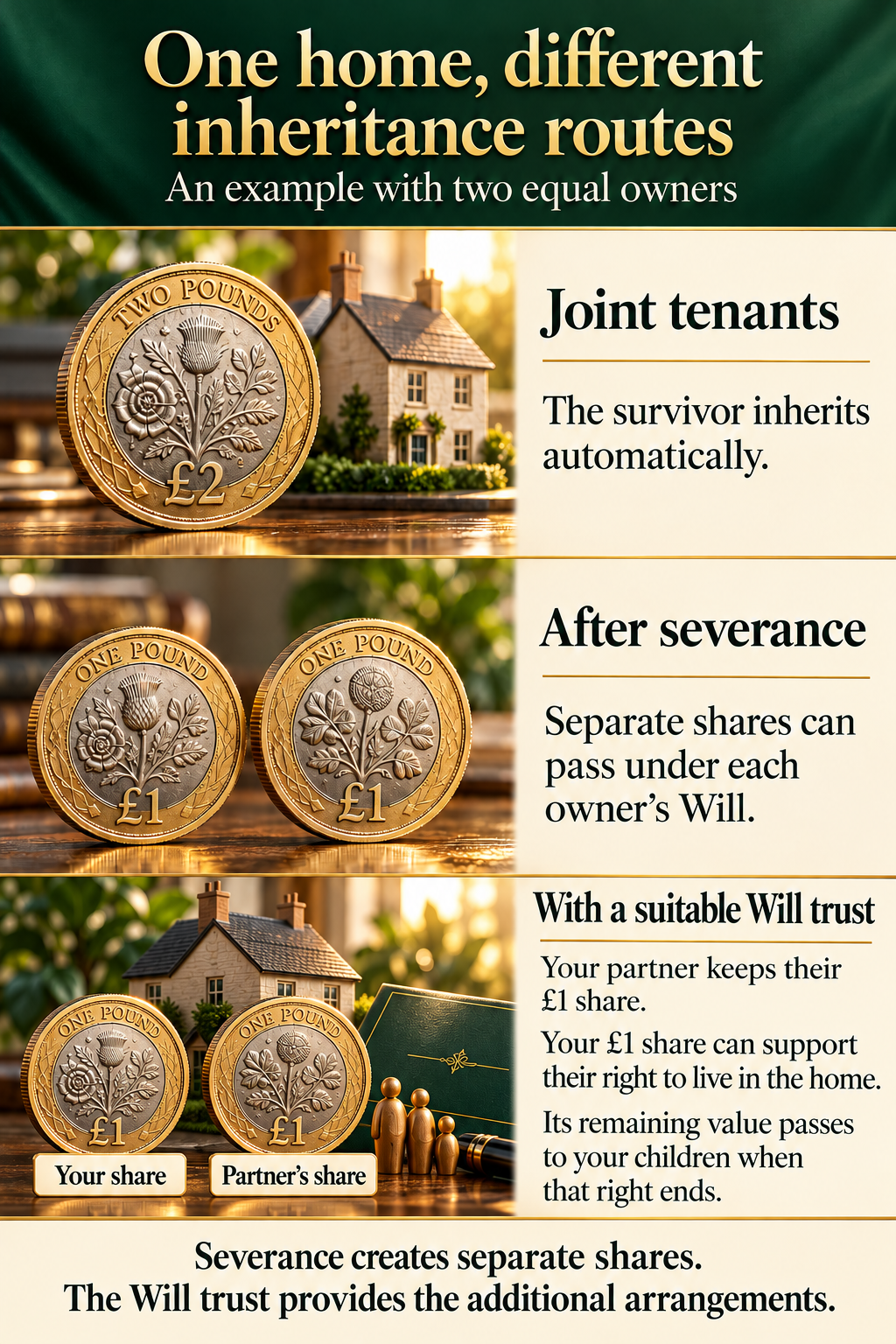
A £2 coin or two £1 coins

Imagine your home is worth £2. As joint tenants, you both own the same £2 coin. When one of you dies, the survivor keeps the whole coin.
For two equal owners, severance is like changing it into two £1 coins. You still own the same home, but each of you now has a separate share that can pass through your own Will.
With a suitable Will trust, your £1 coin can be held for your chosen beneficiaries while your partner has a right to live in the home. Trustees are the people responsible for looking after that share under the terms of your Will.
When your partner’s right ends, the remaining value of your coin passes to the people you chose. Your partner’s own coin follows their arrangements. Severance separates the shares; the Will trust sets out what happens to yours.
Five examples of why it matters
These examples use two owners with equal shares. The right arrangement depends on the family and the documents.
Providing for each other and the children
Alex and Priya want the survivor to stay in the home, with their children inheriting later. They sever the tenancy and make Wills containing suitable trusts. When the first of them dies, that person’s half can go into the trust, which provides for the survivor and sets out the children’s later inheritance.
A second marriage
Brian and Sam each have children from an earlier relationship. Severance and suitable Will trusts allow each to provide for the other while directing the remaining value of their own share to their own children.
If the survivor later remarries
Jo and Kim want their children to inherit from both of them. If Jo leaves everything outright to Kim, Kim’s later choices could change what the children receive. A suitable Will trust over Jo’s separate share can provide for Kim while preserving the children’s entitlement to its remaining value.
After a separation
Emma and Lee separate but still own the house together. Emma arranges severance and updates her Will so that her share can pass to her children. She also takes family-law advice, because severance does not settle the divorce finances or remove possible claims against her estate. See Divorce and your Will.
When the Will and ownership do not match
Tom’s Will leaves his half of the home in trust for his wife and then their children. But he dies while still owning as a joint tenant, so the home passes automatically to his wife. Severing during his lifetime would have allowed his separate share to pass into the Will trust.
How we help you arrange it
We start with what you want for your family, then check whether the ownership of your home and your Will support that plan.
We check the Land Registry title copy and ask you what other ownership documents you have. If the property is unregistered, or the ownership needs further investigation, we explain where specialist advice is needed.
If severance is appropriate, we prepare the agreed documentation and explain what needs to happen. One owner can give the other a valid written notice of severance; the other owner does not have to agree. The notice must be properly given, and the evidence kept. Severance can also be agreed between the owners.
For two joint tenants, severance will normally produce equal shares. If you want unequal shares, or ownership is unclear or disputed, that needs separate consideration. Our Declaration of Trust guide explains how shares can be formally recorded.
Where agreed, we submit the Land Registry paperwork and pass on the receipt or application reference. This confirms receipt, not completed registration. We do not routinely chase the application unless we have separately agreed to monitor it. Tell us promptly if a sale or remortgage makes a delay important.
We bring the severance and Will arrangements together, explaining any outstanding work and where specialist help is needed.
A short note about the title register
If you look at your title register, you may see a joint-ownership entry called a Form A restriction:
“No disposition by a sole proprietor of the registered estate (except a trust corporation) under which capital money arises is to be registered unless authorised by an order of the court.”
In everyday terms, this helps protect other people’s interests if only one registered owner remains. A sale or remortgage can still be possible, but another trustee will usually need to be involved.
The ownership change comes from the valid severance, such as the notice or agreement described above. The register entry is a safeguard. You do not need to interpret the wording yourself.
Practical points before deciding
A Will trust needs to be put into effect after a death. The trustees may need professional help with property, tax, registration and administration. There can be setup and ongoing costs, separate from preparing your Will and severance documents. Current preparation fees are on Services & Fees; specialist administration needs its own scope and quote.
Severance alone does not protect your home against care fees, creditors or divorce settlements. A Will trust’s effects depend on its terms and your circumstances. Giving away or rearranging assets to reduce care charges can be challenged, and the rules differ between England and Wales. A care-fee saving is never guaranteed.
Fern Wills & LPAs prepares trusts within Wills and agreed severance work. We do not set up standalone lifetime trusts, act as trustees, register trusts or provide ongoing trust administration. We identify when specialist help is needed, and you remain free to choose your adviser.
Making your home ownership fit your wishes
The starting question is simple: when one of you dies, do you want the survivor to own the whole home outright, or do you want your share to follow your own Will?
If you are unsure, ask us to review your arrangements. We can explain how your home ownership fits with your wishes and whether severance should form part of your Will planning.
This article is general information only, not individual advice.