LPA MOT: Lasting Power of Attorney Review

Last verified: September 2026 (England and Wales)
Your Lasting Power of Attorney may be registered, but would it still work well for you now? An attorney may have moved away, your relationships may have changed, or your wishes about care and financial decisions may be different
An LPA MOT reviews your existing arrangements against your current circumstances. Fern looks for practical problems, explains the findings and recommends a proportionate next step. Sometimes that is simply updating records. Sometimes the people or wording need closer attention.
The quick answer
- We review your attorneys, replacement arrangements, instructions, preferences and practical access to the LPA.
- You receive written findings using Fern’s Pass, Advisory or Fail labels, with any limits or further checks explained.
- A change does not automatically mean you need a new LPA. We distinguish administrative updates, review work and matters needing prompt advice.
- An MOT is not a guarantee of legal validity, future suitability or acceptance by every organisation.
See the Will and LPA MOT service and fees for the current service details.

What we check in an LPA MOT
The people you have appointed
Are your attorneys still people you trust, and are they willing and able to act? We look at their availability, how they would work together and what happens if someone can no longer act.
Joint attorneys must agree on the decisions covered by their joint appointment. Jointly and severally means they can act individually or together. Mixed arrangements need careful checking because different decisions follow different rules. Replacement attorneys are not temporary cover for a holiday or a disagreement.
For more about choosing people and structuring their authority, read Appointing attorneys in a Lasting Power of Attorney.
The decisions they can make and when
A registered Property and Financial Affairs LPA can allow help while you still have mental capacity, with your permission, if its terms permit this. Some LPAs restrict use to when you lack capacity.
A Health and Welfare LPA only allows attorneys to make a decision when you lack capacity to make that particular decision. We also check whether it expressly gives them authority over life-sustaining treatment. Registration does not give an attorney unrestricted control over your life.
Your instructions and preferences
Instructions are intended to be binding, subject to the law. Preferences express wishes that attorneys should consider. We look for unclear, conflicting or impractical wording and ask whether it still reflects your priorities, including care and treatment wishes.
If you have an Advance Decision to Refuse Treatment or other care-planning documents, tell us. Their relationship with an LPA may need specific advice. A separate note of wishes cannot simply override an LPA instruction.
Registration and practical evidence
We review the documents and information available, including registration evidence, relevant signing details and continuation sheets, and identify anything missing or needing specialist investigation. An MOT cannot reconstruct signing events or settle a disputed capacity or validity question from paperwork alone.
We also check whether the right people know where the registered documents are kept and how authority can be shown when needed. An online access code, the registered original, an OPG official copy or a properly certified copy may be relevant. The suitable route depends on the LPA and the organisation concerned.
A screenshot or ordinary printout alone is not a substitute for the organisation checking the LPA through the appropriate route. The review can identify evidence problems, but a bank or care provider still carries out its own checks.
Choose the right next step
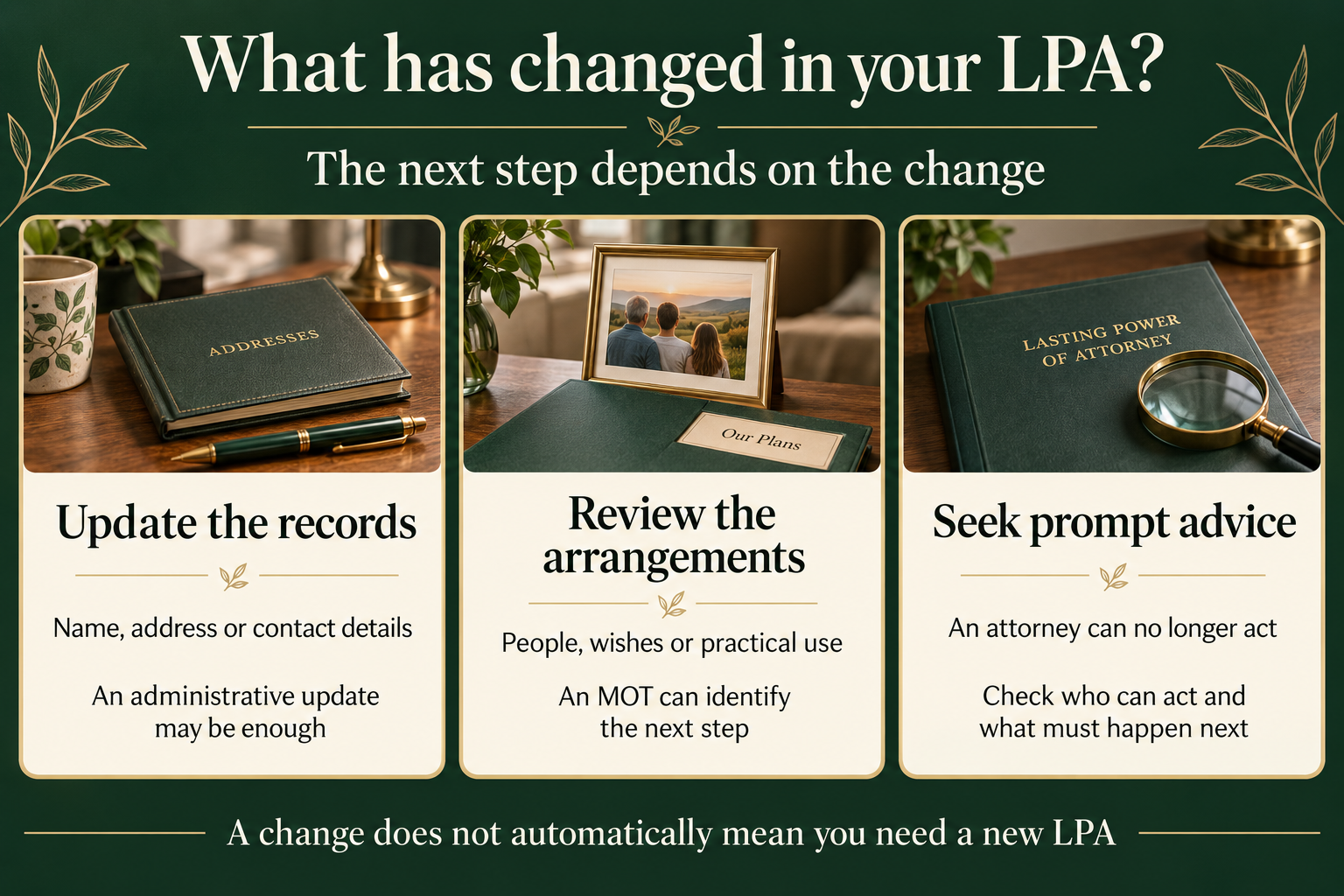
A simple administrative update may be enough
A changed name or address usually calls for an update to the Office of the Public Guardian’s records, rather than a paid MOT or a new LPA. Keep relevant providers and your own contact records up to date too. Do not write changes onto a signed LPA or cross anything out.
For missing documents, contact-detail changes, corrections and evidence routes, use How do I update or correct a registered LPA. That guide covers the practical administrative questions.
An MOT helps when the arrangements may no longer fit
A review is useful if several changes have built up, you are unsure who would act, your wishes have changed or the document is proving difficult to use. We can explain what the current LPA appears to allow and what needs further attention.
Some changes need prompt advice
Contact us promptly if an attorney dies, loses capacity, formally stops acting or needs to be removed. Bankruptcy or a debt relief order can affect a Property and Financial Affairs attorney. Whether the LPA continues depends on its appointment structure and any replacement provisions. Relevant changes must be reported to OPG.
Removing an attorney may be possible through a formal partial revocation if you have capacity to do this, but the effect on the remaining appointment must be checked. Adding a new attorney or changing substantive wording generally requires a new LPA. An already appointed replacement may instead be able to take over under the existing document.
You must have the necessary mental capacity to make a new LPA. If you no longer do, an attorney cannot rewrite it for you. The existing authority and any appropriate Court of Protection or specialist route need to be considered.
When to contact Fern about your LPA
Use these changes as prompts to check your arrangements. They do not automatically mean paid work is needed.
- Your relationship changes: marriage, civil partnership, separation, divorce, remarriage or a new long-term partner.
- Your family or support network changes, and the people you would rely on are different.
- An attorney or replacement attorney has died, become unwell, lost capacity, moved away, become unwilling or become unsuitable.
- Joint decisions are becoming difficult, attorneys disagree or availability is causing delays.
- You want financial help now, but your LPA may restrict use to when you lack capacity.
- Your health, care, treatment or financial priorities have changed, or existing instructions no longer seem practical.
- You cannot find the registered LPA, registration letters or online activation details, or a provider has questioned the evidence.
- You have moved, changed your name or contact details, reorganised storage, or need to update financial and care contact records.
Separation alone does not automatically remove a spouse or civil partner as attorney. Divorce or dissolution generally ends that appointment unless the LPA says otherwise. Check the effect on the whole arrangement, including replacements, instead of assuming a new partner has authority.
An LPA does not expire simply because it is old. If you have not looked at it for years, a brief check is sensible, but there is no automatic ten-year replacement rule or need for a paid MOT just because time has passed.
What the MOT findings mean
Pass: no material concern identified within the agreed review and evidence supplied. Keep the documents accessible and revisit relevant changes.
Advisory: the LPA may still be usable, but we have identified a practical weakness, missing evidence or a point needing clarification.
Fail: a material concern means further action or advice is needed before you rely on the arrangements for the affected purpose. The report explains why and the recommended route.
These are Fern’s service labels, not OPG findings or a court decision. A Fail does not automatically mean a new LPA; a Pass does not guarantee that no future problem can arise. Any replacement drafting or additional work is a separate decision.
Examples of what a review can uncover
These are illustrative situations, not reports of individual client outcomes.
An ex-partner remains appointed. After separation, someone assumes their spouse can no longer act. The review identifies the continuing appointment and the need for advice about changing it while they have capacity.
Joint attorneys struggle to act together. Two adult children live far apart. The review explores how the joint requirement affects decisions and whether the donor wants different arrangements. A replacement cannot simply cover an attorney’s holiday.
Care wishes have changed. The donor now has different priorities about treatment or where they live. The review distinguishes preferences from binding instructions and identifies whether further advice or a new LPA is needed.
The registered original cannot be found. The first task is to establish what evidence and official or certified-copy options are available. Missing paperwork does not by itself prove that a new LPA is required. An instruction causes difficulty. A provider queries wording in a financial LPA. The review identifies the issue and the appropriate advice or clarification route, without promising that the provider must accept it.
How this fits with your Will and Letter of Wishes
LPAs deal with decisions during your lifetime and end when you die. Your Will deals with your estate after death. A Letter of Wishes can explain relevant intentions, but it is generally non-binding and cannot amend your Will or LPA.
Changes involving beneficiaries, guardians, gifts, property or family finances may also justify a Will MOT review. The documents have different jobs; they do not all need replacing whenever one changes.

Can I change just one part of my LPA
Administrative details can often be updated without a new LPA. Substantive changes usually need a new document, although removing an attorney has a separate formal route. Get advice on the effect before taking action.
Can my attorneys help while I still have capacity
For Property and Financial Affairs, often yes after registration, with your permission and subject to the LPA’s terms. Health and Welfare attorneys can only decide a matter when you lack capacity to decide it yourself.
Is registration enough to know my LPA is still suitable
No. Registration does not keep your choice of people or wording aligned with later changes, or remove an organisation’s evidence checks.
How often should I pay for an MOT
There is no automatic paid-review timetable. Check after relevant changes and contact us if something is unclear. A short conversation or administrative update may be sufficient.
Do I need to review my Will too
That depends on what has changed. We can help you identify whether the concern affects your LPA, your Will, your practical records or more than one of these.
Take the next step
If you are unsure whether your LPA still fits your circumstances, contact Fern Wills and LPAs. Tell us what has changed and what you want help with. We can explain whether an administrative update, an MOT or specialist advice is the sensible next step, without committing you to a rewrite.
Have your existing LPAs, any registration correspondence, the names of your attorneys and a short note of your concerns to hand. See the Will and LPA MOT service and fees before booking.
Keep the shared When to contact Fern estate planning checklist PDF with your records as a reminder of changes worth discussing.
General information for England and Wales. Your documents and circumstances need to be considered individually. An LPA MOT is a review service, not a court ruling or a guarantee of validity or acceptance.