Property & Financial Affairs LPA

Last verified: July 2026 (England & Wales)
Quick-read summary
A Property & Financial Affairs Lasting Power of Attorney (LPA) lets you choose trusted people, called attorneys, to help manage money, property and practical financial matters. It must be registered with the Office of the Public Guardian (OPG) before it can be used.
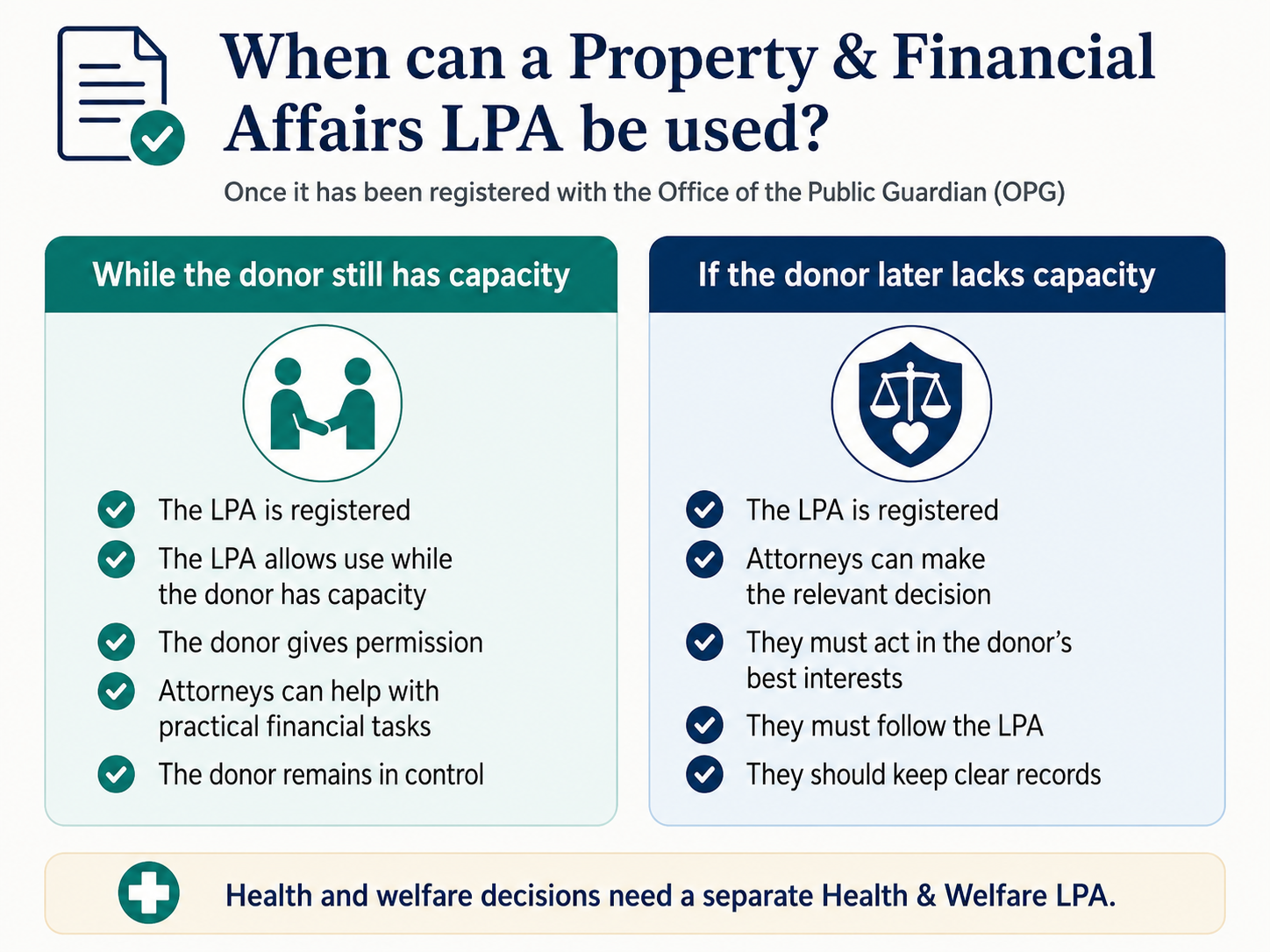
Once registered, your attorneys may help while you still have mental capacity only if the LPA allows this and you give permission. If you later lose capacity for a particular decision, they may make that decision within the authority given by the LPA and must act in your best interests.
The LPA can cover bank accounts, bills, pensions, benefits, tax, insurance, investments, property and dealing with organisations. It does not give your attorneys ownership of your money or permission to use it as their own.
For current fees, please see Services & Fees.
What is a Property & Financial Affairs LPA?
A Lasting Power of Attorney is a legal document that lets you appoint one or more attorneys to help you make decisions or to make decisions on your behalf.
A Property & Financial Affairs LPA covers money, property and practical financial administration. This is different from a Health & Welfare LPA, which deals with care, medical and personal welfare decisions.
Most clients should consider both halves of LPA planning together because they protect different parts of life. Read the Health & Welfare LPA guide.
When can a Property & Financial Affairs LPA be used?
The LPA can only be used after it has been registered with the OPG.
| While you still have mental capacity | If you lack capacity for the decision |
| Your attorneys can help only if the LPA permits this and you give them permission. You remain in control and continue making your own decisions. | Your attorneys may make the relevant decision within the authority given by the LPA. They must involve you as far as possible and act in your best interests. |
Mental capacity is decision-specific and time-specific. A person may be able to make some financial decisions but need help with others, or may be able to decide at one time but not another.
This can be useful where you understand your affairs but want practical help, for example while travelling, during a hospital stay, while recovering from surgery or when paperwork and provider calls have become difficult.
What decisions can your attorneys make?
The answer depends on the wording of the LPA, any instructions it contains and the circumstances at the time. Attorneys may be able to help with:
- bank and building society accounts;
- bills and household expenses;
- pensions, benefits and income;
- tax, insurance and utilities;
- investments and savings;
- property repairs, letting or sale;
- care fees and practical financial administration;
- dealing with banks, insurers, pension providers and other organisations.
Some decisions need particular care. For example, gifts are limited, conflicts of interest must be managed, and jointly owned property may need additional signatures or independent legal advice. For the specific property-sale issue, read:
Can an Attorney Sell Jointly Owned Property under an LPA?
What attorneys cannot do
A Property & Financial Affairs LPA is not a blank cheque. Attorneys must not treat the donor’s money as their own or use the role to benefit themselves improperly.
- They must stay within the authority given by the LPA.
- They must follow valid instructions and take account of preferences.
- They must act in the donor’s best interests when making a decision for them.
- They must keep the donor’s money separate and maintain appropriate records.
- They cannot make unrestricted gifts. Larger or unusual gifts may need Court of Protection approval.
- They cannot make health and welfare decisions under this LPA.
For a fuller explanation of the restrictions on gifts, see What gifts can attorneys make?
Choosing attorneys
Choosing attorneys is often the most important decision in the process. A suitable attorney should usually be trustworthy, practical, organised, willing to keep records, able to deal calmly with providers and free from obvious conflicts of interest. You can appoint attorneys:
- jointly, so they must make the relevant decisions together;
- jointly and severally, so they can act together or separately;
- using a mixed arrangement for different decisions, where suitable;
- with replacement attorneys who step in if an original attorney can no longer act.
The most suitable structure depends on family relationships, assets, geography, health, availability, possible conflicts and the decisions that may need to be made. A structure that looks simple on the form can create practical difficulty later if the attorneys cannot work together or one becomes unavailable. See also Appointing Attorneys in a Lasting Power of Attorney.
What about banks, utilities and other organisations?
Registration does not automatically add the attorneys to every bank, insurer, utility company or pension provider. Each organisation must still verify the LPA, the attorney’s identity and how the attorneys are authorised to act.
Where the online service is available, the donor or attorney can create a time-limited access code so an organisation can view and verify the LPA online. Some organisations, and LPAs registered before the online service became available, may still require paper evidence.
Fern Wills & LPAs can explain the practical route, including online access-code guidance, secure storage, Fern-prepared self-certifiable LPA copy packs where the donor can certify, and OPG official copies where appropriate and available through the relevant correspondence route.
For practical activation guidance, see What is the best way to activate and use your LPA online?
Preferences and instructions
A Property & Financial Affairs LPA can include preferences and instructions.
- Preferences are guidance. They are not legally binding, but attorneys should take them into account.
- Instructions are binding if they are valid, clear and workable.
The wording matters. An instruction that is vague, contradictory, too rigid or legally impractical can delay registration or make the LPA harder to use. Fern Wills & LPAs will discuss the intended outcome and help keep the wording clear and practical.
Why this LPA matters
A Property & Financial Affairs LPA is often the document a family needs first in a practical crisis. If bills need paying, a house needs insuring, a pension provider needs speaking to or property needs managing, organisations will usually require formal authority before dealing with someone else.
Without an LPA, even close relatives may be unable to act. If the person has already lost capacity, a Court of Protection deputyship application may be required. That route can be slower, more expensive and more restrictive than choosing attorneys in advance.
A properly prepared and registered LPA gives the chosen attorneys a clearer route to help, while keeping them subject to legal duties, the wording of the document and OPG oversight.
For current fees, please see Services & Fees.
Cases
Hospital stay and missed bills
Mr Davis managed his own finances for years. After a sudden hospital admission, his family had no straightforward authority to speak to providers or manage urgent bills. A registered Property & Financial Affairs LPA could have given his chosen attorneys a clear route to help, provided its terms allowed use and he gave permission while he retained capacity.
Rental property and practical management
A landlord wanted his adult children to be able to deal with rental income, repairs and tenants if he became unwell. The LPA provided formal authority for practical financial decisions, while the wider planning clarified who should deal with what and whether specialist property or tax advice might still be needed.
Banking help while still capable
A client retained mental capacity but found online banking and provider calls increasingly difficult. Because the registered LPA allowed use while the client had capacity, and the client gave permission, the attorneys could help with practical administration without taking control away from the client.
Jointly owned property
A couple owned their home jointly and wanted to reduce future delay if one of them became unable to deal with a sale or other paperwork. The LPA formed part of the planning, but it did not remove the separate rules governing jointly owned property, trustees and conflicts of interest. Those issues may require specific property advice.
Keeping records for attorneys
An attorney was worried about being accused of doing the wrong thing. Clear appointments, practical guidance and consistent records helped reduce confusion. Attorneys do not need to be perfect accountants, but they must be able to explain what they have done with the donor’s money and why.

When does a Property & Financial Affairs LPA take effect?
It can only be used after registration. While you still have capacity, your attorneys can act only if the LPA allows this and you give permission. If you later lack capacity for the relevant decision, they may act within the authority given by the LPA.
Do I lose control after making an LPA?
No. Making or registering an LPA does not remove your control. While you have capacity for a decision, you continue making that decision. Attorneys should support you rather than take over unnecessarily.
Can my attorney sell my home?
Possibly, if the LPA gives the necessary authority, the decision is in your best interests and the legal requirements are met. Joint ownership, trustee requirements, a proposed sale to an attorney or another conflict of interest can make the position more complex and may require separate legal steps or advice.
Can my attorney make gifts?
Only within limited legal powers. Attorneys cannot give away your money or assets simply because they think it is sensible. Larger, unusual or non-customary gifts may require Court of Protection approval.
Can I appoint more than one attorney?
Yes. You can decide how multiple attorneys should act. They may act jointly, jointly and severally, or under a suitable mixed arrangement. The wording must be clear and workable.
Should I appoint replacement attorneys?
Often, yes. A replacement can help preserve the LPA if an original attorney dies, loses capacity, becomes bankrupt or subject to a debt relief order, disclaims the appointment or otherwise can no longer act. The replacement steps into the appointment only in accordance with the LPA’s structure.
What happens if I do not have one?
If you lose capacity and no suitable Property & Financial Affairs LPA is available, someone may need to apply to the Court of Protection for authority. That can take time and may be more expensive and restrictive than making an LPA in advance.
Do I also need a Health & Welfare LPA?
Usually, it is sensible to consider both. Property & Financial Affairs covers money and property. Health & Welfare covers care, medical and personal welfare decisions. They are separate documents and do different jobs.
Optional technical notes
- Property & Financial Affairs LPAs are governed principally by the Mental Capacity Act 2005 and came into use in 2007.
- The donor must be at least 18 and have mental capacity when making the LPA.
- The LPA must be registered with the OPG before it can be used.
- Use while the donor retains capacity depends on the LPA permitting it and the donor giving consent.
- Mental capacity is assessed for the particular decision at the particular time.
- Attorneys must act in the donor’s best interests when deciding for them, keep appropriate accounts and records, avoid conflicts and keep the donor’s money separate from their own.
- A person who is an undischarged bankrupt or subject to a debt relief order cannot act as a Property & Financial Affairs attorney.
- Gifts are restricted by section 12 of the Mental Capacity Act 2005 unless the Court of Protection authorises something wider.
Next steps
A Property & Financial Affairs LPA is about practical protection. It helps make sure bills can be paid, accounts can be managed, property can be dealt with and trusted people can speak to organisations if you cannot deal with the matter yourself.
Most clients should consider it alongside a Health & Welfare LPA so both halves of LPA planning are covered.
Contact Fern Wills & LPAs to discuss which LPA, or which combination of LPAs, suits your circumstances, or review the current fixed-fee LPA service.
This article is general information only, not individual advice.
If you would like help applying it to your circumstances, Fern Wills & LPAs can guide you through the available options.