Appointing Attorneys in a Lasting Power of Attorney

Last verified: July 2026 (England & Wales)
Quick-read summary
Choosing the right attorneys is the single most important part of setting up a Lasting Power of Attorney (LPA). An attorney is the person (or people) you appoint to step in and make decisions for you if needed. They might help with your finances, deal with paperwork, or make health and welfare choices if you can’t.
It’s a role that requires trust, responsibility, and a clear understanding of your wishes. Many people delay choosing their attorneys, but leaving it too late can mean the Court of Protection makes the choice for you instead.
The good news is that you have control over who acts, how they act, and whether replacements are appointed. This article explains the key choices, what happens if attorneys disagree, and how the appointment structure affects continuity in real life.
Practical checklist: what to decide when choosing attorneys
- Choose people you trust completely to put your best interests first.
- Ensure they are aged 18 or over and, for Property & Financial Affairs LPAs, not bankrupt.
- Consider their skills and availability – do they live nearby, are they organised, and can they cope with responsibility? An attorney can live abroad, but distance, time zones, and practical dealings with banks or providers can affect how easy the role is day to day.
- Decide how many attorneys you want: one or more than one.
- Decide whether they act jointly (always together), jointly and severally (together or separately), or a mix, depending on the decision.
- Think about whether they communicate well, respect each other’s judgement, and can resolve disagreements without delaying important decisions.
- Appoint replacement attorneys in case your first choices cannot act.
- Be clear about any preferences or instructions. If some decisions must be made jointly, identify them precisely, for example the sale of a particular property, rather than using vague labels such as “major decisions” or “large transactions”.
What to consider
Who can act as an attorney?
Any adult with mental capacity can be appointed. They do not need to be a family member, but they must be willing, able, and trustworthy. For Property & Financial Affairs LPAs, an attorney cannot be an undischarged bankrupt.
How many attorneys should I have?
You can appoint a single attorney, but many people choose at least two. This provides a safeguard, particularly if they act jointly and severally (so either can act, but both remain accountable).
Should I appoint replacements?
Usually, yes. Replacement attorneys are particularly important if you appoint only one attorney, or require your attorneys to act jointly for some or all decisions. If your attorneys act jointly and severally, the remaining original attorneys can usually continue if one stops acting, although a replacement may also step in depending on how the LPA is structured. The appointment arrangements should therefore be checked carefully.
What safeguards exist?
Attorneys must:
- Act in your best interests
- Follow the Mental Capacity Act 2005 and Code of Practice
- Keep proper records of financial decisions
- Avoid conflicts of interest
- Respect any instructions or preferences you set out in the LPA
The Office of the Public Guardian (OPG) oversees attorneys, and misuse of powers can lead to investigation, removal, and even criminal prosecution.
What happens if my attorneys disagree?
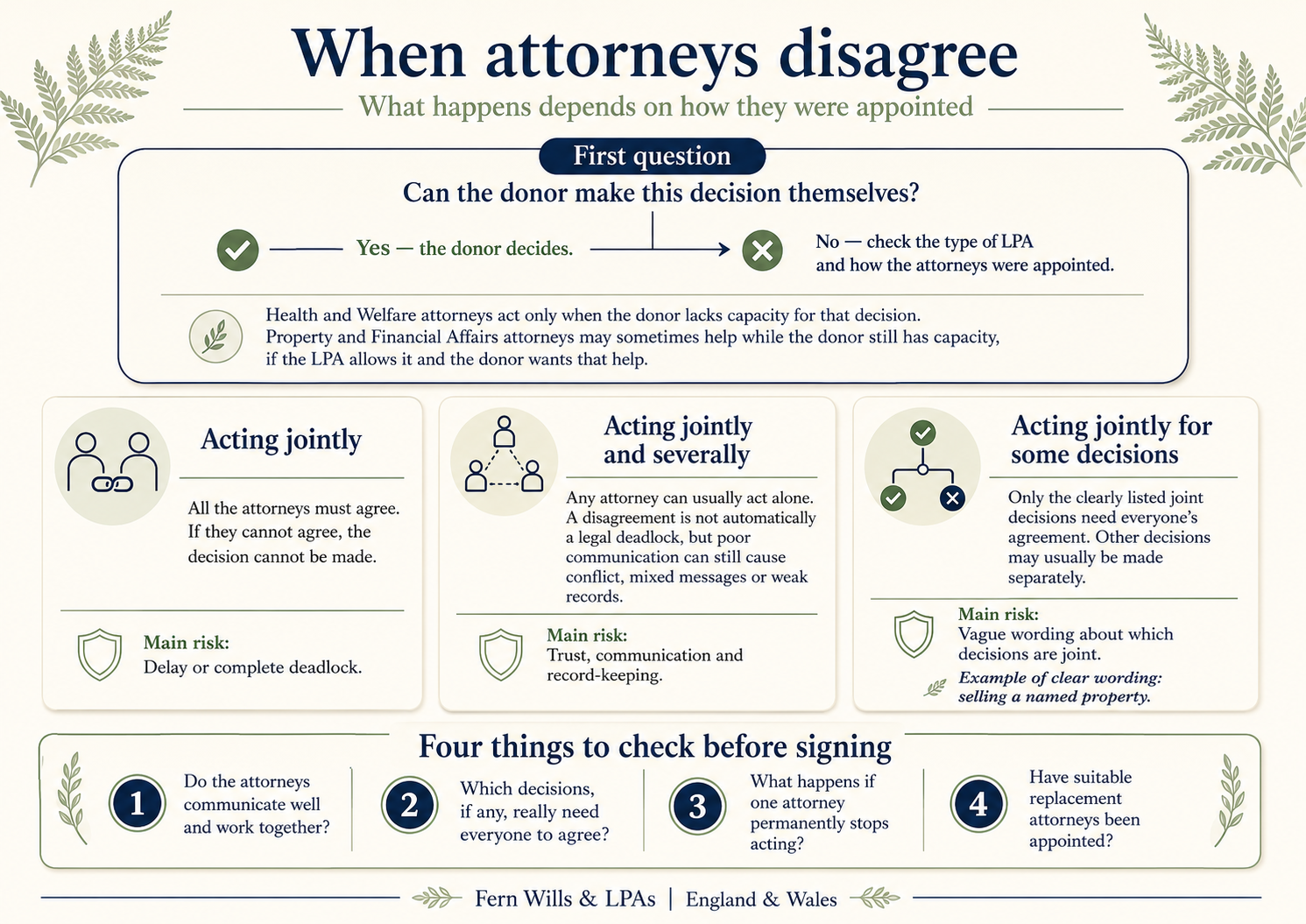
Before treating a disagreement as a deadlock, ask whether you can make the decision yourself. If you have mental capacity for that particular decision, your decision comes first.
Health and Welfare attorneys can act only when you lack capacity to make the particular decision. Property and Financial Affairs attorneys may be able to help while you still have capacity if the registered LPA allows it, but you remain in control and they need your authority.
What happens next depends on how the attorneys were appointed:
- Acting jointly: all the attorneys must agree. If they cannot agree, the decision cannot be made. For a serious or unresolved disagreement, the attorneys may need guidance from the Office of the Public Guardian, professional advice or, in some cases, a decision from the Court of Protection.
- Acting jointly and severally: any attorney can usually make the decision alone. A disagreement is therefore not automatically a legal deadlock, but poor communication can still produce conflicting instructions, weak records, delay or concerns about whether decisions are being made in your best interests.
- Acting jointly for some decisions and jointly and severally for others: unanimity is required only for the decisions clearly identified as joint. The wording must be precise. General phrases such as “major decisions” or “large transactions” may not provide enough certainty.
Good planning is not necessarily about forcing everyone to agree on everything. It is about choosing compatible people, identifying any joint decisions clearly, and arranging suitable replacements if an attorney permanently stops acting.
If an existing LPA contains joint appointments, unavailable attorneys or recurring conflict, an LPA MOT can check whether it still works as intended.
How this works in real life
- Mr Davis’ careful choice: He appointed both his sons jointly and severally. When one son was abroad, the other could still manage bills, ensuring continuity without delay.
- Mrs Cole’s forward planning: She appointed her daughter as her attorney and a trusted neighbour as replacement. Years later, serious ill health meant her daughter could no longer continue and she formally disclaimed the appointment. The replacement then stepped in under the LPA.
- Mr Singh’s family safeguard: He wanted all three children to agree before his home could be sold. The LPA identified the property and required them to act jointly for that specific decision, while allowing them to act jointly and severally for everything else. The precise wording mattered: “large transactions” on its own would have been too vague.
Frequently asked questions
1. Who can I choose as my attorney?
Anyone over 18 with mental capacity. For Property & Financial Affairs LPAs, they must not be bankrupt. They do not have to be family – trusted friends or professionals are equally valid choices.
2. Can I appoint more than one attorney?
Yes. You can appoint multiple attorneys and decide how they should act (jointly, jointly and severally, or a mix depending on the decision).
3. What happens if my attorney cannot act?
It depends on how the attorneys were appointed. If there is only one attorney, or the attorneys must act jointly, the LPA may stop working for some or all decisions unless a replacement can step in or the document provides otherwise. If the attorneys act jointly and severally, the remaining original attorneys can usually continue. Replacement attorneys cannot provide temporary cover for holidays or short-term unavailability: they step in when an original attorney permanently stops acting.
4. When do attorneys start acting?
- Property & Financial Affairs LPA: once registered, and if you allow it, while you still have capacity.
- Health & Welfare LPA: only when you lack the capacity to make the decision yourself.
5. What are the duties of an attorney?
They must act in your best interests, keep your money separate, follow your instructions, and comply with the Mental Capacity Act 2005.
Optional technical notes (for those who want the detail…)
- Acting jointly: all attorneys must agree on every decision covered by the joint appointment. If one attorney permanently stops acting, the others may be unable to make those decisions unless an appropriate replacement steps in or the LPA contains valid alternative arrangements.
- Acting jointly and severally: an attorney can make decisions alone or with the other attorneys. The appointment does not require unanimity or consultation for every decision, although communication and proper records remain important.
- Acting jointly for some decisions and jointly and severally for others: the LPA must identify clearly which decisions require unanimity. Decisions not listed as joint can normally be made by any attorney acting alone.
- Replacement attorneys: replacements usually step in only when an original attorney permanently stops acting through death, loss of capacity, disclaimer or another legally recognised event. They cannot temporarily cover an attorney who is on holiday or otherwise still able to act.
- Mental Capacity Act 2005: attorneys must support the donor to make their own decisions where possible, assume capacity unless established otherwise, act in the donor’s best interests and choose the least restrictive effective option.
Next steps
If you are thinking about creating an LPA, your first priority is choosing the right attorneys. It is not a decision to put off: you must make the appointment while you have capacity, and delays can leave your family powerless.
At Fern Wills & LPAs, we guide you through every step:
- Helping you decide who to appoint
- Structuring your LPA with safeguards
- Ensuring replacements are in place
- Handling the registration process with the OPG
Contact us today to discuss your LPA and secure the right attorneys for your future.