Can a Promise Affect a Will?

Last Verified: July 2026 England & Wales
People sometimes assume that an unwritten promise is not worth the paper it was never written on. In some circumstances, however, words and conduct can still have legal consequences.
Yes, a promise can sometimes affect a Will. A Will is important, but it does not necessarily remove rights or potential claims arising from earlier words and conduct.
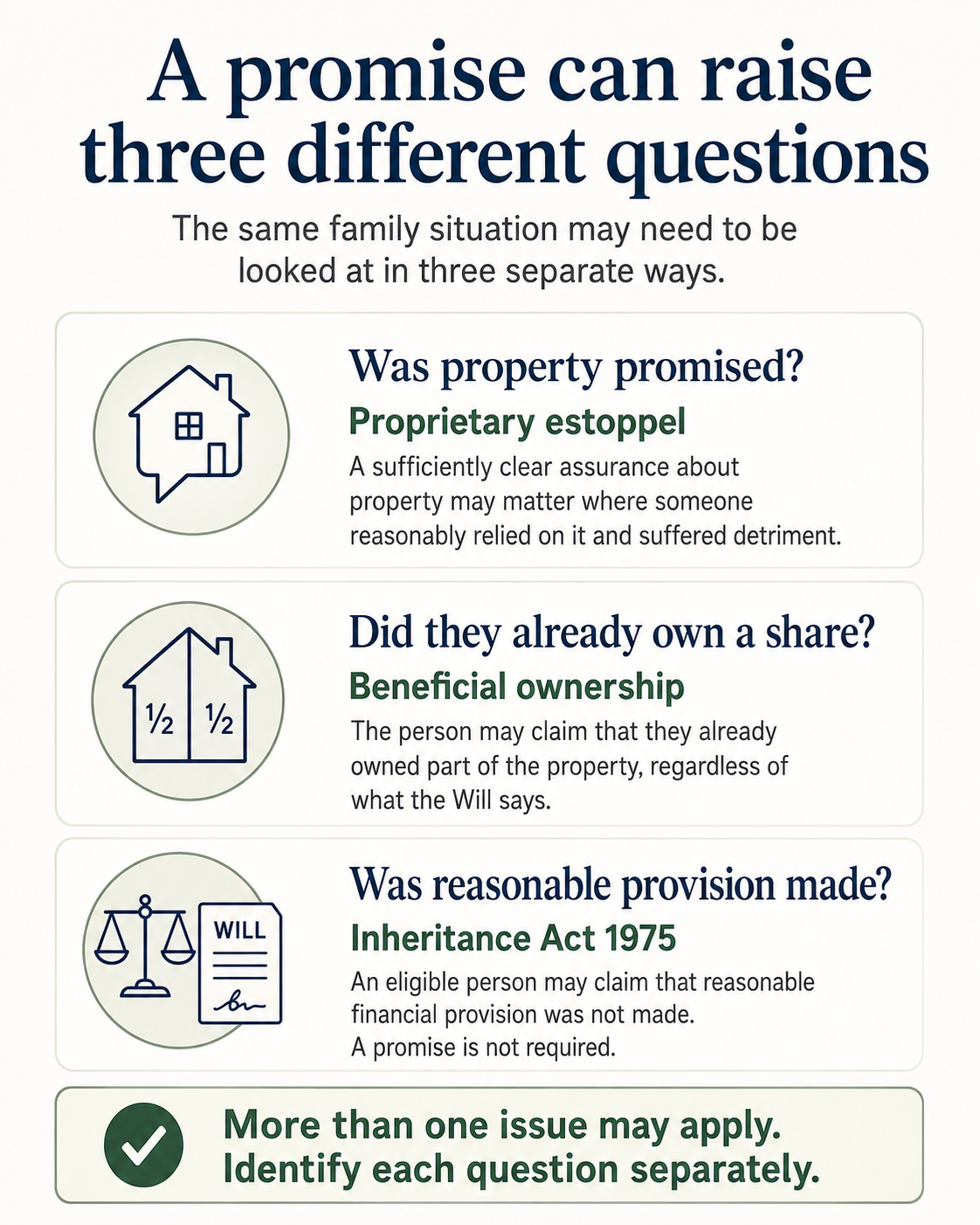
If someone gave a sufficiently clear assurance that another person would receive or be able to use a home, land or another interest in property, and that person reasonably relied on it to their detriment, a legal principle called proprietary estoppel may apply.
A separate claim under the Inheritance (Provision for Family and Dependants) Act 1975 may arise even where no promise was made. Someone may also argue that they already own a beneficial share of the property, regardless of what the Will says.
Not every family reassurance is enforceable. “I will look after you” is not automatically the same as “you can live in this house for the rest of your life”. The exact words, the surrounding circumstances and what happened because of them all matter.
| Practical point: If you are making or reviewing a Will and any of this sounds familiar, raise it before the Will is signed. The safest time to clarify a promise is while the person who made it can still explain what they meant. |
Can a verbal promise really affect a Will?
The words do not have to appear in a formal contract or in the Will before they become relevant. Potential warning phrases include:
- “This house will be yours.”
- “You can live here for the rest of your life.”
- “Sell your home and move in with me. You will always have a home here.”
- “Keep working in the business and one day it will all be yours.”
- “Do not worry about your own pension or savings. I will provide for you.”
None of these phrases proves a claim by itself. A court would examine what was said, how clearly it related to property, whether it was repeated, what the speaker intended or appeared to communicate, what the other person reasonably understood, and whether they changed their position because of it.
A promise may also be evidenced by conduct. A person might repeatedly encourage someone to work, care, contribute money or give up another opportunity while allowing them to believe that a home or other property would eventually be theirs.
What is proprietary estoppel?
Proprietary estoppel is the legal principle that may apply where:
- someone gives a sufficiently clear promise or assurance that another person has or will receive an interest in property;
- the other person reasonably relies on that assurance;
- they suffer detriment because of that reliance; and
- in all the circumstances, it would be unconscionable, meaning sufficiently unfair for the court to intervene, for the person who made the assurance or their estate simply to go back on it.
These are not boxes that automatically produce a result. The whole history matters.
The leading Supreme Court case of Guest v Guest involved a son who worked on the family farm for many years at relatively low rates after receiving assurances about his future inheritance. The court confirmed that proprietary estoppel can arise from a property promise followed by reasonable reliance and detriment. It also confirmed that the remedy is flexible. The claimant does not automatically receive everything they expected.
The difference between reassurance and a property promise
Families often use broad language without intending to create a legal commitment.
“I will look after you” could mean many things. It might refer to day-to-day support, pension income, a cash legacy, a right to remain in a home or simply emotional reassurance. By itself, it may be too vague to establish a property promise.
“You can remain in this house for the rest of your life” is more specific. If the recipient then sells their own home, pays for major improvements or reorganises their finances because of that assurance, the legal risk becomes more serious.
The question is not only, “What did I mean?” It is also:
- What did I actually say?
- What would the other person reasonably have understood?
- Did I know they were acting on that understanding?
- What did they give up, pay or do because of it?
Does the promise have to involve a house?
Proprietary estoppel is principally concerned with property or an interest in property. Many cases involve homes, farms or land, but the circumstances can be wider.
A general expectation of receiving “something in the Will” is not automatically proprietary estoppel. A vague promise of money may raise other legal or evidential issues, but it should not be treated as a property claim without specialist assessment.
This is one reason why the exact words matter. “I will leave you something” is different from “this house will be yours” or “you will own half of this property”.
What counts as reliance and detriment?
Reliance means that the person acted, or decided not to act, because of the assurance.
Detriment is the disadvantage, sacrifice or loss that followed. It does not have to be purely financial, but it must be substantial enough to matter in the overall circumstances.
Examples may include:
- selling or giving up another home;
- moving into the property and abandoning a secure tenancy;
- paying towards the purchase price, mortgage or major improvements;
- working for reduced pay because of an expected inheritance;
- providing substantial unpaid care or work over many years;
- giving up employment, career or pension opportunities;
- arranging savings, investments, gifts or their own Will on the assumption that housing or capital would be provided; or
- declining another opportunity because the promised arrangement appeared secure.
A person may have relied on a promise without suffering sufficient detriment. Equally, they may have made substantial contributions for reasons unrelated to any promise. The connection between the assurance, the decision and the disadvantage needs to be examined carefully.
A typical example
Consider a person in a later marriage who owns the family home in their sole name. They intend to divide the property between their spouse and children from an earlier relationship.
During the marriage, they have repeatedly told their spouse, “You will always have a home here.” The spouse has sold a previous property, contributed towards renovations and arranged their own finances on the assumption that they will be secure in the home.
An outright share of the house might or might not reflect what was promised. It may not provide a secure right to remain if other owners want the property sold. A Right to Occupy or another Will trust might better reflect the intended protection, but each option has legal and tax consequences that need individual advice.
Before the Will is completed, the questions are not limited to percentages. It is necessary to establish what was said, what the spouse understood, what they did because of it, whether they already own a beneficial interest and whether the proposed Will is consistent with the assurance.
If you are making or reviewing your Will
Tell your Will adviser about any promise, assurance or family understanding involving a home, land, business property or inheritance. A structured Will MOT can also help identify whether older arrangements and current intentions still match.
Do not assume that it is irrelevant because:
- nothing was signed;
- the conversation happened years ago;
- the person has already received some financial help;
- you now regard the promise as unfair;
- your circumstances have changed; or
- your new Will says something different.
The adviser may need to ask:
- What were the exact words?
- When and how often were they said?
- Who heard them?
- Is there anything in messages, letters, cards or earlier Will instructions?
- What did the other person do differently?
- Did they contribute money, work or care?
- Does someone already own a beneficial share?
- Have different promises been made to different people?
- Does the proposed Will honour, replace or contradict the earlier understanding?
The right response may be to clarify the position, change the proposed planning, document ownership, use an appropriate Will structure, prepare a careful Letter of Wishes or obtain specialist advice before the Will is signed.
A Letter of Wishes should not be used as a casual attempt to cancel a legal issue. It may become important evidence of what was considered and why.
If you believe a promise was made to you
Preserve the evidence and obtain specialist advice promptly. Relevant material may include:
- text messages, emails, letters and cards;
- previous Wills or Will instructions;
- diary entries and contemporaneous notes;
- bank statements, mortgage records and invoices;
- evidence of work, reduced pay or lost employment opportunities;
- records of care or other substantial support;
- photographs of improvements;
- witnesses who heard the assurance or saw the reliance; and
- documents showing the home, tenancy, pension or financial arrangements that were given up.
Do not assume the only question is whether the Will is valid. A property promise, an existing beneficial interest and a claim for reasonable financial provision are different legal routes. Our guide to contesting a Will explains the broader dispute routes.
Three different legal questions
| Issue | Core question | Does it require a promise? |
| Proprietary estoppel | Was a sufficiently clear assurance made about property, was it reasonably relied upon, and did that reliance cause detriment? | Yes. The assurance is central. |
| Inheritance Act 1975 | Has the Will or intestacy failed to make reasonable financial provision for an eligible applicant? | No. |
| Beneficial ownership | Did the person already own a share because of an agreement, common intention, declaration of trust or the parties’ dealings? | Not necessarily. |
More than one issue can exist in the same case. The correct analysis should come before assumptions about what the Will can distribute.
For the wider reasonable-financial-provision position, see Deliberate Exclusions. For ownership recorded behind the legal title, see Declaration of Trust.
Can a Letter of Wishes solve the problem?
No. A Letter of Wishes can explain:
- what the Will-maker says was or was not promised;
- the family and financial background;
- why particular provision was selected;
- what alternatives were considered; and
- how trustees should approach any discretion.
It cannot extinguish a proprietary estoppel claim, remove an existing beneficial interest or prevent a genuine Inheritance Act claim.
Because it may become evidence, it should be accurate and carefully prepared. Where a significant assurance or reliance is identified, specialist advice may be needed before the final wording is settled.
What can a court do?
A successful proprietary estoppel claim does not automatically transfer the whole promised property.
The court has flexibility. Depending on the facts, the remedy could involve a property interest, a right to occupy, a payment or another form of relief. The aim is to address the unconscionable effect of withdrawing the assurance, while ensuring that the remedy is proportionate to the circumstances.
That uncertainty is another reason to resolve the position during lifetime where possible. Litigation after death can be expensive, evidentially difficult and destructive of family relationships.
Download: 50 questions to help identify the issues
Our editable Word checklist brings the main fact-finding questions together without turning this article into a legal questionnaire.
It covers:
- what was said or promised;
- what the recipient understood;
- reliance and detriment;
- property ownership and contributions;
- possible Inheritance Act 1975 factors;
- available evidence; and
- questions to consider before making or changing a Will.
How to use the checklist:
You can type directly into the checklist or print it and complete it by hand. Save your own copy before you begin. You do not need to answer every question. Brief notes are enough at this stage.
The checklist does not decide whether a claim exists. It helps you organise the history, identify possible evidence and prepare for a discussion with an appropriate adviser.
The completed checklist may contain sensitive personal, financial and family information. Keep it securely and send it to an adviser only if requested and an appropriate delivery method has been agreed.
Someone has already died or a dispute has started? Do not delay seeking specialist advice while completing every question. Legal time limits may apply. Free Claim Checker

Is a verbal promise legally binding?
Sometimes, but not simply because the words were spoken. The legal effect depends on the nature of the promise, the surrounding circumstances, reliance, detriment and the legal route involved.
Can a Will override a promise about a house?
Not necessarily. A Will can change who is named to inherit, but it may not remove an equity arising from proprietary estoppel or an ownership interest that already existed.
Is “I will look after you” enough?
It is relevant and should be investigated, but it may be too vague by itself. The context, repetition, property involved and actions taken in reliance are important.
Does the person automatically receive what was promised?
No. Even where proprietary estoppel is established, the court has flexibility over the remedy.
Is this the same as an Inheritance Act claim?
No. Proprietary estoppel concerns a property assurance, reliance and detriment. An Inheritance Act claim concerns reasonable financial provision from the estate and does not require a promise.
What if the property is registered only in the deceased’s name?
Sole legal title does not always answer every question about beneficial ownership. The parties’ agreements, intentions, contributions and dealings may need to be examined.
When to obtain help
If you are making or reviewing a Will, raise the issue before the Will is signed. Fern Wills & LPAs can help identify the planning questions, consider whether the proposed Will reflects the intended outcome and signpost specialist property, tax or litigation advice where needed.
If someone has died and a promise may already be in dispute, use our free inheritance disputes claim checker or obtain advice from a specialist contentious probate solicitor promptly. Fern Wills & LPAs does not conduct contentious probate claims, but we can introduce an appropriate specialist.
You remain free to choose your own adviser.
This article is general information only, not individual advice.
Words said around a kitchen table can outlive the person who said them. A Will should not leave a family guessing what “I will look after you” was meant to promise.
The best time to put the promise, the property and the Will on the same page is before your family has to piece them together afterwards.