How soon can you sell a house after probate is granted?
Last verified: September 2026 (England and Wales)
There is no statutory waiting period after a grant of probate has been issued. A sale can move to exchange and completion as soon as the personal representatives, title and transaction are legally ready. The grant removes an important barrier, but it does not make the property ready to sell by itself.
The practical answer depends first on how the property was owned. A sole-owned home will normally need the grant before the personal representatives can transfer it. Where the legal title was held jointly, it usually passes to the surviving legal owner or owners, while the deceased person's beneficial share may still need to be dealt with through the estate.
Need help dealing with the estate? Contact Fern for an introduction to a probate specialist. The specialist can discuss your probate questions and the support you need directly with you.
If you are still dealing with the immediate arrangements after a death, start with First steps after someone dies. This guide focuses on the property sale itself.
Is there a waiting period after probate is granted?
No. Once the grant is available, the conveyancer can use it as evidence of the personal representatives' authority. Exchange and completion can then take place when the title, contract papers, buyer, mortgage arrangements and any other legal issues are ready.
That may be soon after the grant if the work has been prepared carefully. It may take longer if the title is unregistered, documents are missing, the property is leasehold, a mortgage must be redeemed, the Will creates a trust or right to occupy, or a beneficiary or ownership dispute needs to be resolved. A fixed promise such as one week or one month after probate is therefore not reliable.
What can you do before the grant?
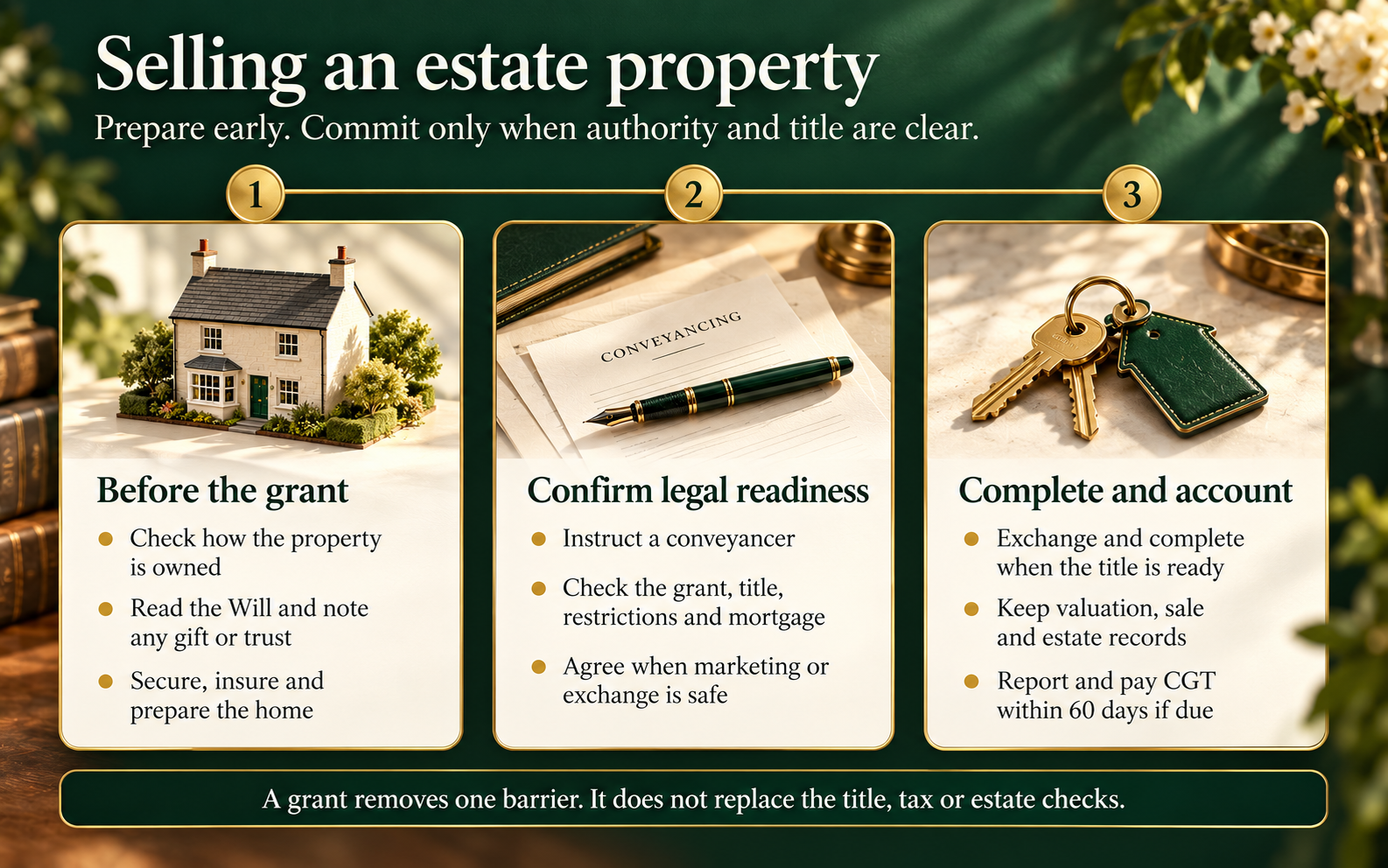
Useful preparation can begin before the grant. The people dealing with the estate can secure the property, notify the insurer, check the Will, obtain title information, gather guarantees and planning papers, arrange valuations and ask a conveyancer what will be required. They can also consider clearance, repairs and presentation, provided they keep proper records and do not dispose of items that may be gifted or disputed.
GOV.UK advises against putting a property on the market until probate has been obtained. Some estates consider earlier marketing in practice, but that should only happen after the conveyancer has checked the ownership and the proposed timetable. A buyer must be told about the position, and a sole-owned property cannot normally be transferred by the personal representatives without the grant.
Check how the property is owned
Do not assume that the Will, the Land Registry title and the family's understanding all say the same thing. The conveyancer should check the registered proprietors, any restriction or trust, and what interest actually forms part of the estate.
- Sole legal owner. The grant will normally be needed before the personal representatives can sell or transfer the property.
- Joint legal owners. The legal estate usually passes to the surviving registered owner or owners. The deceased person's name can be removed from the register using the appropriate evidence of death.
- Beneficial ownership. A share held as tenants in common does not pass automatically by survivorship. It may form part of the estate even though the surviving owner holds the legal title. Restrictions, trusts and the need for an additional trustee are matters for the conveyancer.
Obtain advice before agreeing a sale where there is an unregistered title, a lifetime trust, a right to occupy, a specific gift of the property, an ownership promise, an overseas element or doubt about who is entitled to sell.
What must be ready before exchange and completion?
An estate agent can find a buyer, but the conveyancer confirms whether the estate can enter the contract and transfer the title. Before exchange, expect checks covering:
- the grant of probate or letters of administration, where required;
- the registered or unregistered title, restrictions, trust arrangements and the correct sellers;
- the Will, any codicils and any gift, trust or right affecting the home;
- identity checks, property forms, searches, enquiries and leasehold information where relevant;
- the mortgage or other secured lending, including a redemption figure;
- whether a claim, caveat, court order or beneficiary dispute affects what it is safe to do.
Exchange creates a binding contract. Do not agree a short completion date until the conveyancer confirms the estate can meet it. This is especially important at auction, where the successful bid usually commits the seller immediately and completion can follow quickly.
Choose the sale route around the estate's priorities
Open-market sale, auction and a sale to a property-buying company each involve different trade-offs between price, certainty, fees and speed. There is no dependable universal timescale for any route. A normal sale can fail because of a buyer's chain or finance; an auction can create a demanding legal timetable; and a quick-buying company may offer less than open-market value.
Compare the likely net result, not just the headline price or the promised completion date. Ask what happens if the grant is delayed, what fees are payable, whether the offer can be reduced, and whether the estate will be legally ready to complete.
Keep the decision fair and documented
Personal representatives should act in the estate's interests and take reasonable care when selling. A suitable valuation, sensible marketing evidence and a written record of offers and decisions can help explain why a route or price was chosen. More than one valuation may be prudent where the property is unusual, the estate is taxable, beneficiaries disagree or the proposed buyer is connected to the family or a personal representative.
Beneficiaries do not automatically control every sale decision, but their rights and the terms of the Will matter. Keep them appropriately informed, avoid distributing sale proceeds too early, and obtain advice if one person wants to buy the property or alleges that it is being sold at an undervalue.
Allow for tax and holding costs
For Capital Gains Tax, the starting point for the personal representatives is generally the property's market value at the date of death, not the amount the deceased originally paid. Tax may arise on growth between that value and the net sale proceeds. If tax is due on a UK residential property disposal, the reporting and payment deadline is normally 60 days after completion. The available annual exempt amount for personal representatives is time-limited, so ask the estate's tax adviser before exchange if a gain is possible.
If the sale price differs materially from the value used for the estate, tell the probate or tax adviser. A qualifying sale of land or buildings at a loss within four years of death may support an Inheritance Tax loss-relief claim where Inheritance Tax was paid, but the conditions and the estate's other land sales must be checked.
Keep a realistic budget for insurance, security, utilities, essential maintenance, estate-agent and legal fees, mortgage interest and council tax. An unoccupied property may be exempt from council tax while it remains in the deceased owner's name before probate, and sometimes for up to six months after the grant, but the conditions matter. Contact the local council and insurer rather than assuming the property is covered or exempt.

What if beneficiaries disagree or a dispute affects the sale?
Pause before exchange if there is a genuine dispute about the Will, ownership, the sale price, the identity of the personal representatives or the right to occupy the home. A sale made during a dispute can make the position harder and may expose the estate to unnecessary cost.
For a family conflict about the Will, read What happens when a sibling contests a parent's Will? or the broader guide, Can you contest a Will?. If exchange or distribution is close, make the urgency clear when seeking specialist advice.
A practical sequence
- Check the Will, the title and whether the property forms part of the estate.
- Secure the home, notify the insurer and keep essential outgoings under review.
- Obtain an appropriate date-of-death valuation and separate sales advice where needed.
- Instruct a conveyancer early and give them the grant as soon as it is issued.
- Choose the sale route only after comparing price, certainty, fees and legal readiness.
- Keep the completion statement and valuation records, then deal with estate tax and accounts before distribution.
Getting the right help
Fern Wills & LPAs can arrange an introduction to an appropriate probate or estate administration specialist. We do not carry out probate work or provide individual probate or tax advice. The specialist will discuss your probate questions, explain the options and agree any work and fees directly with you. Ask the specialist whether the agreed work includes coordination with your conveyancer or tax adviser where the estate requires it. Our Probate and Executor Support guide explains the available levels of help.
Contact Fern if you would like an introduction. You do not need to decide the whole sale route before getting in touch.
This article is general information only, not individual legal or tax advice.