What Happens When a Sibling Contests a Parent’s Will?

Last verified: September 2026 (England and Wales)
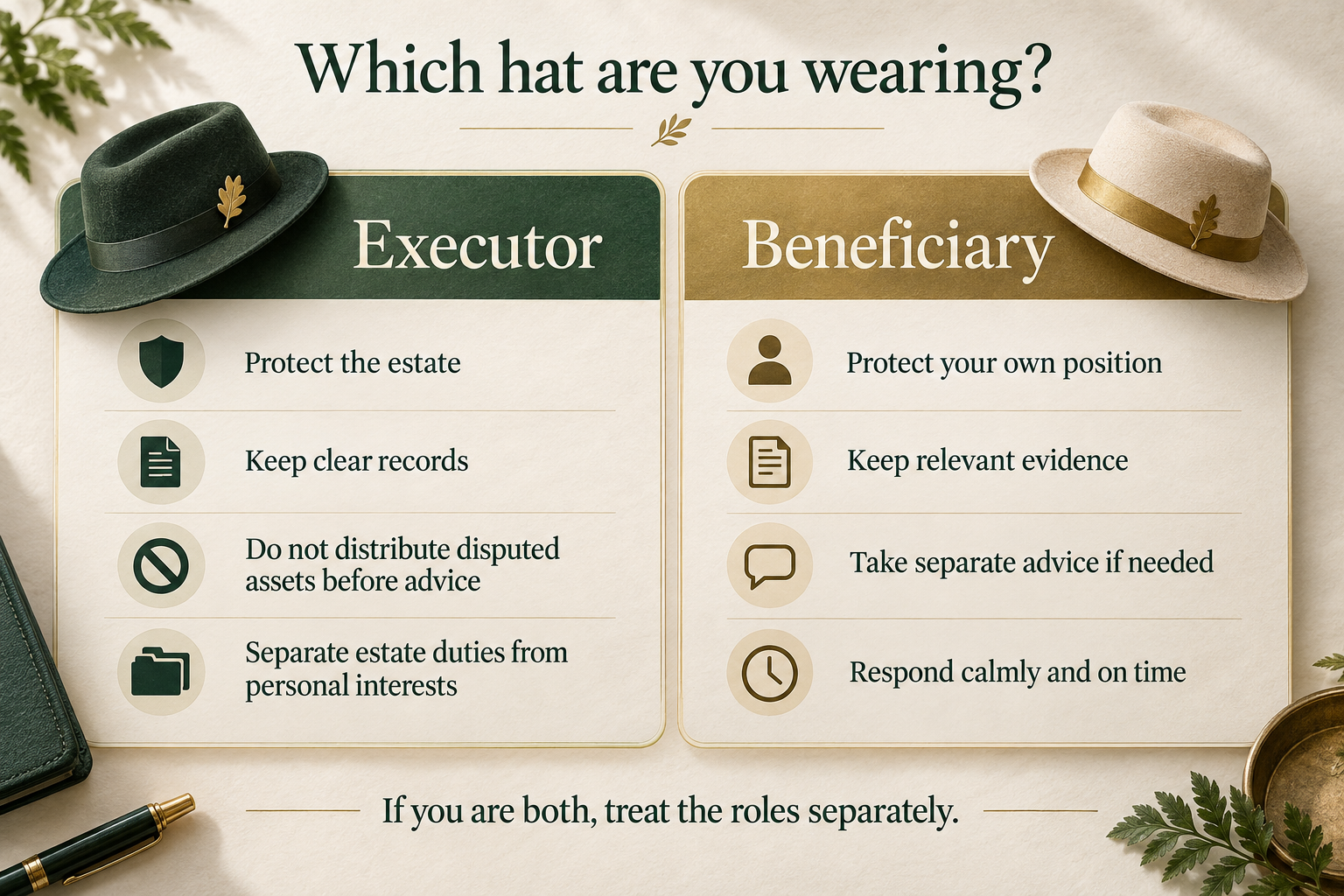
If your brother or sister challenges your parent’s Will, their unhappiness alone does not make the Will invalid. Your next step depends on the role you are wearing. An executor must protect the estate and deal with the challenge properly. A beneficiary may also protect their own inheritance. If you are both, keep those two roles separate.
Do not ignore a formal Letter of Claim or court papers, and do not rush into an emotional reply. Avoid distributing disputed assets or taking an irreversible step until the position has been reviewed. A caveat may stop a grant being issued, while a dispute can still matter after probate has already been granted. Neither event proves that the challenge will succeed.
Fern has chosen IDR Law as its specialist partner for inheritance disputes. If you are considering a claim of your own, use IDR Law’s free Claim Checker through our tracked introduction link. You deal directly with IDR Law and do not need to contact Fern first. If you are responding to a formal claim or a deadline is running, seek specialist legal advice promptly; completing a checker does not protect a deadline.
Quick read summary
• A parent does not have to leave equal shares to adult children. Unfairness and legal invalidity are not the same thing.
• An executor’s estate duties are different from a beneficiary’s personal interest in defending their inheritance.
• Preserve the Will, estate papers, correspondence and relevant records. Do not alter, discard or selectively share them.
• A caveat stops a grant for an initial six months, but it is not a decision that the challenge is valid.
• A grant already issued does not make every challenge disappear. The claim type, timing and progress of the administration matter.
• Many disputes settle through informed correspondence, negotiation or mediation, but only after the parties understand the claim and evidence.
Start with your role
The most useful first question is not “Who is right?” It is “What role am I acting in?” The same person may be both executor and beneficiary, but the responsibilities and personal interests should not be blurred.
Is this a Will challenge or a different estate dispute?
A sibling may use the words “contest the Will” for several different complaints. The route changes depending on what they actually allege.
• A validity challenge asks whether the Will should operate at all, for example because of capacity, knowledge and approval, undue influence, fraud, forgery, or signing and witnessing concerns.
• A financial-provision claim accepts that the Will may be valid but argues that the estate did not make reasonable financial provision for an eligible applicant.
• An administration complaint may concern delay, missing assets, unexplained estate accounts or an executor’s conduct. That is not automatically a challenge to the Will.
For a fuller explanation of the possible claim types, read Can you contest a Will? If the problem is ordinary estate administration rather than the Will itself, see Probate and Executor Support.
What should an executor do?
An executor should protect the estate, preserve evidence and avoid making the dispute worse. That does not necessarily mean every routine task must stop. Securing property, maintaining insurance, keeping records and paying necessary expenses may still be required. Final distributions and irreversible steps affecting disputed assets need particular care.
• Keep the original Will and any codicils safe. Preserve earlier Wills, correspondence and estate records that may be relevant.
• Record what has been received, when it arrived and any deadline stated. Pass formal correspondence to the adviser handling the response.
• Do not distribute the disputed part of the estate before taking advice. If some assets are not disputed, ask whether and how the administration can safely continue.
• Do not treat estate money as available for a personal family fight. Ask which work is properly undertaken for the estate and which costs belong to a beneficiary personally.
• If you are also a beneficiary, say so openly and obtain separate advice where the two roles could conflict.
What should a beneficiary do?
A beneficiary whose inheritance may be reduced or lost can take a personal position on the challenge. They do not have to pretend that the outcome does not matter. However, a measured response is usually more effective than trying to win the family argument by email.
• Keep relevant messages, financial records, earlier explanations and documents. Do not edit or embellish them.
• Ask what information can properly be provided and what remains confidential. Do not circulate medical or professional records casually.
• Take your own advice if your personal position differs from the executor’s estate role or from another beneficiary’s position.
• Do not assume your personal legal costs will automatically be paid from the estate.
What if a caveat has stopped probate?
A caveat can stop a grant of probate or letters of administration being issued. It lasts for six months at first and can be extended. It does not decide whether the Will is valid, and it should not be treated as proof that your sibling has a strong case.
If you are an executor and discover a caveat, obtain specialist advice before trying to remove it or pressing ahead. The right response depends on the alleged ground, the evidence and whether an agreement can be reached. A caveat may affect the grant, but the estate may still need practical protection while the dispute is considered.
What if probate has already been granted?
A grant does not make the Will unchallengeable. A probate claim may seek a different order about the Will or the grant, and a financial-provision claim follows a different route. Some claims have short time limits. A claim under the Inheritance (Provision for Family and Dependants) Act 1975 is normally brought within six months of the grant, although the court can allow a late claim.
Tell the specialist how far the administration has progressed. Mention any sale, exchange of contracts, planned distribution or payment already made. If the estate includes a property, read our separate guide to selling a house after probate, but take dispute-specific advice before completing a sale or distributing the proceeds where the property is affected by the claim.
What if you receive a Letter of Claim or court papers?
A Letter of Claim is a formal pre-court document setting out the basis of the proposed claim, the facts relied on and what the claimant wants. It is not the same as a court judgment, but it should be answered carefully and within a reasonable or stated timeframe.
Court papers are more urgent. Probate claims and financial-provision proceedings have formal response requirements. Do not rely on a family discussion, an unfinished email or the hope that the other side will lose interest.
• Note the date and method of service and every stated deadline.
• Send the complete document, including attachments, to the specialist. Do not summarise away details that may matter.
• Preserve documents and stop routine deletion of relevant emails or messages.
• Check whether any legal-expenses, executor or professional policy may need prompt notification.
• Avoid admitting or denying detailed allegations before the evidence and your role have been reviewed.
What evidence may matter?
The evidence depends on the allegation. A late or unequal Will is not automatically suspicious, and family closeness is not automatically undue influence. The useful question is what reliable material explains the parent’s understanding, instructions and circumstances.
• the signed Will, codicils and any earlier Wills;
• the Will writer’s or solicitor’s instructions, attendance notes and file, where disclosure is appropriate;
• relevant medical or care records obtained through the proper route;
• correspondence, messages and notes made at the time;
• witness evidence from people with direct knowledge;
• estate accounts, valuations and information about gifts, dependence or property ownership where relevant to the actual claim.
Preserving evidence does not mean gathering everything in the family’s possession and sending it to everyone. Let the specialist identify what is relevant, what can be disclosed and how it should be obtained.
Can the family settle without going to court?
Often, yes. The parties may resolve some or all issues through informed correspondence, negotiation or mediation. Mediation uses an independent person to help the parties explore settlement. It does not decide who wins and does not force an agreement.
Settlement works best when the parties understand the claim, the evidence, the estate value and the consequences of the proposed agreement. Any agreement may affect the administration, tax position or distribution, so it should be documented with appropriate professional advice.

Where specialist help fits
Fern Wills & LPAs has chosen IDR Law, a specialist firm dealing with contentious Wills, probate and trusts, as our partner for inheritance disputes. IDR Law handles both bringing and defending claims. You deal with their team directly; there is no need to speak to Fern before using our introduction link.
If you go on to instruct IDR Law through our introduction, Fern Wills & LPAs receives a commission of 10% of the fees received by IDR Law during your case. Your fees will not be any greater than if there were no such arrangement. IDR Law remains independent, acts in your interests, and provides impartial and confidential advice. Information you give IDR Law is not disclosed to Fern unless you consent.
If you are considering a claim, use IDR Law’s free Claim Checker. It provides an initial assessment from the information you give, with follow-up from IDR Law’s team. The checker and initial discussions are free and without obligation. If you proceed, IDR Law agrees the work and fees directly with you. The checker assesses potential claims; it is not a substitute for legal advice on defending an existing claim or meeting a deadline.
These are the questions families most often need answered at the start of a sibling Will dispute.

Can my sibling challenge the Will just because they received less?
Not simply because they feel the outcome is unfair. They need a recognised legal route and supporting facts. An unequal Will can prompt questions, but it is not automatically invalid.
What if I am both executor and beneficiary?
Be explicit about which role you are acting in. Protecting the estate and responding as executor is different from defending your personal inheritance. Separate advice may be needed if those interests pull in different directions.
Does a caveat mean my sibling has a good case?
No. A caveat stops a grant for a period while the dispute is addressed. It is not a ruling that the Will is invalid or that the person who entered it will succeed.
Can an executor continue administering the estate?
Some protective and routine work may continue, but final distribution and disputed or irreversible steps need care. The safe boundary depends on the claim and the estate, so obtain advice rather than applying a blanket rule.
What if the complaint is really about the executor?
Delay, missing assets, poor communication or unexplained accounts may be an administration dispute rather than a Will-validity challenge. Read Probate and Executor Support for the distinction between routine administration and disputes. Allegations of wrongdoing or a formal claim need specialist legal advice.
What if the death was recent and we have not started probate?
Protect the original Will, avoid premature distribution and deal with the immediate practical steps first. Our First steps after someone dies guide explains the starting point. If a dispute or deadline has already arisen, seek specialist advice at the same time.
Take the next step
Concerned about your own inheritance claim? Use IDR Law’s free Claim Checker to take the first step directly with our specialist partner. You do not need to contact Fern first. If you are defending a claim, obtain specialist advice on your response promptly and make any deadline clear.
This article is general information only, not individual advice.