Probate and Executor Support
Last verified: September 2026 (England and Wales)
You can ask a professional to help with particular estate tasks or handle a much wider part of the administration. The right choice depends on the work involved and how much you want to take on yourself.
Fern Wills & LPAs can introduce you to an appropriate probate or estate administration specialist, whether or not we prepared the Will. The specialist explains the options, agrees the scope and fees with you, and carries out the work you instruct them to do. Costs can usually be paid from the estate where sufficient funds are available, although some amounts may be payable upfront.
Contact Fern for an introduction. You do not need to know which service you need before getting in touch. For immediate arrangements after a death, our First steps guide is there when you need it.
Probate and estate administration
A grant of probate is the official document confirming an executor’s authority to deal with the estate. Where there is no Will, the corresponding grant is usually called letters of administration. Estate administration is the wider work of dealing with the person’s property, money and possessions, paying liabilities and passing the remaining estate to the beneficiaries. Obtaining a grant is one stage, where a grant is needed.
Choose the level of help that suits you
Help with particular tasks. You instruct a specialist to handle agreed work, such as the probate application, while you manage the remaining tasks. This can suit someone who is comfortable organising the estate but wants professional help with a specific part. Broader estate administration. The specialist handles more of the work, which can include collecting assets, dealing with debts and tax, preparing estate accounts and arranging distribution. This can suit someone with limited time, a complicated estate or a preference for more support.
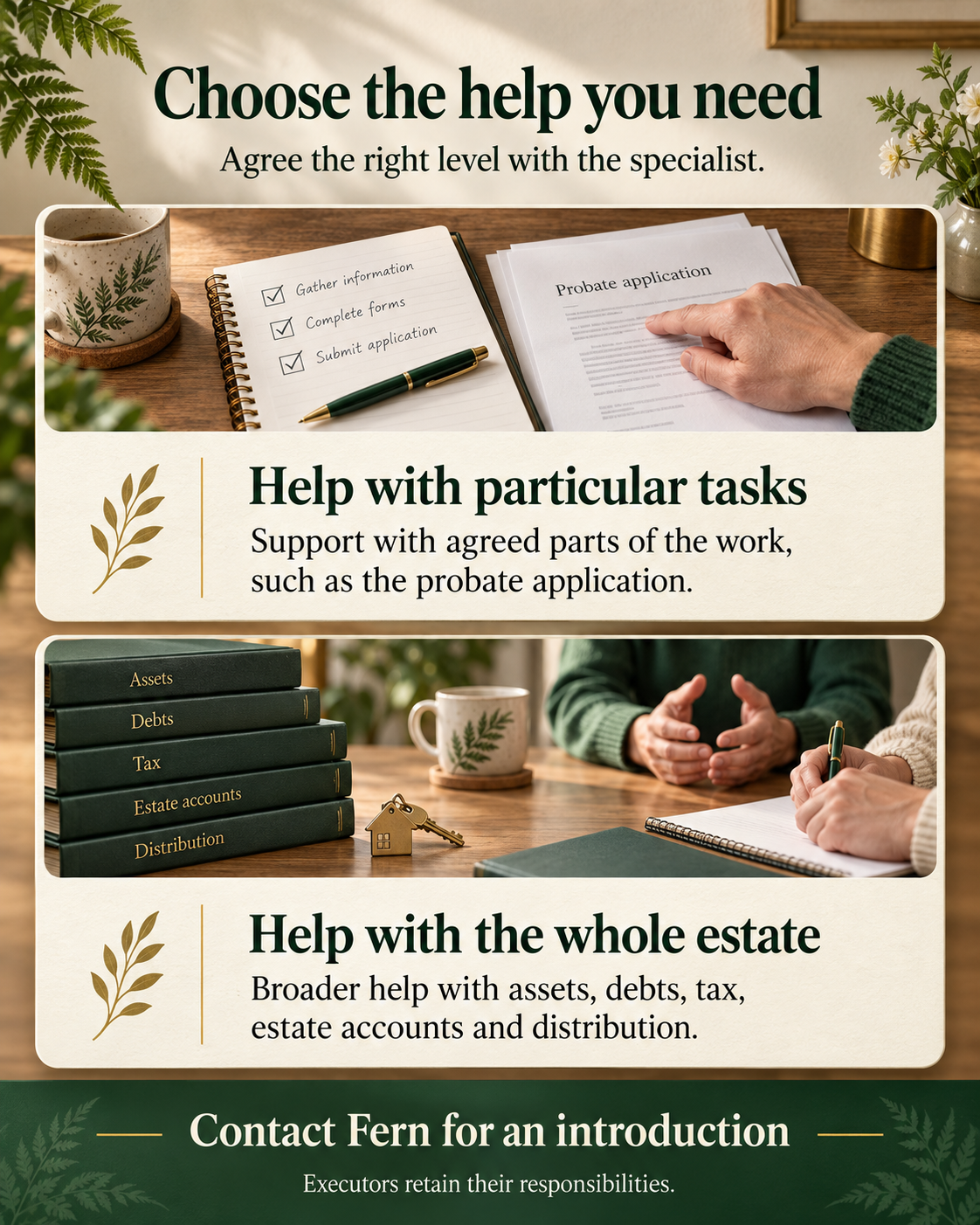
A grant-only service does not include everything needed to finish an estate. Before instructing anyone, agree what they will do, what remains with you and who will keep you updated. Executors who appoint a specialist still retain responsibilities.
When professional help is useful
You do not have to wait for a problem. Limited time, distance, bereavement or uncertainty can be enough reason to ask for support. Not every estate needs paid help, but you do not have to manage it alone simply because it looks straightforward. Seek advice early if there are trusts, overseas assets, uncertain tax, missing records, doubts about the Will or concerns that the estate cannot cover its debts. These can affect both the work required and what it is safe to do next. For example, someone confident with correspondence might ask for help obtaining the grant. Someone facing a property, several investments and uncertain tax may prefer broader support. These are illustrations of different needs, not a test you have to pass before enquiring.
How costs and payment work
Probate and estate administration costs can usually be paid from the estate where sufficient funds are available. Some fees or expenses may be payable upfront; other charges may be payable when estate funds become available. The specialist will explain their fees and payment terms before you decide whether to instruct them. The written scope should make clear what is included, any VAT and third-party expenses, what could change the cost and when payment is due. If most of the estate’s value is in a property, or paying upfront would be difficult, mention this at the start. Payment arrangements must be agreed with the specialist. Do not assume that every payment can wait until the property is sold.
If there is a dispute
Routine administration and an inheritance dispute require different help. If you are considering a challenge, see Can You Contest a Will?. If a brother or sister is challenging your parent’s Will, see our guide to responding to a sibling’s challenge. For concerns about executor delays, missing assets or unexplained accounts, contact Fern for an appropriate specialist introduction. If you have received a formal claim or face a deadline, seek prompt specialist advice and make the urgency clear.

Do we need probate if there is no Inheritance Tax?
Possibly. Whether a grant is needed depends on the assets, how they were held and the requirements of the organisations involved. Having no Inheritance Tax to pay does not settle that question.
Can I get help after I have started?
Yes. Tell the specialist what has already been done and about any commitments or deadlines. They can assess the remaining work. If you want to step back from being an executor altogether, ask for advice about your options before taking further action.
What if there may not be enough money for the debts?
Get specialist advice before making payments or distributing anything. An estate with insufficient assets needs careful handling. Distributing assets before debts and taxes are settled can leave the person administering the estate personally liable.
Ask Fern for an introduction
Contact Fern Wills & LPAs with your name and contact details, whether there is a Will, whether you are an executor, and a few words about the help you want. Mention any property, payment concern or urgency. You do not need every answer at this stage. Fern arranges the introduction. The specialist advises on the estate and agrees the work directly with you. Fern does not administer the estate or manage the probate case. You remain free to choose your own adviser. Where an introduction involves a referral payment to Fern, the specialist pays it. This does not increase the fees you pay. They will explain the arrangement before you decide to proceed.
Remember your own Will when things are underway
An inheritance received or expected can change your own planning. If you would like, ask Fern to contact you by telephone or email in about three months after probate or estate administration gets underway, to review your Will. This is an optional opportunity to consider your own arrangements, not an expectation that the estate will be finished within three months. A review does not automatically mean you need a new Will.
Ask Fern about a Will review and three-month follow-up, or read about our Will and Lasting Power of Attorney MOT.
This article is general information only, not individual advice. Advice about the particular estate should come from the professional instructed to assist with it.