Deeds of Variation: what they can and can’t do
Last verified: September 2026 (England and Wales)
You can choose to pass some or all of an inheritance to someone else using a Deed of Variation. It can help a younger generation, include someone left out, support a charity or change how a gift is held. It can apply whether the person left a Will or died without one.
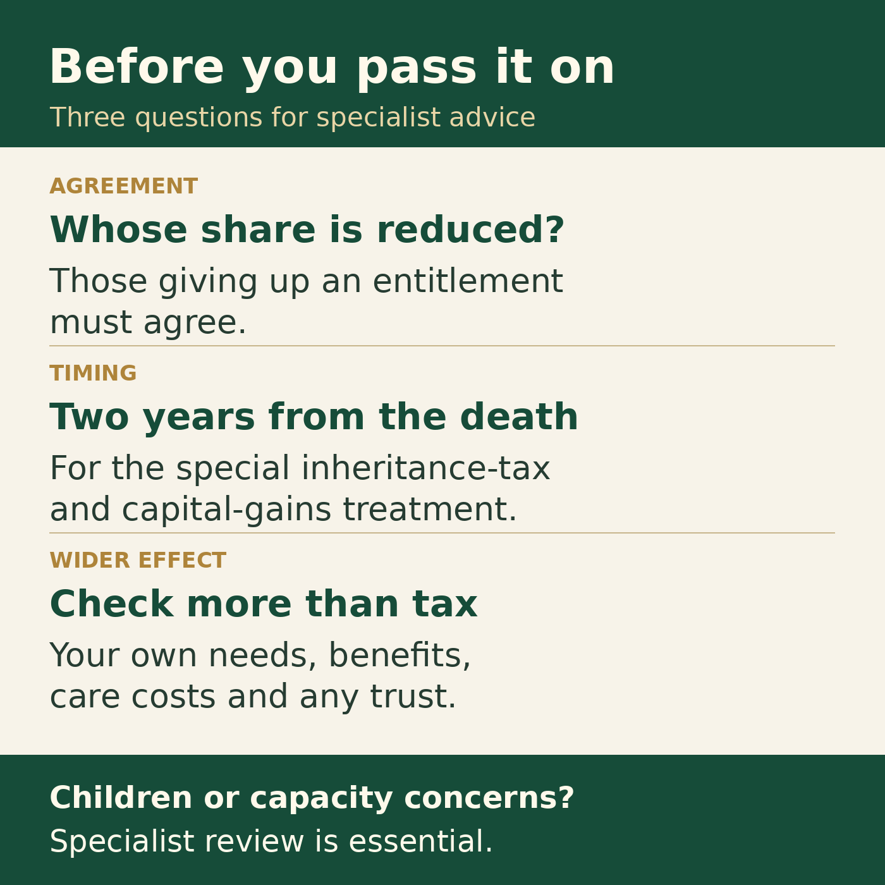
The choice belongs to those giving up their entitlement. Nobody can simply vote away another beneficiary’s share. To obtain the special Inheritance Tax and Capital Gains Tax treatment, the variation must be completed within two years of the death and meet the relevant conditions.
If you are considering this, take advice before transferring the inheritance or signing an agreement. Start with the professional dealing with the estate, if one is already involved. Explain what you want to achieve and mention the date of death.
What can a variation achieve
A beneficiary is someone entitled to inherit. A variation changes the destination of their entitlement, rather than rewriting the original Will. Where there is no Will, it can redirect an entitlement arising under the intestacy rules, which determine who inherits.
For example, an adult daughter who does not need her whole inheritance might want part to pass to her adult son. Another beneficiary might want to increase a charitable gift. These are illustrations, not reports of Fern client cases.
A suitable arrangement can also put an inheritance into a trust, where trustees hold and manage money or property for specified people or purposes. That brings separate choices about control, tax, administration and costs. A trust needs specialist assessment, not simply a different recipient’s name.

Who must agree
Everyone whose entitlement is reduced or otherwise adversely affected must consent. Someone whose inheritance is untouched does not normally need to join in. Consider future and conditional interests as well as the people due to receive money now.
Reducing a child’s entitlement requires court approval; a parent cannot sign it away on the child’s behalf. Unborn beneficiaries can also make court involvement necessary. If an adult lacks capacity to make the decision, an attorney or deputy must obtain the necessary Court of Protection authority before redirecting that person’s inheritance.
Nobody should feel pressured to give up an inheritance. Your own financial security and future needs matter alongside the outcome you hope to achieve for others.
Why the two-year deadline matters
The two years run from the date of death, not from the grant of probate or the day you receive the money. HM Revenue & Customs (HMRC) cannot extend this deadline for the special Inheritance Tax treatment. Starting discussions within two years is not enough; the variation must be completed in time.
A variation can be made before probate or after the inheritance has been distributed, provided the relevant conditions are met. If more than two years have passed, a gift or other arrangement may still be possible, but it will not qualify for this special tax treatment. Obtain advice about its own consequences.
How tax treatment differs from an ordinary gift
A qualifying variation can treat the redirected inheritance, for Inheritance Tax and certain Capital Gains Tax purposes, as passing from the person who died. This is sometimes called tax “read-back”. It can support useful planning, including passing value to another generation or charity.
That treatment is not automatic. The written document must contain the appropriate statement for the tax treatment sought and satisfy the other conditions. Payment or compensation from outside the estate in return for giving up an inheritance can prevent it qualifying.
A variation does not retrospectively rewrite Income Tax treatment. Property transfers and any trust also need their own tax review. Ask the specialist to explain the overall result and costs for everyone affected; a saving in one place is not the whole decision.
What a variation cannot solve
A variation redirects inheritance. It does not change the appointed executors or guardians, and you cannot use it to take someone else’s share without their agreement. It is not a way to remove estate debts or defeat valid claims.
Giving up an inheritance to reduce care charges or obtain means-tested benefits can be treated as deliberate deprivation of assets. The relevant authority may assess you as still having the value you gave away. Take advice before committing if this could affect you.
If there is a dispute about the Will or a possible inheritance claim, Can you contest a Will? explains that separate question and the specialist route. If you are responding to a sibling’s challenge, use our guide to a sibling contesting a parent’s Will. A variation may form part of an agreed settlement, but it does not resolve a dispute by itself or protect a legal deadline.
Do executors have to sign
Not automatically. The people giving up an entitlement are central to the agreement. For the Inheritance Tax read-back rules, the executors or administrators must also join in if the variation increases the tax payable. Keep the person administering the estate informed so the paperwork, accounts and distribution remain consistent.
Does HMRC have to be told
If the variation increases Inheritance Tax and uses the special read-back treatment, it must be sent to HMRC within six months of being made. If tax is reduced, HMRC will need the evidence to deal with the changed liability or repayment. Where the Inheritance Tax payable is unchanged, a copy is not routinely required for that purpose. The specialist should deal with any applicable reporting.
Can we make another variation later
Do not assume you can keep redirecting the same inheritance with the same tax result. HMRC’s rules do not allow the same assets or entitlement to be redirected twice using Inheritance Tax read-back. Different parts of an estate can sometimes be varied separately. Show the adviser any previous variation and treat signing as a committed decision, not a temporary arrangement.
Can it put right an error in the Will
An agreed redirection may achieve the practical outcome the family wants, but it does not correct the original Will. A disputed drafting error or a question about what the Will means may need a different legal route. Seek advice promptly rather than assuming the variation deadline is the only one that matters.
Choose the right help
For a proposed variation, ask the estate’s professional adviser to assess the arrangement, the consents and the legal and tax consequences. Agree the work, fees and who will pay before proceeding. Do not assume that a beneficiary’s personal planning costs will be paid by the estate.
If you need help administering the estate, Fern can arrange a specialist introduction. Contact Fern for probate and estate administration support, or read Probate and Executor Support to understand the available levels of help. The specialist agrees and carries out the work directly with you.
An inheritance received, expected or redirected is also a sensible reason to review your own Will. Fern’s Will and Lasting Power of Attorney MOT can help establish whether your arrangements still fit. A review does not automatically mean a new Will is needed.
This article is general information only, not individual advice.