What does a Certificate Provider do in a Lasting Power of Attorney?

Last verified: October 2026 (England & Wales)
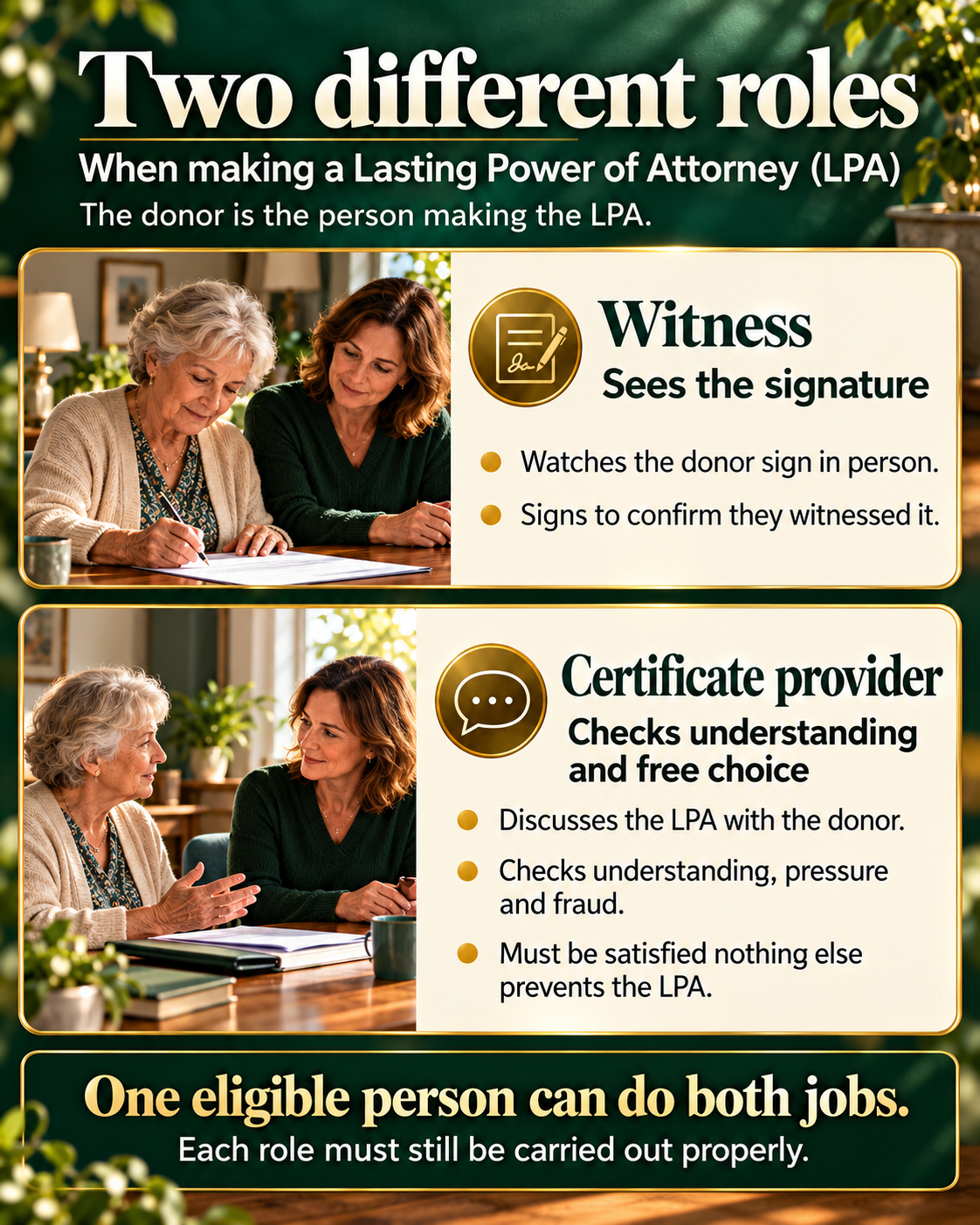
A certificate provider is an independent safeguard when you make a Lasting Power of Attorney (LPA). An LPA lets you appoint people you trust to make certain decisions for you. You are the donor; the people you appoint are your attorneys. The certificate provider speaks with you and forms their own opinion that you understand the document, are making it freely, and that nothing else prevents its creation.
This is more than witnessing a signature. The provider must consider the actual LPA, including the powers you are giving and any restrictions you have included. Their signature in Section 10 records that opinion; it is not simply confirmation that they know you.
You can choose an eligible adult who has known you personally well for at least two years, or someone with the relevant professional skills and expertise. Whoever you choose must be able to take the time, remain independent and be satisfied before signing.
What does the certificate provider confirm?
At the time the donor signs the LPA, the certificate provider must be satisfied that:
- the donor understands the purpose of the LPA and the scope of the powers being given to the attorneys;
- no fraud or undue pressure is being used to induce the donor to make it;
- there is nothing else that would prevent the LPA from being created.
A family member suggesting that someone makes an LPA is not, by itself, undue pressure. However, threatening to stop providing help or having contact unless they appoint a particular person as their attorney is a warning sign. The donor must be free to make their own choice
The donor needs mental capacity to make this particular LPA at the relevant time. In practical terms, they must be able to understand the relevant information, retain it long enough to decide, use or weigh it, and communicate their decision. Communication can be through speech, signing or another suitable method.
A diagnosis of dementia does not, by itself, mean someone cannot make an LPA. Nor does a decision that other people consider unwise. Give the donor practical support to understand and communicate before reaching a conclusion. If concerns remain, the provider must resolve them before signing.
Who can be a certificate provider?
A certificate provider must be aged 18 or over and qualify through one of two routes. The exclusions below apply to both.
Cat A: Someone who knows the donor personally
A friend, neighbour or colleague can qualify if they have known the donor personally well for at least the two years immediately before signing the certificate. This is sometimes called Category A. A passing acquaintance, or someone who has only dealt with the donor professionally, does not meet this personal-knowledge route.
Cat B: Someone with relevant professional skills
The professional route, sometimes called Category B, is for someone whose skills and expertise enable them to make the required assessment. Examples include a GP or other healthcare professional, solicitor, social worker or independent mental capacity advocate. An estate planner may qualify through relevant competence and experience. There is no two-year acquaintance requirement for this route.
A job title or course certificate alone is not enough. The person must have the competence for the individual situation and be able to explain how they reached their opinion.
Chris has training and practical experience and qualifications in applying the Mental Capacity Act 2005 to LPA work, together with the NCFE CACHE Level 2 Certificate in the Principles of Dementia Care. This supports a patient, person-centred conversation, with time for the donor to understand and respond. It is not a medical qualification and does not automatically establish suitability for every case. You can read more about Chris’s dementia-care training.
Who cannot act?
Check the relationship with both the donor and their attorneys, including replacement attorneys. A certificate provider cannot be:
- an attorney or replacement attorney in this LPA, or an attorney or replacement attorney under another LPA or an Enduring Power of Attorney (EPA) made by the donor. The exclusion also covers an earlier LPA or EPA that has been revoked;
- a member of the donor’s family or an attorney’s family. This includes spouses and civil partners, parents, children, brothers and sisters, grandparents, grandchildren, aunts, uncles, nieces, nephews, in-laws and step-relatives;
- the donor’s or an attorney’s unmarried partner, boyfriend or girlfriend, whether or not they live together;
- a business partner or employee of the donor or an attorney;
- an owner, director, manager or employee of a care home where the donor lives, or a member of the family of any of those people;
- a director or employee of a trust corporation appointed as an attorney in the LPA.
Being a colleague is not automatically disqualifying, but being the donor’s or an attorney’s employee or business partner is. If a relationship is unclear, settle eligibility before the conversation and signature. Do not rely on someone being willing to help.
Choosing someone who can do the job well
Choose someone who will listen, communicate comfortably with the donor and form an independent view. They should be willing to read the document, ask questions and decline to sign if they are not satisfied. Familiarity can help, but it does not replace the checks.
A professional may be helpful where communication, capacity or family circumstances need greater experience. That does not guarantee registration or prevent a later challenge. If you are still deciding who should make decisions for you, our guide to choosing your attorneys explains that separate role.
Preparing for the conversation
The provider should read the whole LPA and any continuation sheets, particularly Section 8, which explains legal rights and responsibilities, and Section 10, which contains their certificate. They should understand who is appointed, how the attorneys will act, when their powers can be used, and any instructions or preferences the donor has included.
Allow enough time and use a quiet setting. Where possible, the provider should speak privately with the donor, away from the attorneys and anyone who might influence the answers. A suitable interpreter, hearing aid, communication aid or other support can help. Support should enable the donor to give their own answers, without another person answering for them.

Choose a time when the donor is best able to take part. Explain unfamiliar words plainly and allow pauses. This is a conversation about a significant decision, not a memory test or a demand to repeat legal wording.
Useful questions to explore
- “What would you like this LPA to help with?”
- “Who have you chosen, and why do you trust them?”
- “What decisions would they be able to make for you?”
- “When would they be able to act?”
- “Are there things you have said they must or must not do?”
- “Whose idea was it to make this LPA? How would you feel about saying no or changing your mind?”
These are starting points, not a pass-or-fail script. Follow up in ordinary language and listen to the donor’s explanation. A rehearsed “yes” to every question gives little insight into understanding or free choice. Consider the answers together with the circumstances and the actual document.
In our experience, someone who has known the donor for years may initially think they are only witnessing a signature. Once the role is explained, they understand why a proper conversation and their own informed opinion are essential.
What Section 8 means in everyday terms
Section 8 explains the legal rights and responsibilities of the donor and attorneys. It helps the certificate provider understand the significance of the LPA being certified. The provider’s certificate is in Section 10. Reading only the signature page is not enough.
The five principles behind decisions
- Start by assuming the person can make their own decision, unless it is established that they cannot.
- Give all practicable help before treating them as unable to decide. Simple explanations, a suitable setting or communication support may make the difference.
- Do not treat an unwise choice as proof that someone lacks capacity.
- When acting or deciding for someone who lacks capacity, act in their best interests.
- Consider whether the purpose can be achieved effectively in a way that restricts the person’s rights and freedom less.
Capacity relates to the particular decision and the relevant time. Difficulty with one decision does not automatically remove the ability to make all decisions. Attorneys must support the donor’s own decision-making wherever possible.
Property and financial affairs
This LPA can cover matters such as bank accounts, bills, property and investments, within its terms and the law. It must be registered before it can be used. Section 5 records the donor’s choice about when attorneys may act: either once registered, with the donor’s consent while they have capacity, or only when the donor lacks capacity to make the relevant decision. (This is where many DIY LPAs can go disastrously wrong)
Registration does not automatically hand control of all finances to the attorneys. The provider should check that the donor understands the option actually selected and the powers and restrictions in their own LPA.
Health and welfare
This LPA can cover matters such as care, daily routines, where the donor lives and medical treatment, within its terms and the law. It must be registered, and attorneys can make a particular decision only when the donor cannot make it themselves. They cannot take over a decision simply because they disagree with the donor.
Section 5 contains a separate choice about life-sustaining treatment. Attorneys can give or refuse consent to that treatment only if the donor has expressly given them that authority. The provider should discuss the choice actually made and any relevant instructions. This is a significant decision, not a routine tick box.
The donor’s own instructions still matter
Read any binding instructions, which attorneys must follow where lawful, and any preferences, which express the donor’s wishes for them to consider. The way multiple attorneys are appointed to act also matters. The certificate provider is considering this particular arrangement, not an unrestricted general permission to do anything.
The donor can cancel the LPA while they have the capacity required to do so. Attorneys cannot use an LPA to change the donor’s Will, and the LPA ends when the donor dies.
The role of an attorney is different from the role of an executor dealing with an estate.
Signing: the provider and witness have different jobs
The donor signs Section 9 first. The certificate provider then signs Section 10, before the attorneys and replacement attorneys sign their sections. Signing on the same day is fine, in that order. Otherwise, the provider should sign as soon as possible after the donor. Everyone uses the actual date they sign; do not backdate.
The certificate provider’s opinion concerns the donor at the time the donor signed. A later signature must still have a proper basis for that opinion. If there has been a delay or a change in the donor’s circumstances, resolve any uncertainty before signing.
The certificate provider does not have to act as the witness to the donor’s signature. They may do both jobs if eligible, but a witness must actually be present to watch the donor sign. Signing the certificate afterwards does not turn someone into a witness to a signature they did not see. Our guide to signing your LPA explains the wider signing arrangements.
What if the provider is unsure?
Do not sign simply because the donor, an attorney or a family member asks. Pause if understanding, pressure, eligibility or another concern remains unresolved. Explain the concern calmly and consider whether more time, communication support or appropriate professional input would help. Do not diagnose the donor or assume a diagnosis settles the question.
If the donor cannot make the LPA with the required capacity, a provider’s signature cannot remedy that. Ask for advice about the appropriate next step. If the Office of the Public Guardian (OPG) has concerns, it may seek further information and registration can be delayed or refused. Disputed validity may require a decision by the Court of Protection.
How this worked for Mr Davis
When we helped Mr Davis make LPAs for both health and finances, he chose a neighbour he had known for over ten years as his certificate provider. We explained the role and suggested questions about why he had chosen his attorneys and whether he felt pressured.
His forms were accepted by the OPG first time. Mr Davis described the peace of mind as “worth every penny”. That is his experience, rather than a promise of the same outcome in every case. The useful lesson is to make sure the provider understands the responsibility before being asked to sign.
Here are answers to some other questions people ask about the role.

Do I have to pay a certificate provider?
A qualifying friend or neighbour may be happy to help without charging. A professional may charge, so agree the scope and fee beforehand. For Fern’s current charges, please see Services & Fees.
Can my GP act?
Yes, a GP with the relevant professional skills can act if willing, eligible and satisfied they can carry out the role in your circumstances. Ask whether they offer the service and what it involves. Their profession does not remove the exclusions or the need for their own assessment.
Can the same person certify both types of LPA?
Yes, if eligible and able to assess each one. The provider must consider the different powers and choices in each LPA and sign the separate certificate in each document. One conversation can cover both, provided neither is overlooked.
Should I keep a written record?
Keeping a short written record is good practice. Note when the conversation took place, which LPA you considered, who was present, whether you spoke privately with the donor, the questions you asked, the donor’s answers and why you felt able to sign. If both types of LPA are involved, consider and record each distinctly. Keep the record securely and respect the donor’s privacy.
A written record is optional; carrying out the certificate provider’s checks is not. There is no routine requirement to send an optional record to the OPG. A record supports the evidence but cannot guarantee that the LPA will never be challenged.
If Fern Wills & LPAs is helping with the application, please send us a clear copy of your completed record, with the donor’s agreement, so we can keep it on their file. Keep your own copy too. A record made at the time can help explain your assessment if questions arise later, when memories may have faded.
Do I have ongoing duties after signing?
Generally, being a certificate provider does not give you an ongoing role in managing the donor’s affairs or supervising their attorneys. However, you may be contacted later if the Office of the Public Guardian investigates concerns about how the LPA was made. You may be asked how you knew the donor, what you discussed, what answers they gave and how you reached your conclusions. You could also be asked to provide evidence in Court of Protection proceedings.
That is why keeping a clear record is worthwhile. Your involvement may be brief, but the reasons you felt able to sign can matter later.
How Fern can help
We can help you prepare your Lasting Powers of Attorney and explain what your chosen certificate provider needs to consider. Fern can also provide a certificate provider service where appropriate, subject to independence, suitability and the circumstances of the case. Where specialist input is needed, we can discuss an introduction and any separate fee.
If you are choosing a certificate provider or have been asked to act, contact Chris to discuss the next step.
This article provides general information for England and Wales. It is not advice on an individual situation.