Right to Occupy or Discretionary Trust: Which Is Better?

Last verified: July 2026 (England and Wales)
Conclusion first
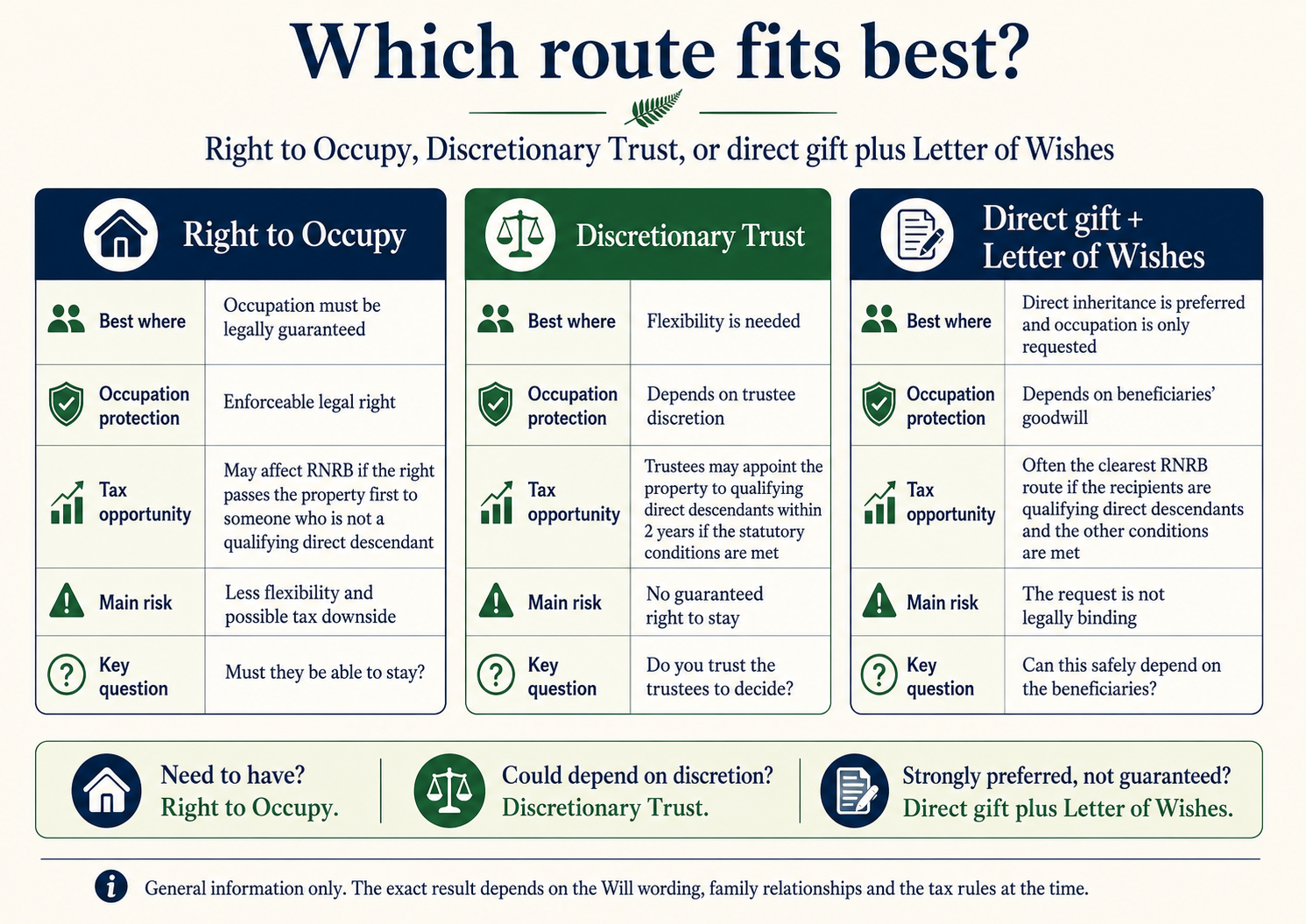
The starting comparison is usually between a Right to Occupy and a Discretionary Trust, but a direct gift to qualifying descendants supported by a Letter of Wishes may also need to be considered. The correct route depends on which outcome is genuinely non-negotiable.
If your partner must have an enforceable legal right to remain in the property, a Right to Occupy is normally the clearer answer. The right can last for a short fixed period, a longer period, for life or until a specified event. The trustees cannot simply change their minds and ask your partner to leave.
If preserving the Residence Nil-Rate Band for children or grandchildren is the overriding priority, a direct gift to qualifying descendants may provide the clearest inheritance route. A Discretionary Trust may retain greater flexibility and a possible route for the trustees to appoint the property to qualifying descendants within two years, but it does not preserve the allowance automatically. Under either route, your partner would not have the same guaranteed legal right to remain as they would under a Right to Occupy.
You may not be able to maximise both certainty and tax flexibility. The real decision is which risk matters more.
Put another way, is your partner’s occupation a “need to have” that must be legally guaranteed, or a “strongly like to have” outcome that could safely depend on trustee discretion or the goodwill of the eventual owners? That distinction should be settled before tax efficiency is allowed to drive the structure.
Quick-read summary
Right to Occupy
- Gives the partner a defined legal right to remain.
- Can last for a fixed period, for life or until a specified event.
- Provides certainty for the partner.
- Gives trustees less freedom to respond to changing circumstances.
- May prevent the Residence Nil-Rate Band from being available where the occupation right is treated as passing the property first to someone who is not a qualifying direct descendant.
Discretionary Trust
- Gives the trustees flexibility over who benefits, when and how.
- Can allow the partner to remain without giving them an automatic entitlement.
- May allow the trustees to appoint the property to qualifying direct descendants within two years in a way that preserves the Residence Nil-Rate Band, if the statutory conditions are met.
- Does not guarantee that the partner can remain.
- Requires carefully chosen trustees and a clear Letter of Wishes.
Direct gift plus Letter of Wishes
- Gives the property directly to the children or other chosen beneficiaries.
- May provide the clearest opportunity to use the Residence Nil-Rate Band where the recipients are qualifying direct descendants and the other conditions are met.
- A Letter of Wishes can explain that you would like them to allow your partner to remain temporarily.
- The Letter of Wishes is not legally binding and does not give your partner an enforceable right to stay.
- The arrangement depends on the new owners remaining willing and able to honour your wishes.
This comparison is particularly relevant to unmarried couples and blended families. Where the proposed occupier is a spouse or civil partner, spouse exemption and the transfer of unused Residence Nil-Rate Band may change the analysis. The allowance may remain unused on the first death and be transferred to the survivor’s estate, but its later availability will depend on the survivor’s estate meeting the qualifying conditions, including a qualifying home passing to direct descendants.
A typical family situation
Imagine that David owns his home in his sole name.
His unmarried partner, Helen, lives with him. David wants Helen to have time to recover from his death and arrange somewhere else to live. He also wants the property to pass ultimately to his children.
David’s first thought is:
Helen should be able to stay in the house for three years, and then it should pass to my children.
That sounds like a straightforward Right to Occupy.
However, the estate may also qualify for the Residence Nil-Rate Band if the home passes to David’s direct descendants. Giving Helen a fixed right over the property can affect that allowance.
A Discretionary Trust may offer flexibility, but Helen would no longer have the same guaranteed legal right to remain. David could instead leave the property directly to his children and use a Letter of Wishes to ask them to allow Helen to stay temporarily, but that request would not be legally binding.
The decision therefore becomes:
Does Helen need an enforceable right to remain, or can her occupation safely depend on trustee discretion or the goodwill of the children so that direct inheritance and the possible Residence Nil-Rate Band can take greater priority?
This decision involves both knowns and unknowns. David may know now that Helen would need secure accommodation if he died. What he cannot know with certainty is the future value of his estate, the tax rules in force at his death, how long Helen may need the property, whether she will still live there, or how family relationships may change. The Will must therefore balance the protection that is needed now against tax and practical outcomes that may be uncertain.
Option one: a Right to Occupy
A Right to Occupy gives a named person the legal right to live in a property.
The Will can state that the right lasts:
- For a fixed period, such as three years.
- For the rest of the occupier’s life.
- Until the occupier moves out permanently.
- Until another specified event occurs.
The precise terms can also address:
- Who pays the council tax, utilities and insurance.
- Who is responsible for repairs and maintenance.
- Whether the occupier can move to another suitable property.
- What happens if the occupier stops using the property as their main home.
- Who receives the property when the right ends.
The principal advantage: certainty
If the Will gives Helen the right to remain for three years, the trustees must respect that right.
Helen is not merely asking the trustees for permission. She has a legal entitlement under the Will, subject to its terms.
That may be the decisive factor where:
- Helen has nowhere else suitable to live.
- Three years is genuinely required rather than merely preferred.
- David does not want Helen to be dependent on his children or other trustees.
- Family relationships may become difficult after David’s death.
- David wants the arrangement to be clear and enforceable.
The principal tax consideration
A right to live in trust property will often create an interest in possession. Where that interest starts on death, it may be treated as an immediate post-death interest.
For inheritance-tax purposes, this can mean that the property is treated as passing to the occupier rather than directly to the children.
If the occupier is an unmarried partner, friend, sibling or another person who is not a qualifying direct descendant, the Residence Nil-Rate Band will normally not be available for that property on that death. Where the occupier is a child, grandchild or another qualifying direct descendant, the occupation interest may still allow the residence to be closely inherited, subject to all the usual conditions.
There can also be inheritance-tax consequences when the occupier’s interest ends during their lifetime. Specialist advice may therefore be needed when the trust is brought to an end.
For a fuller explanation of the structure itself, read Right to Occupy Trust in Your Will.
Option two: a Discretionary Trust
A Discretionary Trust does not give any beneficiary an automatic entitlement to the property.
Instead, the trustees decide:
- Who may benefit.
- When they may benefit.
- How they may benefit.
- Whether support is provided as money, property, a loan or permission to occupy.
The potential beneficiaries could include Helen, David’s children, grandchildren and other descendants.
David’s Letter of Wishes could explain that he would like the trustees to allow Helen to remain temporarily after his death.
The principal advantage: flexibility
The trustees can consider the circumstances that actually exist when David dies.
For example, they could consider:
- Whether Helen still lives in the property.
- Whether she needs a few months or a longer period.
- Whether she has another property available.
- Whether she would prefer financial support towards moving.
- Whether the property needs to be sold.
- Whether the children need the property or its value.
- The inheritance-tax position at that time.
The trustees may then allow Helen to remain temporarily before appointing the property to David’s children.
The principal disadvantage: no guaranteed right
Helen would be a potential beneficiary, not the holder of an enforceable three-year right.
She would depend on the trustees considering her position and exercising their powers in her favour.
A strong Letter of Wishes helps explain David’s intentions, but it is not legally binding.
This means the discretionary route may be unsuitable if David’s instruction is categorically:
Whatever else happens, Helen must be legally entitled to remain for three years.
The quality and independence of the trustees become particularly important. David must be satisfied that they will balance Helen’s needs against the interests of his children fairly.
For more detail about how this structure operates, read Discretionary Trusts: Protection and Flexibility for Your Family.
Option three: direct gift plus Letter of Wishes
David could leave the property directly to his children and write a Letter of Wishes asking them to allow Helen to remain for a limited period.
The principal advantage: direct inheritance
The property is not first tied up by an enforceable occupation interest. Where the children are qualifying direct descendants and all the other conditions are met, this may provide the clearest route to claiming the Residence Nil-Rate Band.
The principal disadvantage: no enforceable protection
A Letter of Wishes records what David would like to happen, but it is not legally binding. Helen would not have the same legal right to remain as she would under a Right to Occupy.
The children might fully intend to honour David’s wishes, but the arrangement still depends on their continuing willingness and ability. Financial pressure, sale, bankruptcy, divorce, death or family disagreement could prevent the intended occupation from continuing.
This route is more likely to fit where allowing Helen to remain is a strongly preferred outcome rather than a non-negotiable need, and David accepts the risk that the request may not be honoured.
Why the two-year period matters
Where property is placed into a Discretionary Trust by a Will, the trustees may be able to appoint it to qualifying direct descendants within two years of death. This is a possible planning route, not an automatic tax result.
If all the statutory requirements are met, section 144 of the Inheritance Tax Act 1984 may allow the appointment to be treated for inheritance-tax purposes as though the Will had originally left the property that way. This route will generally not be available where an immediate post-death interest has already arisen over the property.
This may enable the Residence Nil-Rate Band to be claimed where it would otherwise have been unavailable.
However:
- The appointment must be completed correctly.
- The property must pass in a qualifying way.
- The recipients must be qualifying direct descendants.
- The estate must otherwise qualify for the allowance.
- The tax rules in force at the time must be checked.
- The trustees should obtain appropriate legal and tax advice.
A Discretionary Trust does not automatically save inheritance tax merely because it exists.
Read our separate Residence Nil-Rate Band guide for a broader explanation of that allowance.
A simplified inheritance-tax example
Assume:
- David’s estate is worth £700,000.
- His home is worth enough to use the full Residence Nil-Rate Band.
- He has no transferable allowances from a deceased spouse or civil partner.
- There are no relevant debts, gifts, exemptions or reliefs.
- His children are direct descendants.
- The home would otherwise pass to those children in a way that qualifies for the Residence Nil-Rate Band.
- The standard nil-rate band is £325,000.
- The Residence Nil-Rate Band is £175,000.
- Inheritance tax is charged at 40%.
This is a simplified illustration only. Tax thresholds and legislation may change, and the actual result will depend on the estate, the beneficiaries, the Will wording and the circumstances at the date of death.
If the Residence Nil-Rate Band is unavailable
Estate: £700,000
Less nil-rate band: £325,000
Taxable amount: £375,000
Inheritance tax at 40%: £150,000
If the full Residence Nil-Rate Band becomes available
Estate: £700,000
Less nil-rate band: £325,000
Less Residence Nil-Rate Band: £175,000
Taxable amount: £200,000
Inheritance tax at 40%: £80,000
In this simplified example, the difference is £70,000.
That does not mean every Discretionary Trust saves £70,000, or that every Right to Occupy loses the allowance. The actual position depends on the estate, the beneficiaries, the trust wording and what the trustees do after death.
The example shows why the tax position can be material enough to influence the decision, but it should not automatically outweigh housing protection that the family considers essential.
A three-year right and the two-year tax window
This is where the priorities may collide.
If Helen must have a guaranteed legal right to remain for three years, a Right to Occupy may achieve that outcome directly.
However, a discretionary appointment intended to use section 144 normally needs to be completed within two years of David’s death.
The planning cannot simply assume that Helen will have a guaranteed three-year right while the property is also appointed to the children within the two-year tax window.
Other arrangements may be available, but they require individual legal and tax advice. The conflict should not be hidden from the client.
The decision may genuinely be:
- Give Helen a guaranteed three-year occupation right and accept the possible RNRB consequence.
- Use a Discretionary Trust, leaving Helen dependent on trustee decisions while retaining a possible two-year appointment route.
- Leave the property directly to qualifying descendants, supported by a non-binding Letter of Wishes, and accept that Helen would have no enforceable right to remain.
When a Right to Occupy is more likely to fit
A Right to Occupy is more likely to be appropriate where:
- The partner’s legal entitlement to remain is non-negotiable.
- The partner would be at serious risk without that entitlement.
- The family wants a fixed and easily understood period.
- The person making the Will does not want trustees deciding whether the partner may stay.
- The potential inheritance-tax saving is small, unavailable or less important than the partner’s security.
- The family accepts that the arrangement is less flexible.
When a Discretionary Trust is more likely to fit
A Discretionary Trust is more likely to be appropriate where:
- The inheritance-tax position is a major concern.
- The family wants to preserve the possibility of a qualifying appointment to direct descendants within two years, subject to the statutory conditions and appropriate specialist advice.
- The partner needs support but not necessarily an enforceable right for a fixed period.
- The partner has alternative accommodation or could move within the two-year period.
- Trusted and balanced trustees are available.
- The family wants flexibility to respond to circumstances at the date of death.
- The estate can justify the additional administration and professional advice.
When a direct gift plus Letter of Wishes is more likely to fit
A direct gift supported by a Letter of Wishes is more likely to be appropriate where:
- The property is intended to pass directly to children or other qualifying direct descendants.
- Preserving the opportunity to use the Residence Nil-Rate Band is a significant priority.
- The proposed occupier has suitable alternative accommodation or sufficient financial resources.
- Allowing them to remain is strongly preferred but is not an essential legal requirement.
- The beneficiaries are trusted to consider the request fairly.
- The person making the Will understands that the Letter of Wishes is not binding.
- The risk that the beneficiaries may be unable or unwilling to honour the request is acceptable.
What if none of these options is quite right?
The choice is not always limited to these three routes.
Depending on the family and the property, other options may include:
- A Property Life Interest Trust.
- A Life Interest Trust.
- A Flexible Life Interest Trust.
- A shorter or differently conditioned Right to Occupy.
- A combination of property and cash arrangements.
Our wider guide, Choosing Your Family Trust, explains how several common Will-trust structures relate to one another.
You are not expected to identify the correct technical product before your meeting. The starting point is to decide which outcomes matter most.
Questions to work through
When comparing these options, we would normally discuss:
- Is your partner’s occupation a “need to have” that must be legally enforceable, or a “strongly like to have” outcome that could safely depend on trustee discretion or the goodwill of the eventual owners?
- What is the proposed occupier’s relationship to you: spouse or civil partner, child or other direct descendant, or someone else?
- How long would they realistically need?
- Do they own another property or have other accommodation available?
- Would they be financially able to move?
- Is your estate likely to pay inheritance tax?
- Is the Residence Nil-Rate Band likely to be available?
- How valuable could the allowance be?
- Who would act as trustees?
- Can your partner and children trust those trustees?
- If the property passes directly to the beneficiaries, are you comfortable that they may be unwilling or unable to honour a non-binding request for your partner to remain?
- What should happen if circumstances change?
- Who should pay the property expenses?
- Is the additional trust administration proportionate to the possible benefit?
The answers usually reveal which priority should control the decision.
Ethical and governance note
Fern Wills & LPAs does not take trustee appointments or provide trust administration or trust registration services.
We do draft trusts that arise on death within Wills. If a trust later needs to be operated or registered, we can usually provide general pointers and introduce an appropriate specialist. Any specialist legal, tax or trust-administration work is provided separately, and you remain free to choose your own adviser.
Conclusion
The answer comes back to the same question with which we started.
If your instruction is:
My partner must have a legally enforceable right to remain in the property for three years.
A Right to Occupy is normally the more direct structure, even if that produces a less favourable inheritance-tax result.
If your instruction is:
Preserving the inheritance-tax allowances for my children is the overriding priority, and I trust my trustees to support my partner fairly.
A Discretionary Trust may provide greater flexibility, including the possibility of an appointment to qualifying direct descendants within two years.
If your instruction is:
I would strongly like my partner to be allowed to remain, but I accept that this should not be legally guaranteed.
A direct gift to qualifying descendants supported by a Letter of Wishes may provide the clearest inheritance route, but it leaves the proposed occupier dependent on the beneficiaries remaining willing and able to honour the request.
None of these routes is universally better.
The correct choice depends on which outcome is genuinely non-negotiable: legally enforceable housing security, trustee flexibility, or direct inheritance by descendants. Tax should form part of that decision, but it should not displace protection that the family considers essential.
This article is general information only, not individual legal or tax advice.
If your existing Will contains a Right to Occupy, Right to Reside, Discretionary Trust or similar property arrangement, a focused Will review or Will MOT can check whether it still reflects the balance you want between housing protection, flexibility and inheritance-tax opportunity.
Fern Wills & LPAs can explain the practical Will-planning choices and identify where separate specialist tax advice may be appropriate.