What are the five types of Power of Attorney

Last verified: September 2026 (England and Wales)
For most people planning ahead, the starting point is to consider both Lasting Powers of Attorney (LPAs): one for money and property, and one for health and welfare. They protect different parts of your life.
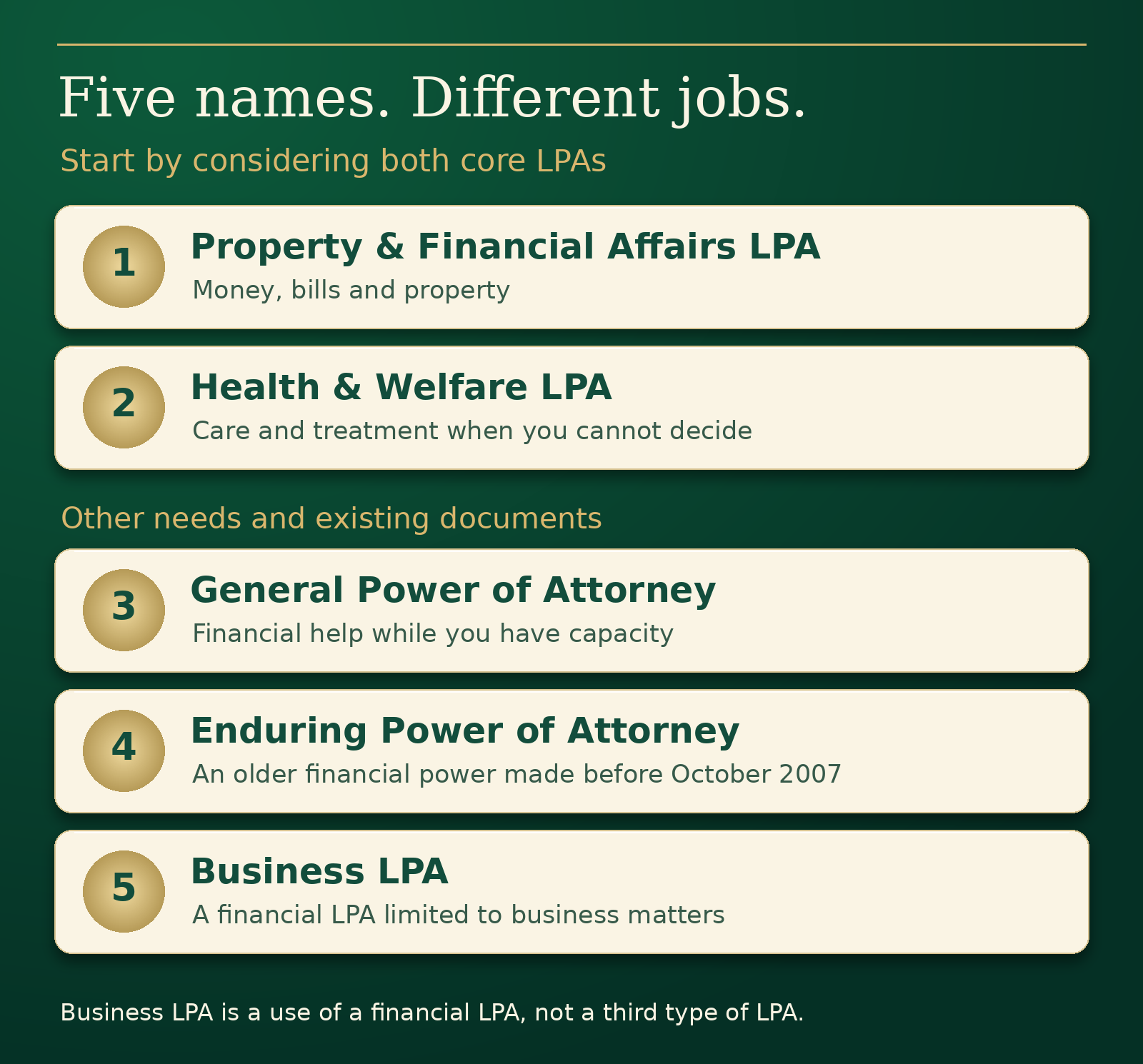
The five names you may hear are Property and Financial Affairs LPA, Health and Welfare LPA, General Power of Attorney, Enduring Power of Attorney and Business LPA. They are not five separate modern legal categories: a Business LPA is a financial LPA with a business-specific scope, and an Enduring Power of Attorney is an older document you may already have.
An attorney is someone you choose to act for you; they do not have to be a lawyer. Mental capacity means being able to make the particular decision when it needs to be made.
1. Property and Financial Affairs LPA
This is the money and property LPA. It can cover bank accounts, bills, pensions, benefits, investments, tax and insurance administration, and managing or selling property within the authority given.
It must be registered with the Office of the Public Guardian (OPG) before use. If the document allows it, your attorneys can help with your permission while you still have capacity. They can also act if you later lose capacity. You continue to make your own decisions whenever you can.
Banks and other organisations may need to check the document, identity and any restrictions before accepting instructions. Registration alone does not mean every account or transaction is immediately ready for an attorney to use.
Read more about the Property and Financial Affairs LPA.
2. Health and Welfare LPA
This covers decisions about care, where you live, daily routines and medical treatment. You choose whether to give your attorneys authority over life-sustaining treatment decisions.
It must be registered, and attorneys can act only when you cannot make the particular decision yourself. They must act in your best interests and within the document’s authority. It does not let them take over while you can decide, or demand treatment that clinicians cannot lawfully provide.
A financial LPA does not give this health and care authority.
Read more about the Health and Welfare LPA.
3. General Power of Attorney
A General Power of Attorney (GPA), also called an Ordinary Power of Attorney, gives financial authority while you have mental capacity. It can help during travel, recovery from surgery, a particular transaction or a gap while an LPA is being registered.
It does not need OPG registration. However, it must be validly made, cover the intended task and be accepted by the organisation involved. Signing a document does not guarantee immediate access to an account or completion of a transaction.
Its duration depends on its terms and circumstances; “general” does not mean it must expire after a fixed short period. Crucially, it cannot continue if you lose the relevant mental capacity. It is therefore not a substitute for an LPA when planning for future incapacity.
See when a General Power of Attorney may help.
4. Enduring Power of Attorney
An Enduring Power of Attorney (EPA) made and signed before 1 October 2007 may still be valid. You cannot make a new one now. It covers property and financial affairs, not health and welfare.
An EPA attorney must apply to register it with the OPG when they believe the person is becoming, or has become, mentally incapable of managing their property and financial affairs. This is a duty, not an optional update to leave until a crisis.
Do not discard an EPA simply because it is old. Review whether the attorneys and authority still fit your circumstances. A Health and Welfare LPA may fill a separate gap. Replacing an EPA or introducing a financial LPA needs care to avoid conflicting authority; cancelling a registered EPA requires Court of Protection approval.
5. Business or Commercial LPA
A Business LPA is a Property and Financial Affairs LPA limited to business matters. It is not a third type of LPA. Separate personal and business LPAs can appoint people with different skills, provided their boundaries are clear and do not conflict.
Depending on the authority and business arrangements, an attorney may help with business banking, invoices, suppliers and contracts. This can matter for sole traders, partnerships, family businesses, landlords and company owners.
It does not automatically let an attorney take over a company director’s office or override a partnership agreement, company rules or bank mandate. The plan needs to fit how the business is owned and run. Fern can help with LPA planning and coordinate with your commercial solicitor or accountant where specialist advice is needed.
Explore the wider questions in business succession and continuity planning.
Which arrangement fits your life?
Start with the decisions someone might need to make, then consider who has the judgement, availability and skills to make them. A trusted relative may be right for personal matters while a different person is better placed for business decisions.
Ask whether you need help now, protection if capacity is lost, or both. Check existing documents, replacement attorneys and any limits on their authority. If you already have LPAs, an LPA MOT can help identify whether your arrangements need attention.
Do not wait for a diagnosis or emergency. A spouse, partner or adult child does not automatically have authority to manage all your money or make every decision for you. Once someone lacks capacity to make an LPA, another person cannot create one on their behalf. Court of Protection involvement may be needed for financial decisions. Health and care decisions usually follow the applicable best-interests process; a welfare deputy is not the automatic alternative.

How this can work in practice
These examples are illustrative; the right arrangement depends on the person and the documents.
After a stroke: Mr Davis has no LPA and cannot make the relevant financial decisions. His family may face checks, delays and a court application rather than simply taking over his accounts.
During recovery: Mrs Cole still has capacity but needs help with bills while her LPA is being registered. A GPA may bridge the gap if it covers the task and her bank accepts it.
Personal and business finances: a business owner wants their spouse to help at home and an experienced colleague to handle business matters. Separate financial LPAs may suit, after checking the business arrangements and avoiding overlapping instructions.
An older EPA: someone finds a valid EPA which still suits their financial needs. A review may support keeping it and adding a Health and Welfare LPA, rather than replacing everything automatically.

Can I make an LPA myself?
Yes. Professional help is not compulsory. It can be useful when you want support choosing attorneys, understanding how they will act together, checking restrictions and reducing avoidable mistakes. Complex family or business arrangements may need specialist advice.
Will an LPA work abroad?
Do not assume an England and Wales LPA will be accepted in another country. Acceptance and any translation or authentication requirements depend on the country, asset and organisation. Obtain advice about the intended use before relying on it overseas.
Can I change or revoke an LPA?
It depends on the change and whether you have the required capacity. Updating contact details is different from changing legal authority. Adding an attorney or making substantial changes generally needs a new LPA; removing an attorney may be possible through a partial revocation. Have the options checked before cancelling useful existing protection.
What if I have dementia but still have good days?
A diagnosis does not by itself decide whether you can make an LPA. Capacity is specific to the decision and the time. You must have capacity to make the LPA when you do so, and you keep making other decisions whenever you can. Seek advice promptly if capacity is uncertain or fluctuates.
Do I still need a Will?
Yes. Powers of Attorney deal with authority during your lifetime and end on death. A Will deals with your estate after death. They do different jobs within your wider plan.
Fees
For current fees, please see Services & Fees.
Professional fees and any OPG registration fees are separate parts of the overall cost. A reduction or exemption from the OPG fee may be available, depending on circumstances.
Talk through the right starting point
If you are unsure which arrangement fits, contact Fern Wills & LPAs to discuss what help you need, who you would trust and any documents already in place. Fern can explain the options within its service and identify where specialist input is needed.
This article is general information only, not individual advice.