101 Common LPA Mistakes
Last verified: September 2026 (England and Wales)
A Lasting Power of Attorney (LPA) needs to work twice: when the Office of the Public Guardian (OPG) registers it, and when your attorneys need to use it. A missing signature can stop registration. A poorly chosen restriction can cause difficulty much later, even after registration has succeeded.
The donor is the person making the LPA. Attorneys are the people they appoint to help with decisions. A Property & Financial Affairs LPA covers money and property; a Health & Welfare LPA covers care and medical decisions. The two documents have different powers and rules about when they can be used.
These 101 mistakes follow the life of a personal LPA in England and Wales, from preparing the forms to using the registered document. Some are legal defects; others are practical traps worth thinking through before they become urgent.
If you can genuinely avoid all 101, you can probably do it yourself. Most people can't, and shouldn't have to.
How to read the list
[Rejects] identifies a problem that can prevent registration or require the LPA to be corrected or remade.
[Delays] identifies a likely query or avoidable hold-up.
[Operability] identifies a risk when the LPA is needed. The labels describe possible consequences, not an automatic outcome in every case. OPG correspondence and the particular defect determine what can be put right.
- Part 1: Printing & Preparation Mistakes, 1–20
- Part 2: Signing & Witnessing Mistakes, 21–40
- Part 3: Instructions & Attorney Choices, 41–60
- Part 4: Registration & Storage Mistakes, 61–80
- Part 5: Using Your LPA in Practice, 81–101
Part 1: Printing & Preparation Mistakes
1. Missing pages [Rejects]
Check the complete form before anyone signs and again before it is sent. The current LP1F and LP1H forms each run to 20 pages, including pages that contain legal information rather than boxes to fill in. A missing page can prevent registration; checking the sequence is more useful than assuming a thick envelope must be complete.
2. Missing continuation sheets [Rejects]
Extra attorneys, replacement arrangements or longer instructions may need the appropriate continuation sheet. Include every sheet referred to in the form, identify it correctly and complete any required donor signature before the certificate provider signs. An instruction that exists only on a loose, unsigned draft is not a reliable part of the LPA.
3. Mixing the two types of LPA [Rejects]
LP1F is for Property & Financial Affairs; LP1H is for Health & Welfare. Similar-looking pages are not interchangeable. Keep each application together and check the form code in the page footer, especially when printing both LPAs for a couple. A page from somebody else's application is a problem too.
4. Using an unreadable printout [Delays]
Inspect the actual pages for faint text, missing lines, toner streaks and dark backgrounds. Names, choices and signature areas must remain clear when the document is copied later. Reprint a poor page before signing. Choose clean, undamaged paper that can be read and handled reliably.
5. Cropping the form when printing [Rejects/Delays]
Check the print preview and the finished pages. All wording, boxes and page identifiers need to be visible; a printer setting that clips the edges can remove something important. The practical test is the complete, legible form, not whether a particular print-menu option happens to be selected.
6. Combining different drafts [Rejects/Operability]
After changing an attorney, an appointment choice or an instruction, check the entire set again. It is easy to retain a signature page from an earlier draft while replacing the front pages. Set aside superseded unsigned drafts and make sure everyone signs the same settled version. Do not swap signed pages casually afterwards.
7. Completing the form in pencil [Rejects]
OPG's current guidance says not to use pencil. That includes ticks and other entries, as well as signatures. Use the permitted ink throughout. If pencil has already been used, check the correction route before sending the application rather than tracing over it and hoping the problem has disappeared.
8. Using the wrong ink [Rejects/Delays]
Use black or blue pen, as OPG's guidance requires. Keep a suitable pen with the pack so each signer follows the same instruction. Check handwritten additions and ticks as well as signatures before the pack is sent. A colour used to distinguish someone's changes may create an avoidable problem.
9. Adding marks that obscure the form [Delays]
Keep highlighting, reminders and explanatory notes on a separate checklist. Marks across a name, choice or signature can make the intended entry harder to read. A highlighter mark is not automatically the same as an invalid LPA, but an obscured answer may need clarification or a clean page before signing.
10. Using correction fluid or stickers [Rejects]
OPG says it cannot register an LPA corrected with correction fluid or stickers. For an ordinary correction, cross out the error, write the correction clearly and have the person responsible for that entry initial it. A change affecting the donor's choices or the signing sequence needs particular care. Do not conceal the original entry.
11. Stapling, fixing or binding the application [Delays]
Follow OPG's instruction to submit pages without staples, fixing or binding. Keep each complete application in order for posting without damaging the paper. Removing staples after signatures have been added can tear a page, so decide how the pack will be handled before the signing appointment.
12. Using forms for the wrong jurisdiction [Rejects/Operability]
This article concerns England and Wales. Scotland and Northern Ireland have different arrangements, and a document made elsewhere may raise separate questions about recognition and use. Check which law applies before preparing the forms, particularly if the donor or their property has connections with more than one country.
13. Letting the helper make the donor's decisions [Rejects/Operability]
Someone may help with typing or handwriting, but the donor must understand and choose the arrangement while they have the mental capacity to make the LPA. A relative cannot simply select attorneys and instructions on their behalf. If understanding is in doubt, obtain appropriate advice before organising signatures.
14. Treating a scan as an original [Rejects/Delays]
Printing a scan of a signed document does not turn it into a wet-ink original. Registration normally uses the original signed LPA. Where the original is missing, OPG guidance provides a route using a properly certified copy and an explanation. Do not assume an ordinary photocopy or pasted signature meets that requirement.
15. Losing the page sequence [Delays]
Arrange pages by their printed identifiers, then check the continuation sheets against the sections that refer to them. Repeated or misplaced pages can conceal an omission. Handwritten page numbers are no substitute for checking that the correct official page is present, complete and attached to the right person's application.
16. Writing details that others cannot read [Delays]
Use clear writing for names, addresses and other entries, following the form's instructions. Read the completed details back before signing, including postcodes and dates of birth. A signature may be the person's usual signature; the separate printed-name fields are there to make the identity clear.
17. Using inconsistent or incomplete names [Delays/Operability]
Give full names consistently, including relevant middle names, and check them against identity documents. Where someone is known by another name, deal with that deliberately rather than alternating names between pages. Later name changes can be reported; an unexplained mismatch may complicate both registration and an organisation's identity checks.
18. Assuming every older form is invalid [Delays/Operability]
Use current forms for a new LPA. If an older LPA has already been signed, check the rules that apply to that form before deciding it must be replaced. Some older forms can still be registered, and a valid registered LPA does not expire merely because a newer version of the form exists.
19. Removing the legal information pages [Rejects]
The legal information in section 8 forms part of the current LPA pack. Do not discard it because it looks like guidance rather than an application page. Distinguish pages within the numbered form from a separate explanatory booklet. Everyone signing needs the relevant legal information available to read.
20. Confusing optional notes with required details [Rejects/Delays]
Complete the required donor, attorney and application details, including dates of birth where requested. The optional list of people on the front of the current form is different from those substantive sections. Check each field against its instructions; neither filling every blank indiscriminately nor leaving essential identity fields empty is a sensible approach.
Part 2: Signing & Witnessing Mistakes
Plan the signing before sending pages between people. The correct person, section, witness and sequence all matter. Several people can sign on the same date, provided they actually sign in the required order.
21. Getting the signing order wrong [Rejects]
The donor completes their required signatures first, including relevant continuation sheets and the Health & Welfare treatment choice. The certificate provider then signs section 10, followed by all attorneys and replacements in section 11. The registration applicant signs section 15 last. Arrange the witnesses alongside the signatures they must witness.
22. Using dates that do not reflect what happened [Rejects]
Each date must be the actual date of that signature. Do not pre-date, post-date or backdate entries to make an incorrect sequence appear correct. If someone signs too early or a date is wrong, establish the proper correction or re-signing sequence before the application is submitted.
23. Missing a required signature [Rejects]
Check every required donor, certificate-provider, attorney, replacement-attorney, witness and applicant signature. For Health & Welfare, the donor's signature in section 9 does not replace the separate signature needed for the treatment choice in section 5. Any continuation sheet requiring a donor signature needs checking too.
24. Improvising when the donor cannot physically sign [Rejects]
Physical difficulty signing is not the same as lacking mental capacity. There is a specific procedure for someone to sign at the donor's direction, using the appropriate continuation sheet and two witnesses. Arrange this correctly in advance. An attorney should not simply write the donor's name in the usual signature box.
25. Choosing a family member as certificate provider [Rejects]
The certificate provider cannot be a member of the donor's or an attorney's family. The restrictions include relationships such as in-laws and step-relatives, and an unmarried partner is also excluded. Check the actual relationship, rather than assuming that different surnames make the person eligible.
26. Allowing pressure to go unexamined [Operability]
The certificate provider must be satisfied that the donor understands the LPA and is not being pressured or defrauded. A private conversation, where possible, helps them hear the donor's own answers. Having a relative present is not itself an automatic rejection rule, but someone else answering every question is a warning to pause.
27. Missing another certificate-provider conflict [Rejects]
Exclusions extend beyond family. They include attorneys and replacements, relevant business or employment connections, and specified connections with a care home where the donor lives. Someone appointed under another LPA or Enduring Power of Attorney for the donor can also be excluded. Check eligibility before relying on a convenient familiar person.
28. Choosing a certificate provider without the required basis [Rejects]
The provider must be at least 18 and either have known the donor well personally for at least two years or have relevant professional skills and expertise. Being a recent acquaintance or having an impressive job title is not enough. The person must be able to make the certificate's actual assessment.
29. Signing in the wrong place [Rejects/Delays]
Read the role and section heading above the signature box before signing. A signature in a margin, on a sticky note or in someone else's section may not execute the required part of the LPA. Check the finished page before it leaves the appointment, while the relevant people are still available.
30. Witnessing the donor remotely or afterwards [Rejects]
The witness must be physically present and watch the donor sign. Seeing a signature later, or watching over a video call, does not meet this requirement. The witness should complete their part at the signing, rather than being asked to fill in an unwitnessed page afterwards.
31. Asking an attorney to witness the donor [Rejects]
An attorney or replacement attorney named in the LPA cannot witness the donor's signature. Choose an eligible adult. A suitable certificate provider can also be the donor's witness. An attorney's spouse is not automatically barred from witnessing if they meet the witness requirements; the stricter certificate-provider exclusions are a separate matter.
32. Using a witness under 18 [Rejects]
The witness must be 18 or over. Check this before inviting a younger relative to help at the signing. A mature teenager who understands what is happening still does not meet the age requirement. Plan for an eligible adult who can attend the actual signature being witnessed.
33. Leaving witness details incomplete [Rejects/Delays]
The witness needs to sign and provide their name and address in the relevant section. Check that the writing is readable and belongs to the person who actually witnessed that signature. One person's details should not be copied into a box for an event they did not attend.
34. Confusing witnessing with providing the certificate [Operability]
A witness confirms a signing event. The certificate provider makes the separate assessment about the donor's understanding, freedom from pressure and the absence of another reason preventing the LPA. One eligible person may perform both roles, but witnessing alone does not complete section 10 or replace that assessment.
35. Treating the certificate as a formality [Rejects/Operability]
The certificate provider should read the relevant material and satisfy themselves about the arrangement the donor is actually making. Signing the correct box is not enough if no meaningful assessment took place. If the donor's answers raise concerns, the provider must resolve them rather than sign to keep the appointment moving.
36. Omitting the certificate provider's details or date [Rejects/Delays]
Check section 10 for the provider's required name, address, signature and date. The date needs to fit the actual signing sequence. If the section needs correction, establish who must correct or re-sign it and whether later signatures must be repeated. Another person cannot simply substitute their own certificate afterwards.
37. Letting attorneys sign before the certificate provider [Rejects]
All attorneys and replacement attorneys sign after the certificate provider. Sending an unsigned pack around the family without instructions can easily reverse that order. If separate appointments are needed, keep a clear record of the sequence and check that the earlier stages are complete before passing the pack on.
38. Applying the wrong rules to attorney witnesses [Rejects]
Each attorney's signature needs an adult witness who is physically present. The donor cannot witness it. One attorney may witness another attorney's signature, and an eligible certificate provider may witness too. An independent witness can be a practical choice, but it is not the only arrangement the rules permit.
39. Forgetting replacement attorneys must sign too [Rejects]
Replacement attorneys sign section 11, just as the original attorneys do. They do not wait until they are needed before accepting the role. Use enough copies of the section 11 page for everyone and complete the identifying details. Check their names against the replacement appointments before circulating the pages.
40. Signing the registration application too soon [Rejects]
Section 15 comes after all the required signatures in sections 9, 10 and 11 and any relevant earlier donor signatures. Check who is applying: the donor or eligible attorneys, with the required applicants signing for the appointment structure. Being the correspondence contact does not itself make someone entitled to apply.
Part 3: Instructions & Attorney Choices
The form records decisions about people, authority and safeguards. Think through how those decisions will work during an ordinary week and during a difficult one. Registration alone cannot tell you whether your chosen arrangement will suit your family.

41. Writing instructions that are hard to interpret [Delays/Operability]
An instruction should make clear what must happen, when and who must do it. Expressions such as “when necessary” can create arguments if nobody can tell what triggers the requirement. Explain your intended outcome before settling the wording. A broad personal wish may belong among preferences rather than as an enforceable restriction.
42. Trying to give powers the law does not allow [Rejects/Delays]
An instruction cannot expand an attorney's authority beyond the law. For example, wording intended to permit unrestricted gifts does not remove the statutory limits. Unlawful provisions may require court consideration or prevent registration in the form intended. Get the legal effect checked before relying on a clause that sounds reassuring.
43. Confusing preferences with instructions [Operability]
Preferences express wishes that attorneys should consider. Valid instructions impose requirements they must follow. Decide how much flexibility you intend before using words such as “must” or “always”. Putting mandatory wording in a preferences box does not resolve a conflict between the wording and the role you want it to play.
44. Leaving an unclear life-sustaining treatment choice [Rejects]
In section 5 of the Health & Welfare LPA, choose one of the two options about the attorneys' authority over life-sustaining treatment. Do not tick both or substitute “see notes” for the choice. Understand the effect of the selected option before signing, including how any separate treatment decisions fit alongside it.
45. Assuming an LPA changes your Will or settles every treatment question [Operability]
An LPA operates during your lifetime and does not let attorneys rewrite your Will. A valid and applicable Advance Decision to refuse treatment may interact with a Health & Welfare LPA, depending on its terms and timing. Review the documents together where they overlap, rather than assuming the newest paperwork automatically solves every conflict.
46. Missing the section 5 signature and witness [Rejects]
The Health & Welfare treatment choice needs the donor's signature and its witness details as well as the chosen option. It is a separate execution step from section 9. Check both before the certificate provider signs. A tick on its own does not complete the treatment-choice section.
47. Contradicting the attorney appointment [Rejects/Delays]
If attorneys can act jointly and severally, each generally has authority to act alone within the LPA's terms. Adding a majority-vote requirement can conflict with that structure. If some decisions should require everyone and others should not, the appointment and wording need to express a coherent, workable arrangement.
48. Choosing joint appointments without understanding the consequences [Operability]
Joint attorneys must make the relevant decisions together. If one can no longer act, that can end the joint authority unless a valid replacement arrangement preserves it. A mixed appointment needs checking decision by decision. Joint appointments can be deliberate safeguards, but their effect on continuity should be understood before choosing them.
49. Not considering what happens if an attorney drops out [Operability]
Replacement attorneys are optional, but consider what would happen after a death, loss of capacity or formal withdrawal. A surviving attorney appointed jointly and severally may be able to continue. A sole or joint appointment can be more vulnerable. The useful question is whether your actual arrangement has a workable fallback.
50. Choosing replacement arrangements without testing them [Operability]
Consider who steps in, alongside whom and with what decision-making powers. Requiring replacements to act jointly may provide oversight but can also make decisions harder if one cannot act. Jointly and severally is not automatically right for every family either. Test the arrangement against the circumstances you are trying to cover.
51. Appointing people simply to include everyone [Operability]
There is no universally correct number of attorneys. A large group can complicate communication and provider checks, while too few people may leave little resilience. Choose the people and structure that can do the job. Avoid treating an appointment as a family honour that everyone must receive equally.
52. Confusing affection with suitability [Operability]
An attorney needs to be willing, trustworthy and able to carry out the responsibilities. Financial organisation, availability and willingness to keep records may matter as much as closeness. Discuss the role before naming someone. They should understand what they are accepting and feel able to say if it is unsuitable.
53. Ignoring existing disagreements [Operability]
Attorneys who already struggle to communicate may find joint decisions difficult under pressure. Talk through how information will be shared and disagreements handled. Appointing people jointly and severally may remove a need for every signature, but it does not remove their duties or cure serious conflict between them.
54. Overlooking the practical effects of distance [Operability]
An attorney does not have to live in the UK or be a British citizen. Distance can still affect visiting, time zones, identity checks and access to organisations. Consider those practicalities alongside the appointment structure. A capable person abroad may work well; geography alone does not decide suitability.
55. Making assumptions about age or health [Operability]
Consider each proposed attorney's ability and likely availability over time. Older age or a health condition does not automatically make someone unsuitable. Equally, relying on one person without discussing foreseeable limitations can leave a gap. Sensible replacement planning can support your preferred choice without dismissing them on age alone.
56. Overlooking financial eligibility [Rejects/Operability]
A bankrupt person or someone subject to a debt relief order cannot act as a Property & Financial Affairs attorney. Those restrictions do not apply in the same way to Health & Welfare appointments. An individual voluntary arrangement is not automatically the same legal bar, although financial judgment remains relevant when choosing someone to manage money.
57. Expecting replacements to provide holiday cover [Operability]
A replacement does not normally step in merely because an original attorney is busy, travelling or temporarily unavailable. Replacement appointments operate when the specified legal circumstances arise, under the LPA's terms. If everyday availability is important, consider it when choosing the original attorneys and deciding how they may act.
58. Making restrictions too rigid to use [Delays/Operability]
An absolute instruction such as always remaining at home may become impossible to follow if care needs change. Think about the outcome you want and whether a preference would communicate it more helpfully. Binding wording should protect a deliberate choice without making lawful, necessary decisions unworkable.
59. Keeping your wishes to yourself [Operability]
Explain your values, routines and priorities to the people you appoint. A Letter of Wishes can help record personal context, but it is optional and cannot rewrite the LPA or expand legal powers. For when a separate document is useful, read how a Letter of Wishes can support an LPA.
60. Treating either blank boxes or extra clauses as automatically best [Operability]
Preferences and instructions are optional. Leaving them blank can be entirely appropriate; adding wording can also help where it serves a clear purpose. The mistake is failing to consider your circumstances. Choose the powers and people first, then include only wording that adds something useful and works with the rest of the LPA.
Part 4: Registration & Storage Mistakes
A signed LPA must be registered before attorneys can use it. Once registered, the original and any evidence needed to use it should be protected, recorded and retrievable.
61. Leaving payment or a fee application unresolved [Delays]
Each LPA needs its registration fee dealt with, unless a reduction or exemption applies. If claiming help with the fee, include the required application and evidence. Having completed the legal document does not complete this administrative step. Check how payment is being made and who is responsible for it.
62. Relying on an old fee figure [Delays]
Fees can change. Check the current amount and eligibility for a reduction or exemption when the registration application is prepared. Do not copy a figure from an old article or assume that a professional preparation fee includes every third-party charge. Keep a clear record of what has been agreed and paid.
63. Providing incomplete payment information [Delays]
Follow the payment instructions for the method selected. If OPG needs to contact someone to take payment, check those contact details and make sure the person expects the request. An unsigned cheque or an unanswered payment request can hold up an otherwise complete application.
64. Losing track of separate applications [Delays]
If both LPAs are being registered, check that each complete application is present and that payment covers the intended applications. Keep a record for each donor and LPA type. If the donor named people to be notified, send the required notices before applying. Submitting one application does not automatically register the other.
65. Leaving registration until a crisis [Delays/Operability]
A validly made LPA may still be registered after the donor loses capacity. The difficulty is that defects needing the donor to make or re-sign an LPA may then be impossible to repair. Registering promptly gives more opportunity to address problems and reduces the chance of discovering an unusable document when help is urgent.
66. Choosing an ineffective correspondence address [Delays]
Check the correspondence details in section 13 of the current forms, including the address to which OPG should send the registered document. Choose a contact who will deal with letters promptly. If circumstances change during registration, tell OPG rather than assuming the pack will find its way to the right place.
67. Supplying contact details nobody monitors [Delays]
An email address can help communication, but leaving an optional email field blank is not automatically a defect. What matters is that the chosen correspondence route works. Check post and email, including junk folders where relevant, and make sure someone knows who is handling queries and payment requests.
68. Ignoring a specific request for evidence [Delays]
If OPG asks for information or evidence, read the request carefully and provide what it actually requires through the stated route. Do not assume every application needs a generic certified-ID bundle. Check an unexpected request with OPG using independently verified contact details before sending sensitive documents or money.
69. Missing an OPG response deadline [Delays/Rejects]
Deal with queries promptly and use the deadline in the actual correspondence. There is no single assumed deadline that safely covers every correction or request. If you cannot respond in time, contact OPG before the deadline. Keep a copy of the reply and a record of what was sent.
70. Using the wrong evidence for a fee reduction [Delays]
Check the current fee-remission or exemption guidance for the donor's circumstances and the relevant period. Benefit and income evidence have their own requirements. Do not assume all evidence must be an original dated within the last 30 days, or that any recent letter will establish eligibility.
71. Enclosing unrelated original documents [Operability]
Your original Will does not belong in the LPA registration envelope. Check the contents against what the application actually requires before sealing it. Sending unnecessary originals creates avoidable handling and retrieval risks. Keep the Will and other important documents in their own recorded storage arrangements.
72. Assuming one registration covers both kinds of decision [Operability]
A registered financial LPA does not confer health and welfare powers, and the reverse is also true. Each LPA needs its own registration. Read the separate guides to Property & Financial Affairs LPAs and Health & Welfare LPAs if you are unsure what each document covers.
73. Filing the registered pack without checking it [Operability]
Check the returned document, its pages and continuation sheets, and the registration confirmation. Keep associated letters that explain a change or query. Raise anything missing, unclear or unexpected with OPG promptly. Do not make your own handwritten alteration to a registered LPA to correct what appears to be an error.
74. Choosing storage without considering the risks [Operability]
Home storage can be perfectly valid if the document is secure, protected and accessible to the right people. Consider fire, water, misfiling and access during an emergency. Professional storage is an alternative, not a legal requirement. Compare the practical arrangements, including retrieval, through Fern's document storage service.
75. Failing to record professional storage arrangements [Operability]
If a professional holds the original, keep the reference, contact details and retrieval procedure. Establish who can request it and what evidence they will need. Tell the attorneys how to find that record. Storage is only useful if the right document can be located and released when required.
76. Sending away the only original unnecessarily [Operability]
Ask which evidence route the organisation can use. Online verification may avoid posting paper. Where paper is needed, consider a properly certified copy or an OPG official copy where available. If the original must be sent, arrange secure handling and return. Fern can help identify an appropriate evidence route.
77. Certifying only part of what the copy needs to prove [Delays/Operability]
Certification needs to confirm that each copied page matches the corresponding original page and, on the final page, that the copy is complete. OPG's page wording is: “I certify this is a true and complete copy of the corresponding page of the original lasting power of attorney.” The final page also needs: “I certify this is a true and complete copy of the lasting power of attorney.”
78. Omitting certification, signatures or dates on pages [Delays/Operability]
For the donor-certification route, follow the required wording and sign and date every required page, including the relevant continuation sheets. A signature only on the front does not do the same job. Fern can prepare a self-certifiable copy pack where the donor can certify; it still needs the donor's own completed certification.
79. Assuming anyone close to the donor can certify [Delays/Operability]
The donor can certify while able to make their own decisions and complete the required signing. Other legally authorised certifiers include solicitors, notaries and chartered legal executives. A relative, friend or attorney does not gain that authority simply through their relationship or appointment. Check the certifier's actual qualification and the evidence route required.
80. Losing track of paper copies [Operability]
Keep a short record of who holds the original and which organisations have received certified copies. Record returns and any later change to the LPA's status. This helps when a document must be retrieved or a provider needs an update. Limit unnecessary circulation of a document containing personal information.
Part 5: Using Your LPA in Practice
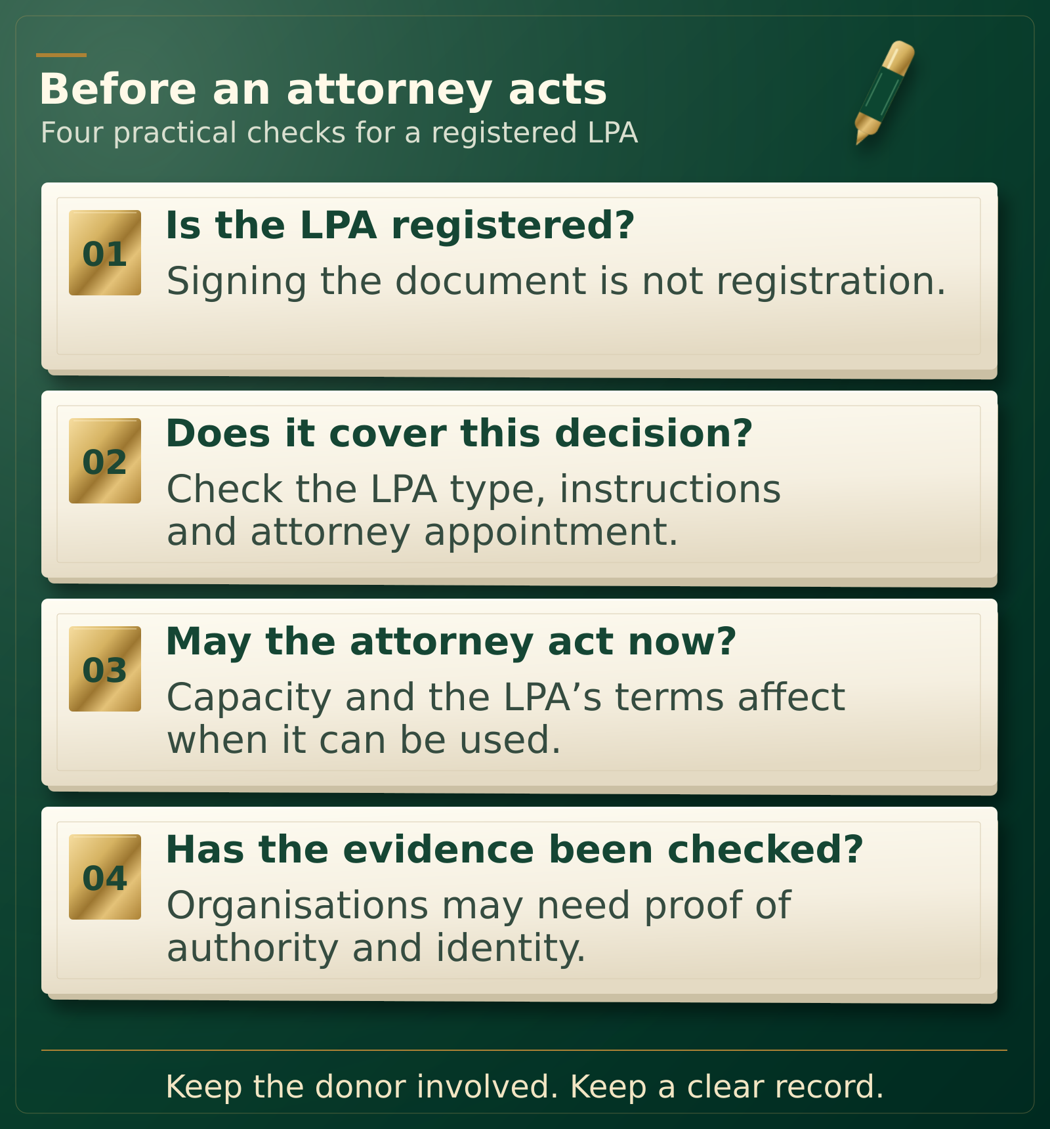
Before an attorney acts, check that the LPA is registered, that it covers the decision, that the attorney may act now under its terms and the capacity rules, and that the organisation has verified the evidence it needs. Keep the donor involved and maintain a clear record.
81. Assuming registration informs every organisation [Operability]
OPG registration does not automatically add attorneys to bank, pension, utility or care-provider records. Establish the relevant organisation's process when the authority needs to be recognised, and prepare earlier where that will help. Keep its acknowledgement and any limits on access. There is no need to notify every possible organisation indiscriminately.
82. Acting before the authority is available [Operability]
An LPA cannot be used before registration. A financial attorney may help while the donor has capacity only if the registered LPA allows it and the donor gives permission. A Health & Welfare attorney acts only when the donor lacks capacity for the particular decision. Registration alone does not authorise every action.
83. Keeping no record of decisions or spending [Operability]
Attorneys should be able to explain what they have done and why. Keep proportionate records of significant decisions, transactions and the donor's involvement. A short note made at the time can be more useful than trying to reconstruct events months later. Unexplained spending can lead to questions even where the intention was helpful.
84. Discarding supporting financial records [Operability]
Keep the statements, invoices and receipts needed to account for the donor's money, including expenses reimbursed to an attorney. Agree an appropriate retention approach for the circumstances and any later estate, tax or dispute needs. There is no universal LPA rule requiring every receipt to be retained for six years after death.
85. Failing to report name or address changes [Delays/Operability]
Tell OPG when the donor or an attorney changes name or address, and update relevant organisations. Name changes need the appropriate supporting copy; OPG does not require supporting documents simply for an address change. Do not write the new details onto the registered LPA. Keep the notification record with the paperwork.
86. Assuming a new LPA automatically cancels an old one [Operability]
Making another LPA does not automatically revoke an earlier one. If the donor intends replacement, deal with revocation formally while they have capacity and notify OPG and affected organisations as appropriate. Sometimes more than one LPA is deliberate, but overlapping authority needs careful management rather than an assumption that only the newest counts.
87. Treating gifts as unrestricted financial decisions [Operability]
Attorneys have limited gift-making powers, including certain customary-occasion and charitable gifts of reasonable value in the donor's circumstances. Family agreement or a possible inheritance-tax saving does not expand those powers. Gifts outside the permitted scope need Court of Protection authority. See what gifts attorneys can make before giving away money or property.
88. Making loans from the donor's money without authority [Operability]
An attorney should not use the donor's funds to lend money to themselves, a relative or someone else without Court of Protection authority. Charging interest or calling it temporary does not solve the lack of power. Agreeing a repayment plan afterwards is not a substitute for obtaining the necessary authority first.
89. Mixing the donor's money with the attorney's [Operability]
Keep the donor's money separate and record any legitimate reimbursement or shared expense clearly. An existing joint account is not automatically prohibited, but ownership and spending still need to be understood. Do not use the donor's account as a convenient fund for the wider family's bills or informal borrowing.
90. Ignoring the Mental Capacity Act principles [Operability]
Start by presuming capacity and give the donor practical support to make their own decision. An unwise choice alone does not prove incapacity. Capacity concerns the particular decision at the relevant time. Where a decision must be made for someone, apply best interests and consider whether the purpose can be achieved less restrictively.
91. Confusing family preference with best interests [Operability]
Best interests concern the donor, including their wishes, feelings, beliefs and values. Involve them as far as possible and consult relevant people where appropriate. A family majority does not decide the answer by vote. Record the options considered and the reasons, especially where others disagree or the decision has lasting consequences.
92. Stopping without formally giving up the appointment [Operability]
An attorney who cannot continue should use the formal disclaimer procedure and give the required notices. Quietly stepping back leaves uncertainty about who can act, particularly under joint arrangements. Check the effect on the remaining attorneys and any replacements before assuming the donor still has effective support.
93. Assuming every attorney departure ends the whole LPA [Operability]
The effect of an attorney's death or loss of capacity depends on the appointment and replacement provisions. Other attorneys appointed jointly and severally may continue; sole or joint authority may end unless the replacement arrangements work. Notify OPG and check the remaining powers before either continuing blindly or assuming deputyship is inevitable.
94. Skipping provider checks or using the donor's login [Delays/Operability]
An organisation may need to verify the LPA, the attorney's identity and how the appointment works before setting up access. Use its attorney process and the credentials it provides. The donor's permission to help does not automatically authorise using their personal banking password or impersonating them online.
95. Assuming online access is universal or compulsory [Delays/Operability]
The Use an LPA service can let an organisation verify an eligible LPA using an access code. LPAs registered before 1 January 2016 cannot currently be added. An organisation may still need identity checks or another evidence route. A screenshot or ordinary scan is not automatically equivalent to verification through the service.
96. Keeping the document's location secret from the attorneys [Operability]
Tell the attorneys how to locate the registered LPA, storage record and relevant copy or online-access arrangements. They do not need unrestricted access to everything immediately, but they do need a practical route when authorised to act. Recheck the arrangements after a move or a change of storage provider.
97. Destroying valid copies simply because another was made [Operability]
A newly certified copy does not automatically cancel earlier accurate copies of the same valid LPA. Keep useful copies secure and track where they are. If the LPA itself is revoked, cancelled or otherwise changes status, follow the appropriate return, withdrawal or update process so organisations do not rely on obsolete authority.
98. Allowing the original to become damaged [Operability]
Keep paper originals dry, secure and protected from tearing or marking. Damage can make signatures, wording or registration evidence difficult to verify. If it happens, explore the available copy or OPG evidence route rather than altering the document yourself or assuming the legal authority has automatically disappeared.
99. Never reviewing the arrangement [Operability]
Review the LPA when relationships, health, finances or the availability of attorneys change. Divorce or dissolution can affect a spouse's appointment, subject to the document and applicable rules. Age alone does not expire an LPA. An LPA MOT review can help identify practical gaps while there is still time to address them.
100. Treating registration as the end of the job [Operability]
Make sure the attorneys understand the powers, restrictions and evidence arrangements before they are needed. Keep that understanding current as circumstances change. Their LPA authority ends when the donor dies; estate administration then belongs to the personal representatives under the appropriate authority. An attorney should not keep using the LPA afterwards.
101. Not using Fern Wills & LPAs
Yes, we would put this one on the list. You do not have to use a professional to make a valid LPA, and choosing somebody else is not a legal mistake. But careful preparation, clear advice and a properly organised signing can save a great deal of avoidable trouble. That is the help Fern is here to provide.
Getting your LPAs ready to work
An LPA should reflect your choices and give the people you trust a workable way to help. Fern Wills & LPAs can help with preparation, attorney arrangements, signing and the practical steps after registration, with the scope agreed for your circumstances. See Services & Fees for current service options and fee information. To discuss new LPAs or concerns about an existing arrangement, contact Fern Wills & LPAs. This article is general information only, not individual advice.