Your Complete Guide: The Top 30 Questions (and Myths) About Lasting Powers of Attorney

Last verified: October 2026 (England & Wales)
You may already have a Will. But who would pay the bills, deal with the bank or speak about your care if you needed help while you were still alive? It is easy to assume that your husband, wife or children could simply step in. That is not always how it works.
A Lasting Power of Attorney (LPA) lets you choose people you trust to help with decisions about your money or your care. They are called your attorneys. You choose them while you can make that decision for yourself, and making an LPA does not mean handing over control of your life.
There are two types, covering different parts of life. Both must be registered with the Office of the Public Guardian (OPG) before they can be used. Thinking about them now gives you time to choose the right people and tell them what matters to you.
Below are 30 questions to help you work out what you need and what to ask next. This guide covers England and Wales. If you would rather talk through your own situation, contact Fern Wills & LPAs.
The two LPAs at a glance
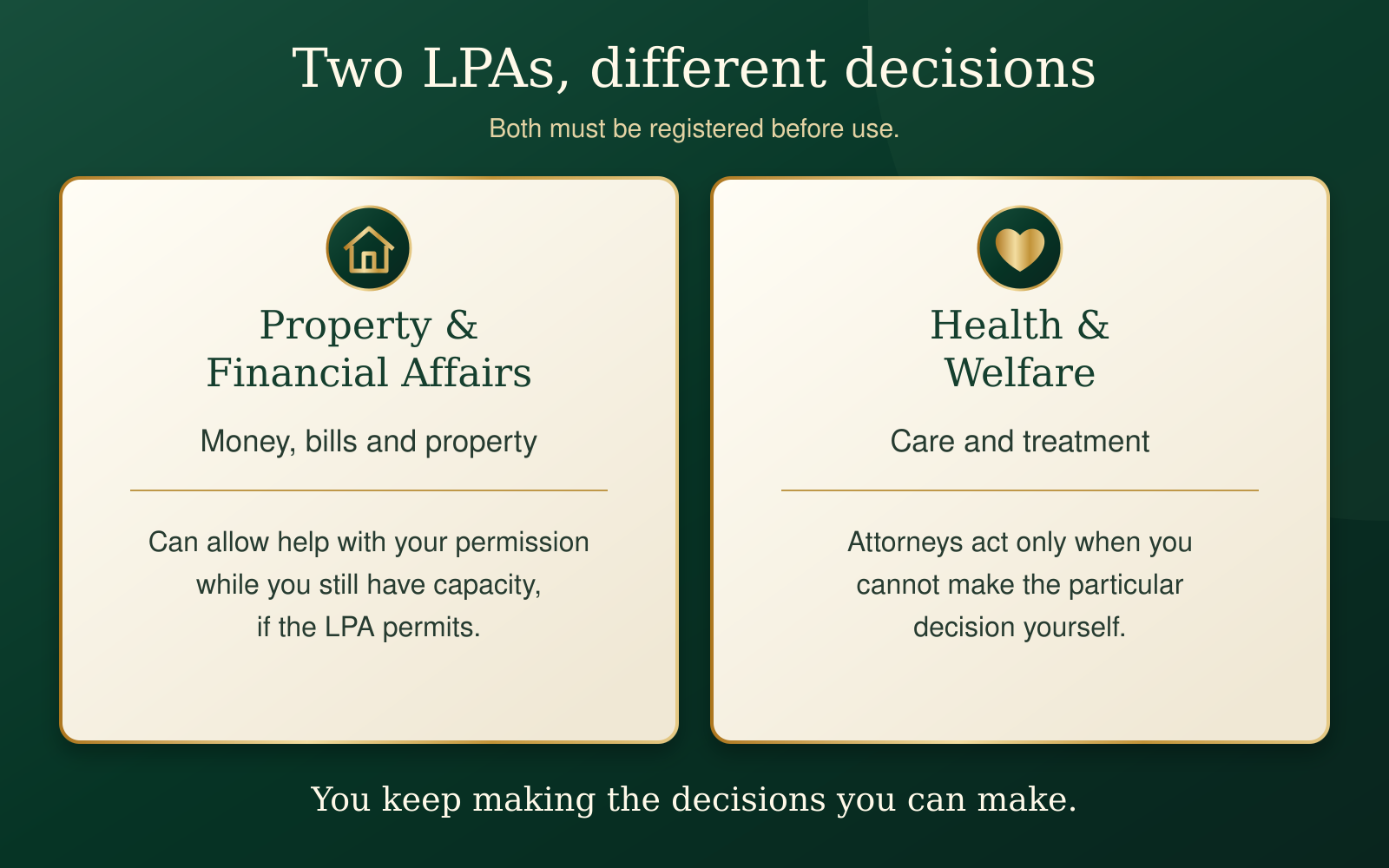
Property & Financial Affairs is about your money and property: paying bills, dealing with savings and managing your home. Once registered, it can let an attorney help with your permission while you still have capacity, if the LPA allows. Health & Welfare is about your care and treatment. That attorney can act only when you cannot make the particular decision yourself.
Is this guide for you?
Perhaps you are sorting out your own paperwork, helping a parent, or wondering what a recent diagnosis means. Start with the question that is on your mind. You do not need to understand every legal term before taking the next step.
How this can help in real life
Imagine recovering at home after a car accident. You can still decide what to do, but sorting out bills and banking is more than you want to manage just then. A registered Property & Financial Affairs LPA, set up to allow help with your permission, could let someone you trust do that work for you. You would still make the decisions you could make. This is an illustration, not a client case history.
If words such as donor, certificate provider or jointly and severally get in the way, our guide What Does That Mean in a Will or LPA? explains them in ordinary language.

The questions are grouped by topic, so you can read straight through or go to the part that concerns you.
Family and relationships
1. Do spouses automatically have power of attorney?
No, even if you have shared a home and managed family life together for years. Marriage or civil partnership does not automatically let one of you manage the other’s sole finances or make health decisions for them. An LPA records who you want to have that authority, and when they may use it.
2. What happens if I do not have an LPA?
For money matters, your family may need to ask the Court of Protection to appoint someone to act if you lose capacity. The court decides who can act and what they can do. That can mean waiting, court and supervision fees, a security bond and, sometimes, professional costs. Care and treatment work differently: professionals can often make decisions in your best interests, involving people close to you, without a welfare deputy. An LPA gives you the chance to choose your own attorneys in advance.
3. Does a Will override an LPA?
Your Will and your LPA have different jobs. The LPA helps during your lifetime and ends when you die. Your Will deals with what happens afterwards, when your executors or other personal representatives deal with your estate. Having one is a good reason to check the other is in place too.
4. Is being next of kin enough?
“Next of kin” may tell a hospital whom to contact, but it does not give that person authority to manage your money or consent to treatment for you. Their knowledge of you still matters. If you cannot decide and there is no authorised health attorney, clinicians can make treatment decisions in your best interests, taking account of your wishes and consulting appropriate people. An applicable advance decision to refuse treatment must also be respected.
5. Can my children just decide together?
They can talk things through and explain what matters to you. But even if they all agree, being your children does not give them legal authority to act. If you want one or more of them to be your attorneys, an LPA puts that choice in writing and sets out how they should work together.
Money and property
6. What is the difference between the two LPAs?
Think of paying the electricity bill and deciding where you should receive care. They belong to different parts of your life. Property & Financial Affairs covers matters such as banking, bills, investments and property; Health & Welfare covers care, daily routines and treatment. One cannot do the other’s job. You can choose the same people for both, or different people whose strengths suit each role.
7. How long does registration take?
Plan in weeks, not days. The OPG’s dedicated registration guide currently estimates 8 to 10 weeks if there are no mistakes. Queries or objections can add time, so that is an estimate rather than a promised date. If you are arranging an LPA because help may soon be needed, raise the timing early; registration cannot be relied on as an emergency fix.
8. What fees should I expect?
There are two separate costs to understand: the OPG’s registration fee for each LPA and any professional fee for help preparing it. Fern collects the OPG fee separately from its own fee and manages registration. Depending on your income or benefits, you may qualify for a reduction or exemption. You can find our current charges on Services & Fees.
9. Does a joint bank account remove the need for an LPA?
A joint account may help with everyday household spending, but it does not give either of you authority over all of the other’s finances. If one holder loses capacity, what can continue depends on the account arrangements and the bank’s requirements. An attorney needs to establish their authority with the bank and use the access it provides. Sharing a password or logging in as the account holder is not the right way to do that.
10. Can attorneys sell my house?
They may be able to under a Property & Financial Affairs LPA, provided the sale is within their authority and in your best interests. It is a decision about your home, not simply another signature. Joint ownership or a conflict of interest can mean extra legal steps are needed. Before making plans, read our guide to selling jointly owned property with an LPA and check the arrangements for the property concerned.
11. Can attorneys make gifts with my money?
An LPA does not give someone a free hand to give your money away. Limited gifts may be allowed on customary occasions, such as a birthday, to people related or connected to you, and certain gifts to charities may be allowed too. The value must be reasonable in your circumstances, and the LPA may restrict gifts further. Anything outside the permitted powers needs Court of Protection authority. A large gift or inheritance-tax plan is a reason to seek advice before money changes hands.
12. Can an LPA cover my business interests?
It can, but it is worth thinking beyond the family bank account. The person you trust with household bills may not be the right person to handle business decisions. A Property & Financial Affairs LPA can cover business affairs within its scope, and a separate business LPA may be useful. What can be delegated depends on the business structure and its own arrangements. We can discuss the LPA planning and identify where specialist business advice is needed.
Health and welfare
13. Can attorneys make medical treatment decisions?
A Health & Welfare attorney can give or refuse consent to treatment when the registered LPA gives them that authority and you cannot make the particular decision yourself. Their job is to act in your best interests, within the law and the LPA. If you also have an advance decision to refuse treatment, the documents need to be considered together: their wording and timing can affect which takes priority.
14. Can they decide about life-sustaining treatment?
Only if you specifically give them that authority in your Health & Welfare LPA. This deserves a proper conversation, including what matters to you and what you would want your attorneys to understand. They must act in your best interests and work with the clinical team. They cannot insist on treatment that clinicians consider inappropriate.
15. Can an LPA influence care-home choice?
Yes. If you cannot make the decision yourself, a Health & Welfare attorney may be able to decide where you live. Knowing that you want to stay near your friends, for example, can help them understand your wishes. They must weigh those wishes alongside your needs, your best interests and the care and funding options actually available. The LPA cannot guarantee a particular place.
16. What if I am physically unable but mentally alert?
You remain the decision-maker. If illness or injury makes paperwork or banking difficult, a registered Property & Financial Affairs LPA can let your attorney help with your permission, where its terms allow. Needing physical help does not, by itself, allow a Health & Welfare attorney to take over choices you can still make.

Capacity and timing
17. Is it too late after a dementia diagnosis?
A diagnosis does not automatically mean it is too late. The question is whether you can understand and make the decision to create an LPA at that time, with appropriate support. People’s circumstances differ, so please raise it promptly rather than assume the opportunity has gone. We can discuss what needs to be considered and whether further assessment would help.
18. Do LPAs expire or need renewing?
There is no routine renewal date. But “still registered” does not necessarily mean “still right for you”. An LPA ends when you die and can end earlier, for example if it is revoked or changes affect the attorneys. A bereavement, separation or major change in family or financial circumstances is a sensible prompt to check that the document still works and the people named can still act.
19. Can I change or cancel an LPA?
Yes, provided you have capacity to make the relevant decision. You can revoke an LPA, and many changes to the arrangements require a new one. A change of address can usually be reported to the OPG without replacing the document. Do not write amendments on a registered LPA. If you are looking at an older one and wondering whether it still does the job, an LPA MOT can help identify what needs attention.
20. Can I wait until I lose capacity?
You need capacity when you make the LPA, so waiting until you have lost it can leave you unable to make one at all. Registration is a separate step: an attorney can register a validly made LPA later, including after you lose capacity. But it cannot be used until registration is complete. My recommendation is to deal with registration promptly, so unfinished paperwork does not become another problem when help is needed.
Choosing your attorneys
21. Can I appoint more than one attorney?
Yes. “Jointly” means your attorneys must agree together; “jointly and severally” lets them act together or separately. You can also use different arrangements for different decisions. It may feel reassuring to require everyone to agree, but think about the practicalities if one person is away or cannot continue. We can talk through the trade-offs. Appointing Attorneys in a Lasting Power of Attorney explains the choices in more detail.
22. What if an attorney dies or cannot act?
This is where replacement attorneys can make a real difference. You name them in advance to step in when the circumstances in the LPA allow. Whether your other original attorneys can carry on depends on how they were appointed. With joint appointments, losing one attorney can prevent the others from acting on those joint decisions. Check the backup arrangements when making the LPA, rather than leaving your family to discover a gap later.
23. What safeguards protect me from misuse?
Start with the people. Choose someone you trust to listen, keep records and put your interests ahead of their own, even when the job is inconvenient. The law also places duties on attorneys: they must support your own decision-making, follow the Mental Capacity Act 2005 and act in your best interests. Clear arrangements and records help, but no document removes every risk. Concerns can be reported to the OPG, and the Court of Protection can intervene or remove an attorney.
24. Who checks what attorneys are doing?
The OPG can investigate concerns and ask for information. It does not check and approve each decision an attorney makes simply because the LPA is registered. Attorneys should keep a record of significant decisions and, for financial matters, accounts and supporting evidence. Being able to explain what they did, why they did it and where the money went is part of the role.
25. Can I choose a professional attorney?
Yes. A professional appointment may be worth considering if you do not have someone suitable, or the work needs particular expertise. Be clear about the charges and the authority to charge before making the appointment. A Health & Welfare attorney must be an individual; a trust corporation can act only for property and financial affairs. We can help you think through the kind of appointment that fits your circumstances.
If you or an attorney lives abroad
Living abroad does not automatically rule either of you out. Neither you nor your attorney has to be British or live in the UK. This guide is about England and Wales, though, and whether an LPA will be recognised overseas depends on the country and organisation concerned. Think about time zones, identity checks and how someone would deal with urgent practical tasks from a distance. Having a willing UK-based attorney alongside a relative abroad may help, but it is not compulsory. Report later address changes to the OPG rather than altering the registered document.
Practical questions
26. Do LPAs need witnesses and a certificate provider?
Yes. You and your attorneys have signatures that need witnessing, and a certificate provider has a separate safeguarding role. They confirm that you understand the LPA and are making it freely, without pressure or fraud. The right people need to sign in the right order. This is a stage to take steadily: Fern guides clients through it to reduce avoidable errors and delays.
27. Can I make an LPA online?
You can use the official online service to prepare an LPA yourself. Under the current process, it still needs to be printed, signed and registered. Professional help is optional. Where it can be useful is in talking through whom to appoint, checking that the arrangements fit together and avoiding wording or signing problems. If you choose Fern, we prepare the LPAs with you and manage registration.
28. Can I restrict what my attorneys do?
Yes. Instructions are binding; preferences tell your attorneys what you would like them to consider. For example, a wish to stay close to friends may help them understand what matters to you. Detailed restrictions need care, because unclear or conflicting wording can make an LPA difficult to use. We can help you express the important choices without accidentally preventing useful help.
29. Can an attorney change my Will or give away my estate?
Your attorney cannot use an LPA to write or change your Will for you, and cannot give away your assets freely. A financial attorney may deal with tax matters within their authority, but the limits on gifts still apply. Some decisions need the Court of Protection’s approval. If the aim is to pass assets to family or reduce inheritance tax, get advice before acting; the LPA alone is not permission to carry out that plan.
30. Are LPAs only for older people?
Anyone aged 18 or over with the required capacity can make one. You do not need to be retired or unwell. An accident or illness can disrupt life at any age, and planning ahead lets you choose who could help while you have the time and freedom to decide. It is a practical piece of adult paperwork, alongside your Will.
Once your LPA is registered
Put the registered document somewhere safe, and tell your attorneys where to find it. When they need to act, banks and other organisations will need evidence of their authority and will check identity and how they were appointed. An online LPA access code may provide that evidence where available and accepted; paper evidence may be needed instead. Registration is the start of having a usable plan, so make sure the people involved know what to do next.
Take the next step
A useful starting point is one simple question: who would you want beside you if managing things became difficult? Then think about what you would want that person to know about your money, your care and the way you like to live.
You do not need every answer before getting in touch. At Fern Wills & LPAs, we can talk through the choices, prepare your LPAs and guide you through signing and registration. If you already have LPAs, we can discuss whether a review would be useful.
Contact Fern Wills & LPAs to talk about your circumstances. Our current charges are on Services & Fees.
This article is general information only, not individual advice.