Can an Attorney Sell Jointly Owned Property under an LPA

Last verified: August 2026 (England & Wales)
Quick-read summary
A registered Property and Financial Affairs Lasting Power of Attorney (LPA) can allow an attorney to act for a joint property owner who has lost capacity. It does not, however, mean that one remaining owner can always complete a sale alone.
Joint registered owners hold the legal title as trustees. Where a sale involves capital money, the property transaction normally needs the appropriate two-person trustee structure. One person cannot usually satisfy that requirement simply by signing once as the continuing owner and again as attorney for the other owner.
Depending on the LPA, the property title and who is available to act, the solution may be another original attorney who is already authorised to act, a separately appointed additional trustee, or in some cases an application to the Court of Protection. The conveyancer dealing with the sale should confirm the correct property-law route.
For the wider LPA position, read our Property & Financial Affairs LPA guide.
The legal issue is not just the LPA
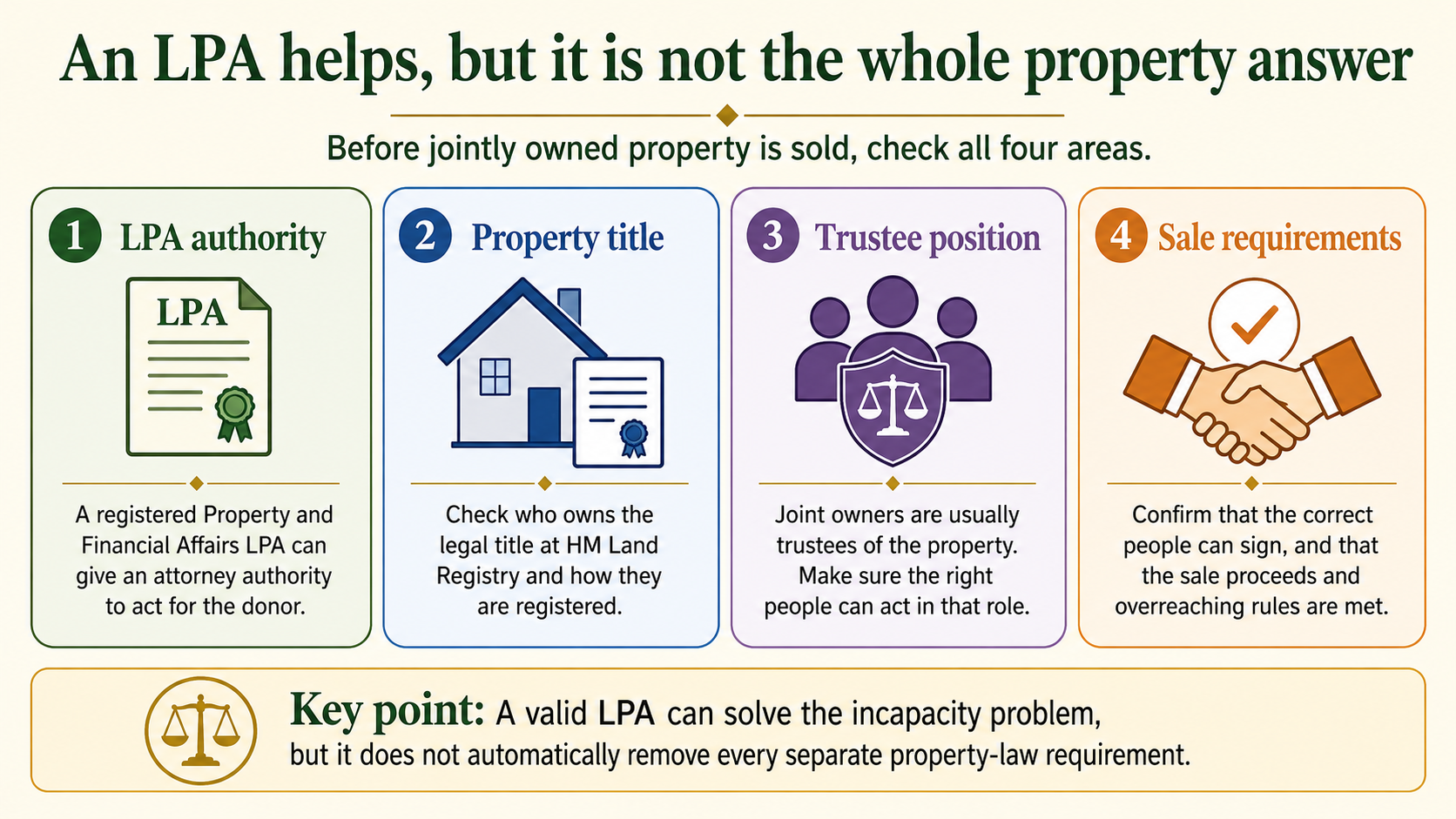
An LPA and a property title perform different jobs.
- The LPA determines whether an attorney can make decisions and sign on behalf of the person who has lost capacity.
- Property and trust law determines who holds the legal title, who can act as trustee and whether the sale proceeds can be received in the required way.
A valid registered LPA is therefore important, but it does not remove the separate legal requirements that apply to jointly owned property.
What happens if one joint owner loses capacity?
The right route depends on the registered LPA, the property title, the beneficial ownership and the people available to act. The conveyancer handling the sale will normally check those points before deciding what is needed.
1. Another original attorney may be able to act
If more than one original attorney was appointed, the conveyancer will need to check how they are authorised to act. An attorney appointed jointly and severally may be able to sign for the owner who has lost capacity while the continuing co-owner signs in their own capacity. If the attorneys were appointed jointly, they must act together and the conveyancer will need to confirm how the transaction should be executed. The exact position depends on the LPA and the property title.
2. An additional trustee may be appointed
Where the ordinary attorney arrangement does not provide the required two-person structure, an additional trustee can often be appointed if the statutory route is available. This is a separate property and trust-law appointment. It is not an amendment to the LPA and the additional trustee is not being appointed as another attorney.
In a straightforward case, this is usually something the conveyancer can deal with as part of the sale. More unusual titles, trusts or family circumstances may require specialist advice or a court application.
3. The Court of Protection may be needed
A Court of Protection application may be needed where there is no workable attorney or trustee appointment route, where the person who lacks capacity is the only surviving trustee, or where the circumstances require the court to appoint or replace a trustee or give other authority.
The important point for families is that a valid LPA can solve the decision-making problem without necessarily solving every separate property-law requirement.
Why appointing each other as sole attorneys may not solve the problem
A common arrangement is for spouses or partners to own their home jointly and appoint each other as sole attorneys.
That can work well for banking, bills and many property decisions. It may still leave a difficulty if one owner loses capacity and the property later needs to be sold.
The remaining owner may then be both one of the property trustees in their own right and the sole attorney for the other owner. That does not normally allow the same person to provide the required two-person trustee structure simply by signing in both capacities.
The LPA has not failed. The difficulty arises because the sale must satisfy both the attorney rules and the separate property and trustee requirements.
Why a replacement attorney is not a spare signature
Replacement attorneys are important, but their purpose is continuity if an original attorney can no longer act. They are not temporary stand-ins for a single transaction while the original attorney remains able to act.
- A replacement attorney normally steps in only when the original attorney they are replacing has permanently stopped being able to act under the LPA, for example because of death, loss of capacity, disclaimer or another recognised terminating event.
- They do not become active merely because a property transaction needs another person.
- They cannot simply step in for the sale and then step back out while the original attorney continues unchanged.
There is, however, an important practical distinction. A person who happens to be named as replacement attorney may also be a sensible candidate to become an additional trustee for the property sale. If that happens, they act because they have been separately appointed as trustee. Their replacement-attorney appointment gives them no special trustee authority and does not need to be activated for that purpose.
For the wider choices around original and replacement attorneys, see Appointing Attorneys in a Lasting Power of Attorney.
How this can work in real life
Mr and Mrs Cole owned their home jointly. Mrs Cole had made a registered Property and Financial Affairs LPA appointing Mr Cole as her sole original attorney. Their adult daughter was named as the replacement attorney.
Mrs Cole later lost capacity and the family decided that selling the property and moving her to more suitable accommodation was in her best interests. Mr Cole could not normally complete the sale alone simply by signing once as the continuing owner and again as Mrs Cole’s attorney.
The daughter could not temporarily activate her replacement-attorney appointment because Mr Cole remained able to act as Mrs Cole’s attorney. Instead, if the statutory route was available, the conveyancer could arrange for a suitable additional trustee to be appointed for the property transaction. That additional trustee could happen to be the daughter.
If the daughter was separately appointed as trustee, she would act in that trustee capacity for the sale. Her status as replacement attorney would not be what authorised her to sign, and her replacement-attorney appointment would not have been activated at all.
If the ordinary trustee-appointment route was not available, the conveyancer would identify whether specialist advice or a Court of Protection application was required.
Practical planning checklist
Where jointly owned property is an important part of your affairs, it is worth considering the following when making or reviewing a Property and Financial Affairs LPA:
- Make and register the LPA before it is needed.
- Do not assume that appointing the other joint owner as the sole attorney will solve every future property transaction.
- Consider whether more than one suitable original attorney should be available and whether jointly and severally is appropriate for your circumstances.
- Use replacement attorneys to protect continuity if an original attorney can no longer act, not as an assumed extra signature for a transaction.
- Remember that a suitable additional trustee may sometimes be appointed separately if a property sale needs another person to act.
- Check whether the property title, beneficial ownership, restrictions or existing trusts could affect the route.
- Involve the conveyancer early if a sale is being considered after an owner has lost capacity.
The right attorney structure depends on the people involved, possible conflicts, family relationships and the wider estate plan. Appointing more attorneys is not automatically better, but joint property ownership is a useful factor to consider when deciding how much continuity and flexibility the LPA should provide.
Common questions
Do I automatically need two attorneys if I own property jointly?
No. The key question is whether the right combination of owners, attorneys and trustees will be available for the particular transaction. Having more than one original attorney may help. Attorneys appointed jointly must act together, while attorneys appointed jointly and severally can usually act together or separately. The appropriate structure depends on your circumstances.
Can one person sign once as owner and once as attorney?
For a normal sale involving capital money, one person cannot usually provide the required two-person trustee receipt simply by signing in both capacities. Another authorised attorney or an additional trustee may be needed.
Can a replacement attorney temporarily step in for the sale?
No. A replacement attorney cannot normally act temporarily while the original attorney remains able to act. Replacement attorneys are intended to take over when an original attorney can no longer act under the LPA.
Can the person named as replacement attorney be appointed as trustee?
Potentially, yes. If that person is suitable and the conveyancer confirms that the trustee-appointment route is available, they may be appointed separately as an additional trustee. They then act as trustee, not as an activated replacement attorney.
Is appointing an additional trustee a difficult process?
Often it can be dealt with by the conveyancer as part of the property transaction where the statutory route is available. It is not something Fern Wills & LPAs undertakes as part of LPA preparation. More complex cases may need specialist or Court of Protection involvement.
Does an LPA always avoid the Court of Protection?
No. A well-prepared LPA can avoid many deputyship problems, but it cannot remove every trustee or court requirement. Some property cases genuinely need a Court of Protection application.
Does it matter whether we own as joint tenants or tenants in common?
Yes, the beneficial ownership and what happens on death are different. For the legal title, however, joint registered owners hold the property as trustees. The title, any restrictions and any trust arrangements still need to be checked before a sale.
What if the property is already held under a trust?
The LPA does not override an existing trust. The trustees, the trust terms, the property title and the beneficial interests all have to be considered. The conveyancer or appropriate specialist should advise on the transaction.
Optional technical notes
- All joint registered proprietors hold the legal estate as trustees.
- For a sale involving capital money, the attorney and trustee arrangement must allow the beneficial interests to be properly overreached.
- Where a registered LPA is being used and the ordinary two-person structure is missing, HM Land Registry guidance recognises routes involving another jointly-and-severally appointed attorney or, where available, an additional trustee.
- A deputy may manage a person’s property and financial affairs but does not automatically acquire the separate trustee authority needed for every property transaction.
Next steps
A Property and Financial Affairs LPA remains an important part of planning for jointly owned property. The key is to choose an attorney structure that is practical for your family while recognising that a future property sale may also involve separate trustee and conveyancing requirements.
Fern Wills & LPAs can help you:
- choose a practical attorney structure;
- prepare or review your Property and Financial Affairs LPA;
- coordinate the estate-planning position with your Will; and
You can also review our Lasting Powers of Attorney fixed-fee service. This article is general information only, not individual advice. If you’d like help applying this to your circumstances, we can guide you through the options.