Common law marriage "myth"
Last verified: 22 October 2026 (England and Wales)
You may own a home together, share bills, raise children and be seen by everyone around you as a committed couple. Friends and family talk about you as “basically married”.
Living together does not make you married in law. In England and Wales, an unmarried partner has no automatic entitlement under the intestacy rules when you die without a valid Will. There is no seven-year rule that changes this.
That does not mean every asset is lost to the survivor. A jointly owned home may pass automatically, and a partner may have a possible claim against the estate. But neither is a substitute for making your wishes clear.
A suitable Will, checked alongside your home ownership and family circumstances, can help you provide for your partner and protect an intended inheritance for your children.

What happens if an unmarried partner dies without a Will?
The intestacy rules decide who receives the estate. A partner who is neither your spouse nor your civil partner is not included simply because you live together. Having children together does not change that position for your partner.
Your children may inherit under those rules, but that does not give your partner ownership of their inheritance or a secure right to remain in your home. An outdated Will can cause a similar problem if it leaves too little to the person now sharing your life.
If either of you is still legally married to someone else, raise this at the outset. Separation alone does not end a marriage, and an existing spouse may retain inheritance rights. See Divorce and your Will for that separate planning question.
Your Will and your home need to work together
A Will lets you choose beneficiaries and appoint executors to deal with your estate. It only controls assets that pass under it, so the way you own your home matters.
Joint tenants: on death, your interest normally passes automatically to the surviving joint owner. You cannot leave that interest to someone else in your Will.
Tenants in common: each owner has a share that can pass under their Will. Without a valid Will covering it, the intestacy rules apply to that share.
Sole ownership: if the home belongs to one partner alone, the other should not assume that living there gives them ownership or a lifelong right to stay. Any separate ownership claim needs legal advice.
The useful question is: “Would the survivor have both somewhere to live and enough money to manage?” Check the mortgage, household costs and available cash alongside the Will. Ownership arrangements should be reviewed before relying on a home-based trust.
Inheritance Tax: unmarried couples have different rules
Leaving assets to an unmarried partner does not qualify for the spouse or civil-partner exemption. Unused Inheritance Tax allowances cannot be transferred between you simply because you are a couple.
The standard Nil Rate Band is currently £325,000. Inheritance Tax is normally charged at 40% on the taxable amount above the available allowances, after relevant exemptions and reliefs. This is an estate calculation, not a separate £325,000 allowance for every beneficiary. Earlier gifts can affect what remains available.
A home passing automatically to a surviving joint owner is not automatically free of Inheritance Tax. Legal ownership and tax treatment are separate questions.
The Residence Nil Rate Band can add up to £175,000 where a qualifying home passes to direct descendants and the other conditions are met. It is not an extra allowance for leaving a home to an unmarried partner. Your partner’s children do not become your qualifying stepchildren just because you live together, although another qualifying relationship, such as adoption, may apply.
The amount can also be reduced for larger estates. Our Residence Nil Rate Band guide explains the conditions in more detail. Ask for individual tax advice where the estate, ownership or family position is complex.
Providing for your partner and protecting your children
You may want your partner to feel secure while keeping an eventual inheritance for children, including children from an earlier relationship. Start with that priority, then consider the arrangement and its tax consequences.
For example, if your partner must be able to stay in the home, that need should be reflected in enforceable terms. A hope that trustees will allow it is a different level of protection.
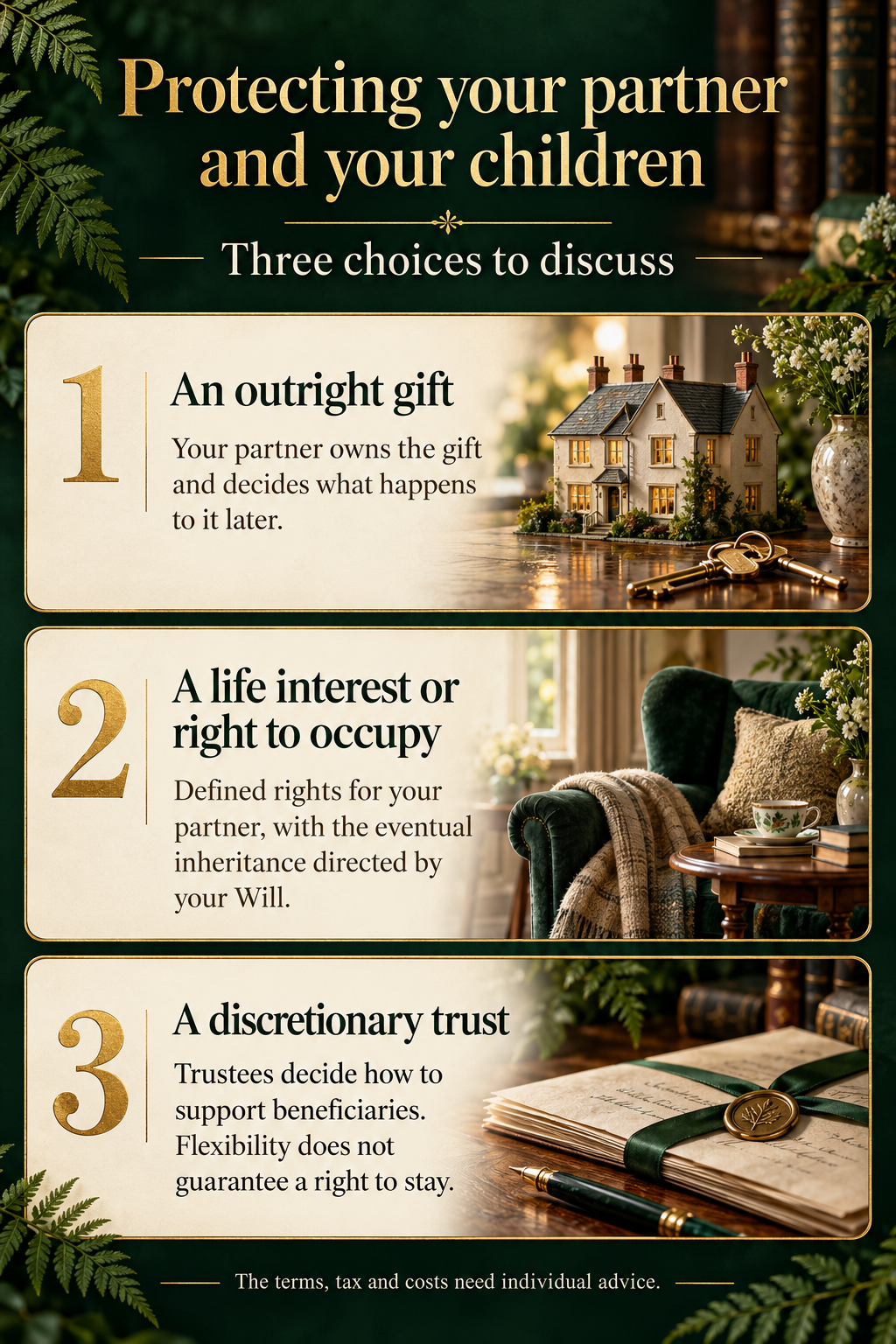
An outright gift
Leaving assets directly to your partner gives them ownership and control. It may be the simplest suitable choice. They can normally spend, give away or leave those assets under their own Will, so your children’s later inheritance is not secured by your wishes alone. The assets also form part of your partner’s own estate.
A life interest or right to occupy
A Will trust can give your partner defined rights, such as income or a right to live in the home, while directing who receives the remaining assets later. The wording needs to deal with matters such as moving home, expenses and when the right ends.
Where the arrangement creates an immediate post-death interest, the underlying assets are generally included in the survivor’s estate for Inheritance Tax. There is no spouse exemption for the initial gift to an unmarried partner, so tax may arise on both deaths, depending on the available allowances and circumstances.
first-death Residence Nil Rate Band should not be assumed simply because children will inherit after the partner’s interest ends. Their eventual inheritance does not make them the immediate beneficiary.
A discretionary trust
Trustees decide which beneficiaries to help, when and how, within the Will’s terms. They may be able to allow a partner to occupy a property, but being a potential beneficiary does not itself guarantee that right. A letter of wishes guides trustees; it does not bind their decisions.
A properly structured discretionary trust may keep assets outside the survivor’s personal estate. A Nil Rate Band Discretionary Trust uses the available Nil Rate Band; it does not create a new allowance or a guaranteed tax saving. The trust must actually be funded and managed after death.
There can be ten-year and exit charges, other taxes, registration duties and ongoing professional costs. Read Nil Rate Band Discretionary Trusts and Will trust costs and administration before weighing the benefits against the responsibilities.
No trust is automatically best for every unmarried couple. A reassuring name such as “property protection trust” does not tell you what rights it gives or how it is taxed. Those depend on its terms.
Can a surviving partner claim against the estate?
A qualifying partner may ask the court for reasonable financial provision under the Inheritance (Provision for Family and Dependants) Act 1975, whether there is a Will or not.
The cohabitant route generally requires living in the same household as if married or civil partners throughout the two years immediately before death. A separate route may apply to someone substantially maintained by the deceased immediately before death. Children and people treated as children of the family have their own eligibility categories.
Eligibility is not a guaranteed award. For an unmarried partner, the provision is assessed by reference to reasonable maintenance in the circumstances. If a death has already occurred and provision is inadequate, seek specialist advice promptly because time limits apply.
Banfield v Campbell: why an old Will can fall short
Mrs Campbell’s Will left £5,000 to Mr Banfield, described as her friend, with the residue left to her son subject to reaching 25. The Will dated from an earlier stage of the relationship.
After her death, Mr Banfield claimed that it did not make reasonable financial provision for him. The court accepted his eligibility despite a dispute about their relationship and evidence that they slept separately because of his health.
The property was ordered to be sold. Mr Banfield received a life interest in half the net sale proceeds to provide accommodation, rather than an outright capital payment. This addressed his housing needs while preserving capital for her son.
The practical lesson is to review your Will as a relationship develops, rather than leaving your partner and children to resolve competing needs after your death.
Case summary based on Banfield v Campbell [2018] EWHC 1943 (Ch).
Children, guardians and funeral wishes
Parental responsibility means the legal rights and responsibilities involved in caring for a child. Check who holds it in your family. A parent with parental responsibility can appoint a guardian in their Will, but when that appointment takes effect depends on the surviving parent’s position and any relevant court order. Naming someone does not automatically displace a surviving parent with parental responsibility.
Our Guardianship guide explains the planning considerations. Discuss your choice with the proposed guardians and consider how the children’s financial support will be arranged.
An unmarried partner does not gain priority over funeral arrangements simply by being described as next of kin. Appointing suitable executors and sharing your funeral wishes can reduce uncertainty. Funeral wishes are generally not legally binding, so talk to those who would be involved as well as recording your preferences.
What if one of you needs care?
Care funding has separate rules. In England, the home must normally be disregarded in the care-home financial assessment while a qualifying partner who is not estranged continues to occupy it as their main or only home, having done so since before the move into care. This protection can apply to unmarried partners; it is not merely a discretionary concession.
Wales has its own charging rules. Seek advice on the relevant assessment and your circumstances. A Will trust should not be presented as a guaranteed way to avoid care fees.
We have mirror Wills. Is that enough?
Mirror Wills often reflect similar wishes, but each remains a separate Will. If you leave everything outright to each other, the survivor can normally change their own Will later. Check whether that meets your wishes for children from earlier relationships.
Does making a Will remove Inheritance Tax?
No. A Will can direct your estate and support suitable planning, but leaving assets to an unmarried partner does not create the exemption available between spouses or civil partners.
Should we review our Wills if we decide to marry?
Yes, before the ceremony. Marriage or civil partnership normally revokes an existing Will unless it was properly made in contemplation of that particular marriage or civil partnership. Review the arrangements when you separate or your family circumstances change too.
Take the next step
Begin with three questions: who should inherit, where should the survivor live, and what should eventually pass to your children? Bring your existing Wills and any home-ownership paperwork to the discussion.
Fern Wills & LPAs can help you review your wishes, explain suitable Will-planning options and identify where specialist tax or legal advice is needed. Ongoing trust administration and contentious estate claims require appropriate specialist support.
Contact Fern to discuss your circumstances. For current fees, please see Services & Fees.
This article provides general information for England and Wales. The right arrangements depend on your circumstances and require individual advice.