A Will Has Been Found: Executor First Steps Before Probate
Last verified: July 2026 — England & Wales
Finding a Will after someone has died is an important step, but it is not the same as being ready to distribute the estate.
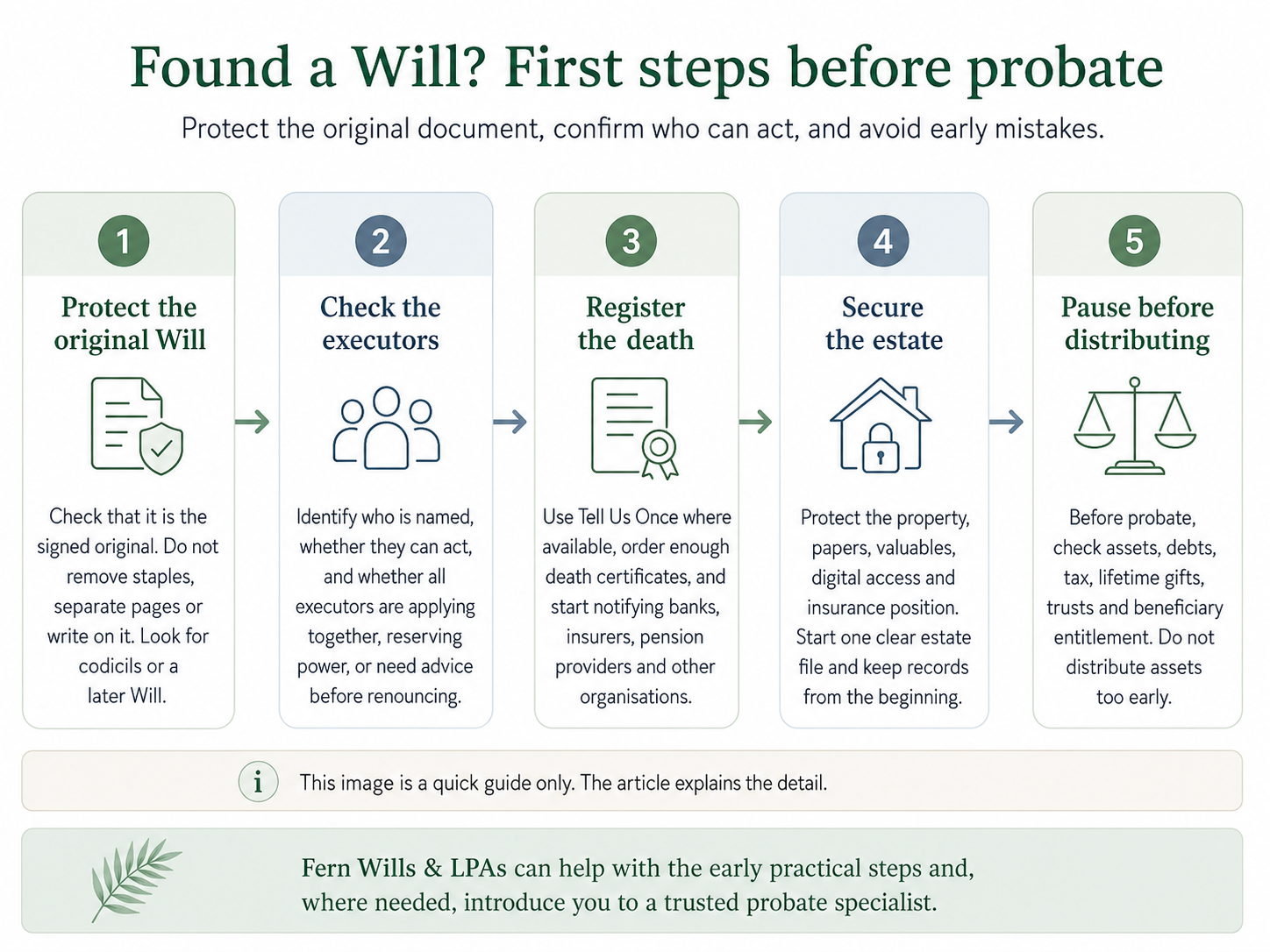
The first job is to slow down, protect the original document, check who is allowed to act, and work out what needs to happen before probate.
This guide is for family members, named executors and close relatives who have found a Will and need a practical first route through the early stages.
It is not a full probate manual, and it does not cover contested probate in detail. It is a first-steps guide to help you avoid the common mistakes that cause delay, conflict or avoidable risk.
If the estate involves tax, trusts, missing documents, disagreement or uncertainty about who can act, it is safer to pause and take advice before making irreversible decisions.
Quick answer
If a Will has been found, do these first:
- Check whether it is the signed original Will, not just a copy.
- Do not remove staples, bindings or covers.
- Look for codicils or any later Will.
- Identify the named executors.
- Check whether all executors can and want to act.
- Secure the Will and keep a clear note of where it was found.
- Register the death and use Tell Us Once where available.
- Order enough death certificates.
- Secure the home, paperwork, digital access and valuables.
- Avoid distributing assets until authority, assets, debts, tax and beneficiaries are clear.
The safest early approach is simple: preserve evidence, keep records, and avoid rushing irreversible decisions.
First: is it the original Will?
For probate, the original signed Will matters.
A photocopy, scan or draft may be useful evidence, but it is not the same as the original document. If probate is needed, the Probate Registry will normally require the original Will.
Check carefully whether the document is:
- signed by the person who died;
- signed by two witnesses;
- dated;
- complete;
- stapled, bound or otherwise held together;
- accompanied by any codicils;
- marked “copy”, “draft” or “unsigned”;
- stored with any covering letter or storage certificate.
If you have only found a copy, do not assume the estate can simply proceed under it. A missing original Will can create a legal and evidential problem.
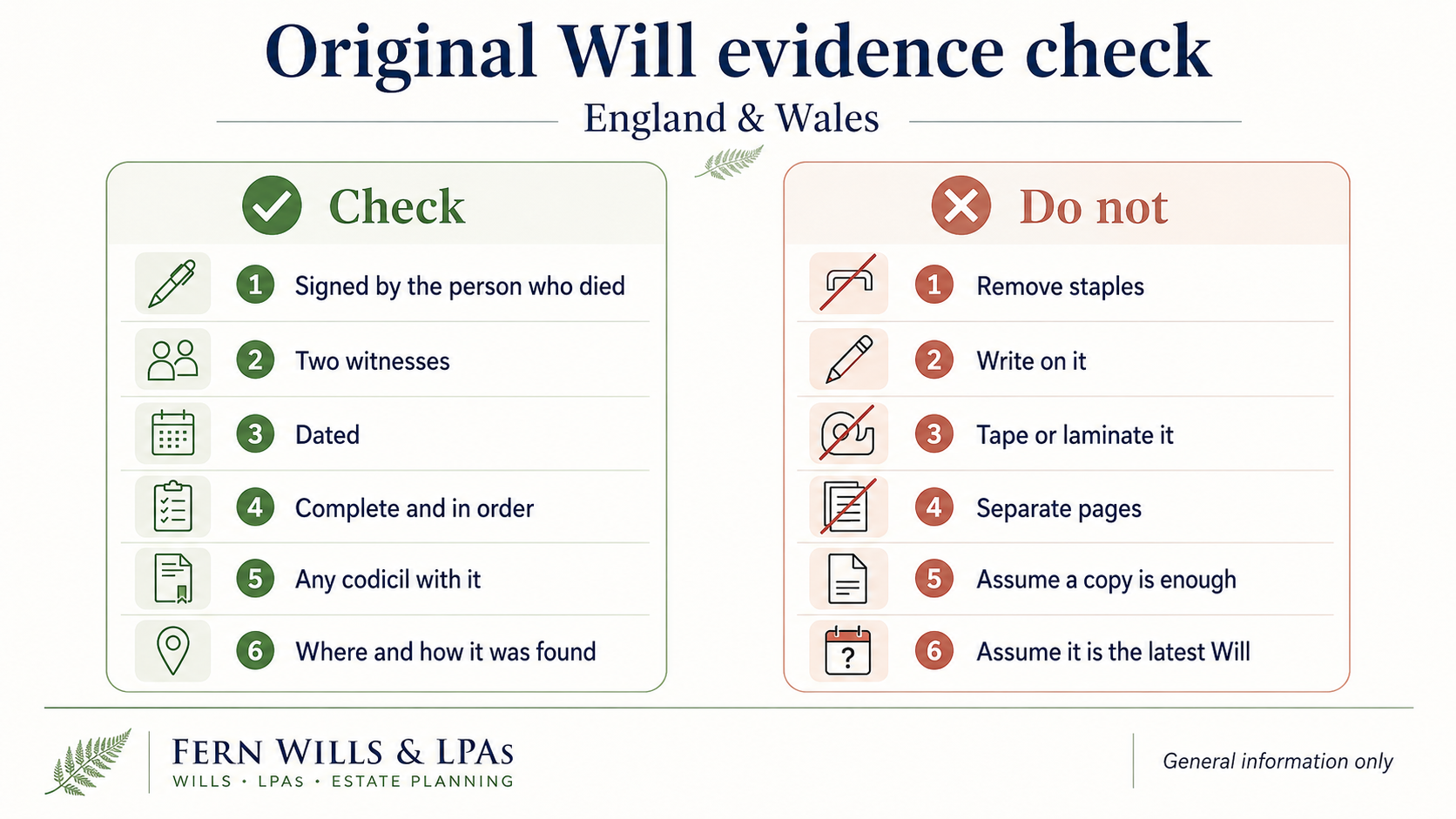
Before probate, the original Will should be preserved, checked and kept intact.
Do not alter, unstaple or mark the Will
Treat the original Will as evidence.
Do not:
- remove staples;
- separate pages;
- add notes to it;
- write on it;
- attach sticky notes directly to it;
- laminate it;
- repair it with tape;
- hole-punch it;
- scan it through a feeder if that risks damaging it.
If a Will has been taken apart, damaged or altered after signing, it can cause questions later. The issue is not just neatness. It may raise questions about whether anything was removed, replaced or changed.
If you need copies, take photographs or scans without changing the physical document.
Record where and how it was found
Make a simple note straight away.
Record:
- the date the Will was found;
- who found it;
- where it was found;
- whether it was in an envelope, folder, safe, drawer, solicitor’s packet or storage service;
- whether anything else was with it;
- whether the Will was already damaged, loose, unstapled or marked;
- who has taken custody of it.
This is especially useful if there is later uncertainty about whether the Will is the last valid Will, whether it was stored properly, or whether another document may exist.
You do not need to turn this into a legal statement at this stage. Just keep a clear factual record.
Check for codicils
A codicil is a formal document that changes or confirms part of a Will.
It may change executors, gifts, funeral wishes, guardians, beneficiaries or other provisions. It may be short, but it can still be important.
Look for codicils:
- attached to the Will;
- stored in the same envelope or folder;
- mentioned in a covering letter;
- held by the Will writer, solicitor or storage provider;
- referred to in later correspondence;
- listed on a storage certificate.
Do not assume the Will is complete until you have checked whether any codicil exists.
Check whether there is a later Will
The Will you found may not be the latest one.
Look for clues such as:
- a later date on another Will;
- letters from a Will writer or solicitor;
- a storage certificate;
- National Will Register search results;
- a later Letter of Wishes referring to a newer Will;
- divorce, remarriage, separation or major life changes after the Will date;
- family members saying the person “updated everything” later.
If there is any doubt, pause before applying for probate or distributing assets.
A later valid Will may revoke the earlier one. Acting on the wrong Will can create serious problems.
Identify the executors
The Will should name the executors.
Executors are the people appointed to deal with the estate. They are not automatically the same as the beneficiaries.
Check:
- who is named as executor;
- whether any substitute executors are named;
- whether any named executor has died;
- whether any named executor lacks capacity;
- whether any named executor is unwilling to act;
- whether the wording appoints people jointly or in sequence;
- whether a professional executor is named;
- whether the Will creates trusts needing trustees.
Do not assume that the person holding the Will is the person entitled to act.
If there is more than one executor
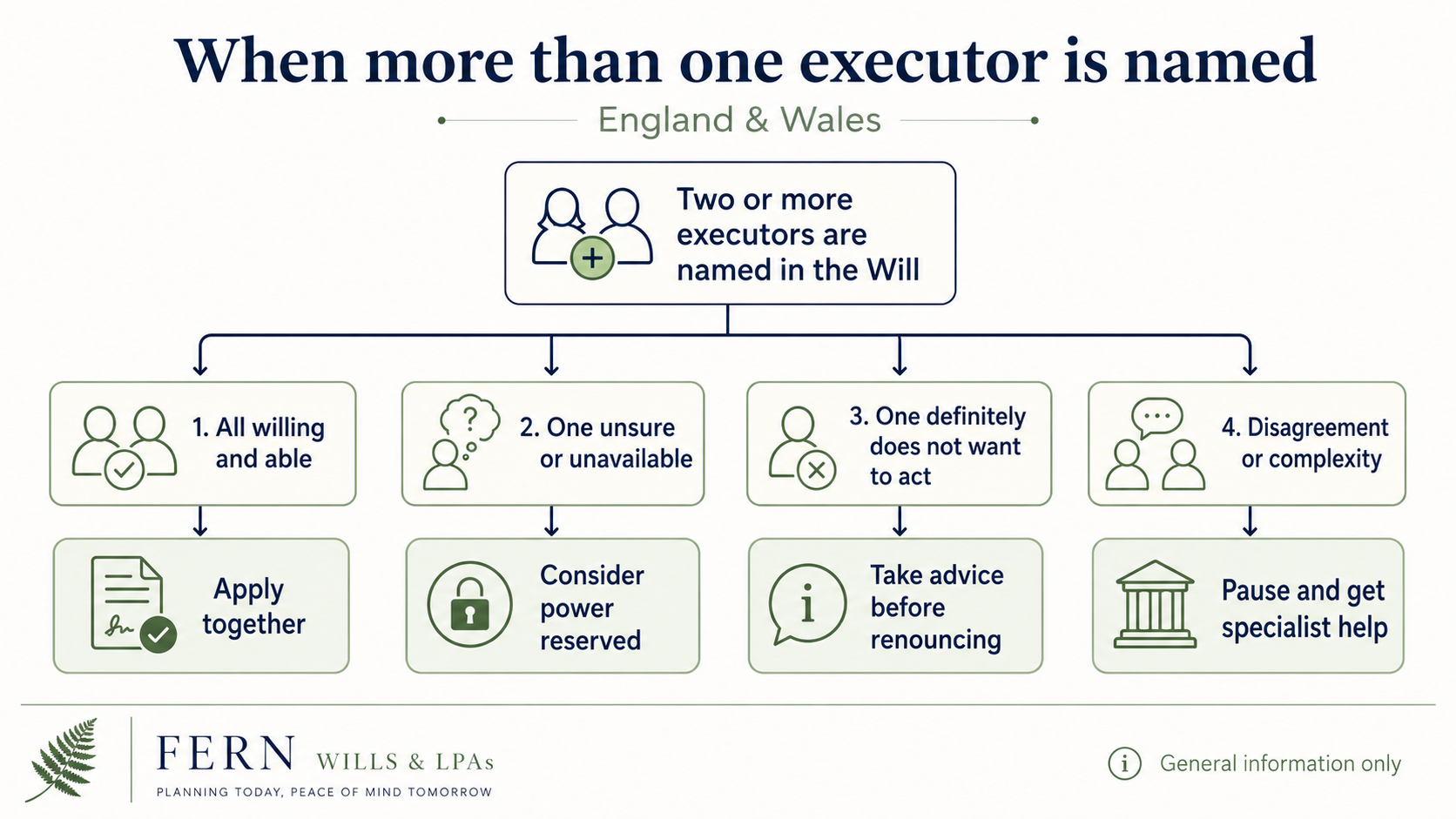
Where more than one executor is named, the executors need to coordinate before probate is applied for.
Common options include:
- all active executors applying together;
- one or more applying while another has power reserved;
- an executor renouncing, if they are sure they do not want to act;
- a substitute executor acting if the Will allows it and the first-choice executor cannot act;
- specialist advice if an executor has died, lacks capacity, is abroad or cannot be contacted.
Do not pressure someone into renouncing. Renunciation is a serious step and is usually intended to be permanent.
If an executor is unsure, it may be safer to pause and take advice before signing anything or taking estate action.
Where more than one executor is named, the first decision is who will act and how.
Do not confuse executor authority with beneficiary entitlement
A common family mistake is to treat the main beneficiary as the person automatically in charge.
That is not always correct.
The Will decides who the executors are. The Will also decides who benefits. These may be the same people, but they do not have to be.
For example:
- a daughter may be executor but not sole beneficiary;
- a spouse may inherit but not be named as executor;
- two siblings may inherit equally, but only one may be appointed executor;
- a professional may be appointed as executor;
- trustees may need to hold funds for children or vulnerable beneficiaries.
Before anyone deals with estate assets, check the Will carefully.
Register the death and use Tell Us Once
The death must be registered before many practical steps can move forward.
Where available, Tell Us Once can notify several government organisations. This can reduce duplication, but it does not notify every private company, bank, pension provider, insurer or utility.
You will still usually need to contact:
- banks and building societies;
- pension providers;
- life insurers;
- utility companies;
- mortgage lenders;
- landlords or managing agents;
- care providers;
- investment providers;
- accountants;
- HMRC where needed;
- subscription and digital providers.
Keep a log of who has been notified, when, by whom, and what reference number was given.
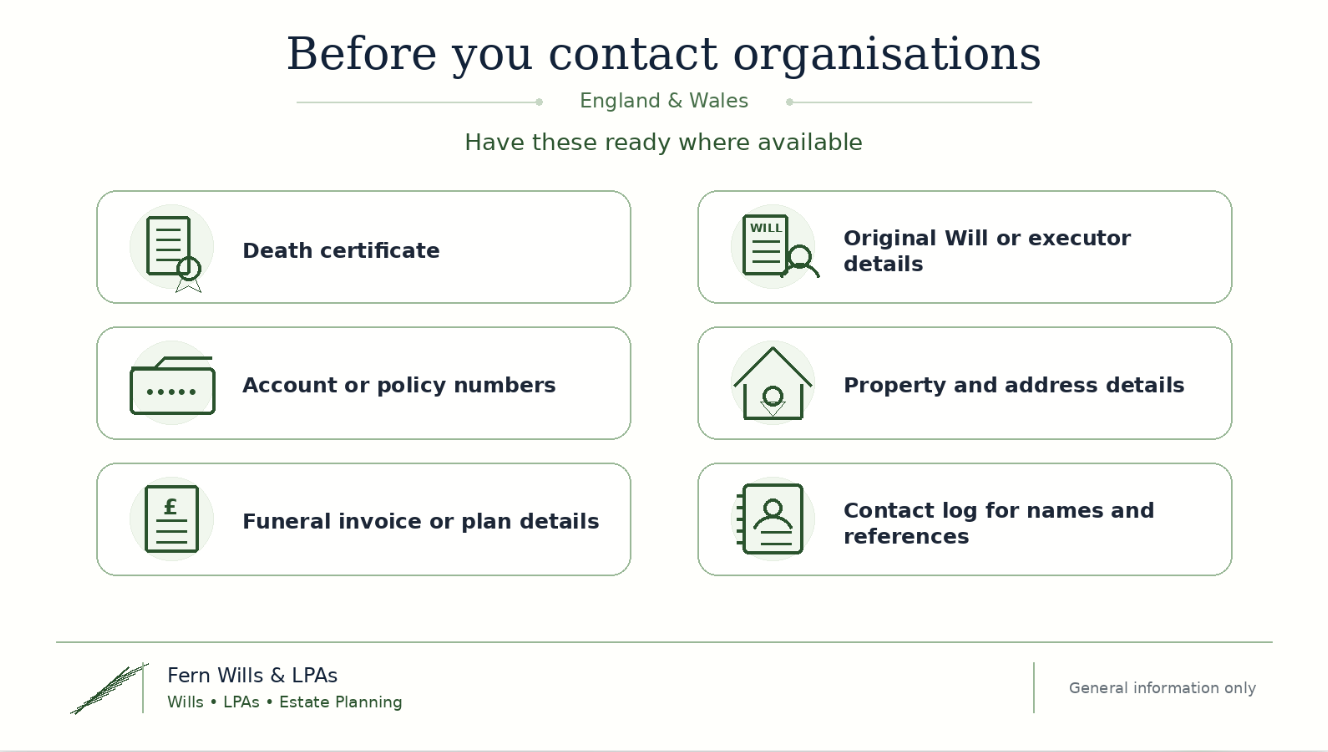
Having the key details ready before calling banks, insurers and providers can reduce repeated calls and missed records.
Order enough death certificates
Executors often need several official death certificates.
Banks, insurers, pension providers and other organisations may ask to see one. Some accept scans or certified copies; others may want an original certificate.
Ordering too few can slow things down. Ordering too many can waste money.
A practical approach is to consider how many institutions need to be contacted and whether they are likely to return originals quickly.
Keep a note of where each certificate is sent.
Secure the property and papers
Before probate, the priority is to protect the estate.
That may include:
- making sure the home is locked and insured;
- checking whether anyone has keys;
- securing jewellery, cash, cards, passports and important documents;
- photographing high-value items if appropriate;
- checking whether there are pets or vehicles needing care;
- redirecting post if needed;
- protecting paperwork from being cleared or thrown away;
- checking whether the home insurance has vacancy conditions.
Do not let well-meaning relatives empty the house too early.
House clearance, gifts of personal possessions and informal “taking what Mum wanted me to have” can create avoidable disputes.
Tell the bank, but do not use the deceased’s card or online banking
After death, the deceased person’s sole bank account should not be used as if they were still alive.
Do not:
- use their card;
- use their online banking login;
- transfer money out casually;
- pay yourself back without records;
- continue subscriptions without checking;
- distribute money to beneficiaries early.
Contact the bank’s bereavement team and ask what they require.
Banks often have their own bereavement process. They may freeze sole accounts, cancel cards, stop direct debits, and explain what they can release before probate.
Joint accounts are different and should be checked separately.
Funeral costs
Funeral costs are often dealt with before probate.
If there is a funeral plan, check the documents. If not, the funeral director may be able to invoice the estate, or the bank may be willing to pay the funeral invoice directly from the deceased’s account.
Avoid paying large sums personally unless you understand how reimbursement will be handled and keep full records.
If several family members are contributing, record clearly whether the money is a gift, a loan, or an expense to be repaid from the estate.
Start an estate file
Create one clear file from the beginning.
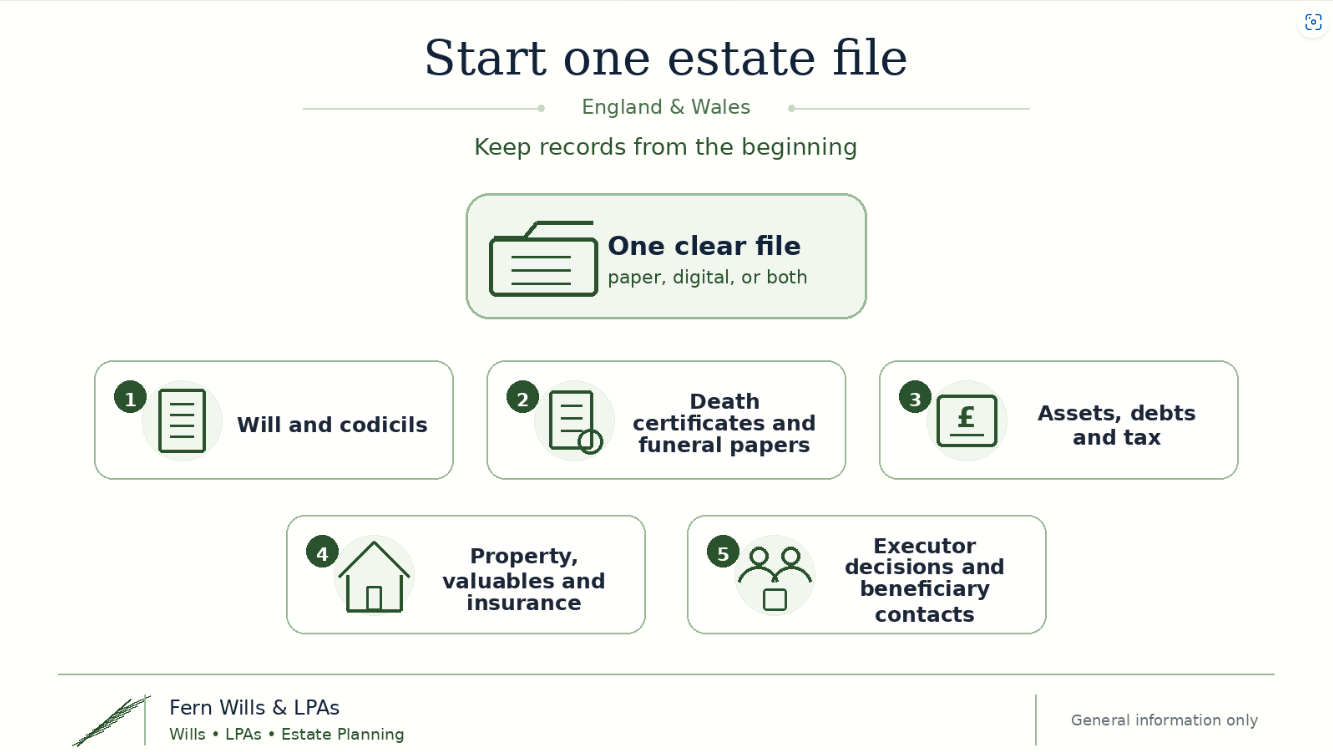
An estate file gives executors one place for documents, decisions, contacts and evidence.
This can be digital, paper, or both.
Include:
- the Will and any codicils;
- death certificates and funeral papers;
- asset and debt details;
- tax records and property information;
- executor decisions;
- beneficiary contacts;
- expenses, invoices and receipts;
- correspondence with banks, insurers, pension providers, HMRC and other organisations.
The aim is not perfection on day one. The aim is to create one reliable place where decisions and evidence are kept.
Executors should expect to account for what they did.
Good records reduce arguments and make later probate, tax and estate administration much easier.
Work out whether probate is likely to be needed
Probate is the legal authority to deal with the estate where a Will exists.
Whether probate is needed depends on the assets, their value, how they are owned, and what each organisation requires.
Probate is more likely where there is:
- a solely owned property;
- significant bank or investment accounts;
- shares;
- complex assets;
- business interests;
- inheritance tax work;
- institutions requiring a Grant of Probate;
- disputes or uncertainty.
Probate may be less likely where assets are small, jointly owned, or pass outside the estate. But do not assume. Different banks and providers have different thresholds and procedures.
Value the estate before distributing anything
Executors need to understand the estate before paying beneficiaries.
That means identifying:
- assets;
- debts;
- funeral costs;
- tax;
- lifetime gifts;
- jointly owned property;
- nominated pension or insurance benefits;
- business or farming assets;
- overseas assets;
- trusts;
- loans to or from family members.
It is risky to distribute money before debts, tax and beneficiary entitlement are clear.
If the estate later owes tax, debts or expenses, executors may have difficulty recovering money already paid out.
Check lifetime gifts
Do not assume the estate is only what exists on the date of death.
For Inheritance Tax, gifts made in the seven years before death may matter. In some cases, gifts where the deceased continued to benefit may also need careful checking.
Look for:
- large bank transfers;
- house deposits paid for children or grandchildren;
- property transfers;
- gifts of shares or investments;
- loans written off;
- regular financial support;
- assets sold for less than market value;
- continued occupation or benefit after a gift.
A one-year bank review may not be enough.
If there may be significant gifts, the executor should keep a schedule showing dates, amounts, recipients, evidence and any known exemptions.
Check whether the Will creates a trust
Some Wills are simple. Others create trusts.
A trust may arise where:
- children inherit before a stated age;
- a spouse or partner can live in the home for life;
- a vulnerable beneficiary needs protection;
- assets are held until someone reaches 18, 21 or 25;
- a beneficiary receives income but not capital;
- trustees have discretion over who receives what and when.
If the Will creates a trust, executors should not treat the estate as a simple immediate distribution.
Trust wording needs to be read carefully, and the trustees may have continuing duties after probate.
Check personal possessions separately
Personal possessions can cause disproportionate conflict.
The Will may refer to:
- personal chattels;
- a separate Letter of Wishes;
- gifts of jewellery;
- family items;
- vehicles;
- collections;
- sentimental items.
Do not assume personal possessions can simply be divided informally.
If there is a Letter of Wishes, check whether it is the latest version and whether it clearly relates to the Will.
Where families agree, practical division may be straightforward. Where they do not, the executors should be careful and keep records.
Watch for warning signs
Pause and get help if:
- only a copy Will has been found;
- the Will is damaged, loose, marked or unstapled;
- there may be a later Will;
- there is a codicil;
- an executor has died, lost capacity or cannot be contacted;
- an executor wants to step back but has already started acting;
- family members disagree about the Will;
- someone threatens to contest the Will;
- there is a dependent who may have been left out;
- the estate includes a business, farm, trust or foreign asset;
- there are large lifetime gifts;
- there may be Inheritance Tax;
- there are unclear loans or family payments;
- the deceased was separated, divorced or remarried;
- there are minor or vulnerable beneficiaries.
The earlier the issue is spotted, the easier it usually is to handle.
Where Fern Wills & LPAs fits
Fern Wills & LPAs does not act as professional executor and does not conduct contentious probate in-house.
Where appropriate, we can help you understand the first practical steps, identify whether specialist probate help may be needed, and make a warm introduction to a trusted probate specialist.
That may be useful where:
- you are unsure whether probate is needed;
- the Will is unclear;
- executors disagree;
- there are trusts;
- there are tax or lifetime gift issues;
- you want help staying organised;
- the estate is becoming too time-consuming;
- there is a risk of a dispute.
The aim is not to take control away from family executors. It is to help them stay in control while getting the right help where the estate needs it.
Related reading
You may also find these useful:
- What to do first after someone dies
- Probate and Executor Support
- Probate Executor Support service
- Secure Storage and Insurance
- Document Storage
- What is the 7-year inheritance tax rule?
- Life & Legacy Logs
- What Happens When a Sibling Contests a Parent’s Will?
Final practical checklist
Before applying for probate, check:
- You have the signed original Will.
- You have checked for codicils.
- You have considered whether a later Will may exist.
- You know who the executors are.
- Executors have agreed who is applying.
- Any non-acting executor has made a clear decision.
- The death has been registered.
- Government bodies have been notified where appropriate.
- Banks and asset holders have been contacted.
- The home and valuables are secure.
- Funeral costs are recorded.
- Assets and debts are being listed.
- Lifetime gifts have been considered.
- No early distributions have been made.
- Any dispute, tax, trust or missing-document issue has been flagged.
If in doubt, pause before distributing assets or making irreversible decisions.