Will the council take my house if I go into care?

Last verified: June 2026 (England & Wales)
Will the council take my house if I go into care?
Not automatically. A home may be counted in a care-fee financial assessment, but it may also be disregarded if specific rules apply, such as where a spouse, civil partner, dependent child or certain qualifying relatives still live there.
Care funding is a specialist area. Fern Wills & LPAs does not give detailed care-fee, benefits, or local authority funding advice. What we do deal with is the estate-planning side of the problem: Wills, trusts in Wills, Lasting Powers of Attorney, document storage, family records, and making sure the right people have authority to act when decisions become urgent.
This article is written for families who are starting to ask practical questions about care, the home, inheritance and who can make decisions.
For Fern clients, the practical point is this: do not guess, do not panic-transfer assets, and do not treat a Will, trust or LPA as a substitute for proper care-funding advice where that advice is needed.
Quick-read summary
- Care fees are not just an estate-planning issue. They involve care needs, local authority assessments, benefits, capacity, property ownership and family circumstances.
- A home is sometimes ignored, or “disregarded”, in a financial assessment. This can happen in specific circumstances, for example where a spouse, civil partner or certain qualifying relatives still live there.
- Families should not avoid a local authority assessment simply because they are worried about the house. That can lead to missed support, missed benefits and poor decisions.
- Giving away the house or using a trust mainly to avoid care fees can be risky and may be treated as deliberate deprivation of assets.
- Wills and Will trusts can still matter, but usually for survivor protection, sideways disinheritance, family control and keeping inheritance on track, not as a guaranteed care-fee solution.
- Lasting Powers of Attorney are often more urgent than people realise, because care decisions and financial paperwork may need someone with clear legal authority.
- If the care-fee question is detailed, disputed or high-value, the sensible route is to involve a specialist care-fees adviser or solicitor alongside your estate-planning review.
Why this matters
Families often ask one of two questions too late:
“Can we protect the house from care fees?”
or
“Should we avoid speaking to the council because they will take the house?”
Both questions can lead people in the wrong direction.
The better question is:
“What needs to be checked before we make decisions about care, the home and the family estate?”
That usually means looking at:
- the person’s care needs;
- whether the local authority should assess those needs;
- whether Attendance Allowance or other support may be available;
- whether NHS Continuing Healthcare should be considered;
- how the home is owned;
- who lives in the home;
- whether the person has mental capacity;
- whether valid LPAs are in place;
- what the Will says;
- whether any trust planning is already in place;
- what records and documents the family can access.
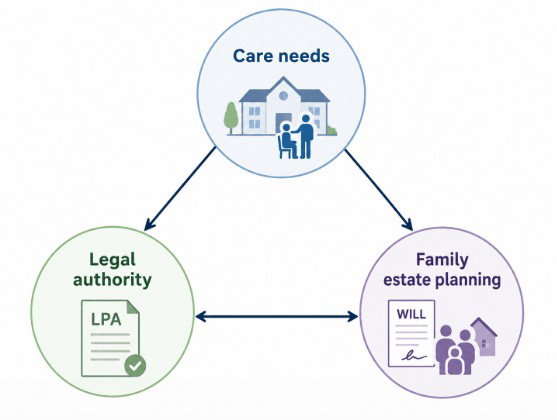
This is where estate planning and care planning overlap.
The aim is not to hide assets. The aim is to make better decisions, avoid avoidable delay, and keep legal authority, family records and estate planning in order.
When is a home disregarded in a care-fee assessment?
A common mistake is to assume that the home is always counted in a care-fee financial assessment.
Another common mistake is to assume that it is always safe.
The correct position is more fact-specific.
The value of a person’s main or only home may be ignored in some circumstances. This is often called a property disregard.
For example, the home may need to be disregarded where it is still occupied as the main or only home by a spouse, civil partner or certain qualifying relatives. A qualifying relative can include, among others, a relative aged 60 or over, a child under 18, or a relative who is incapacitated.
This can make a major difference.
It means families should not make quick assumptions based only on fear, hearsay, or something they have read online. The facts matter.
Why “do not ask for an assessment” can be bad advice
Some families worry that asking the local authority for help will automatically put the home at risk.
That is too simplistic.
A care-needs assessment is about understanding the person’s care and support needs. A financial assessment is about what they can afford to contribute if the local authority is involved in arranging or funding care.
If the family avoids assessment altogether, they may miss:
- care and support that should have been considered;
- Attendance Allowance or related benefit checks;
- NHS Continuing Healthcare screening where health needs are significant;
- proper advice on the home and any possible disregard;
- deferred payment information where relevant;
- practical planning time before a crisis;
- evidence that may later matter if decisions are challenged.
In some cases, the home may be relevant. In other cases, it may be disregarded. In other cases, the answer may change over time.
The point is not that every family should rush into a funding process without advice. The point is that fear of the house being “taken” should not stop the family from finding out what the correct position is.
What is the 12-week property disregard?
Where a person first enters a care home as a permanent resident, the value of their main or only home may be disregarded for the first 12 weeks in certain circumstances.
This does not mean care is free. It also does not mean the home is permanently protected.
It is intended to avoid a forced sale at the point of crisis and to give time for proper decisions about care, funding, the property and the person’s longer-term arrangements.
If the home may later be taken into account, families may need advice on options such as a deferred payment agreement, sale, letting, family contributions, or alternative care arrangements.
Fern Wills & LPAs does not advise on deferred payment agreements or detailed care-fee calculations. But we do help clients make sure the linked estate-planning documents are in order, especially Wills, LPAs, trusts in Wills, records and document storage.
The current capital limits
For England, the national capital limits for social care charging in 2026 to 2027 remain:
- lower capital limit: £14,250;
- upper capital limit: £23,250.
Broadly, if a person has capital above the upper limit, they are usually responsible for the full cost of their care. If their capital is between the limits, they usually contribute from income and a calculated amount from capital. If their capital is below the lower limit, capital is usually disregarded, but income may still be assessed.
This is only a broad summary. It is not a substitute for a proper financial assessment or specialist advice.
The figures can change. Always check the current position before relying on thresholds in a real case.
Deprivation of assets: why “just give the house away” is dangerous
Families sometimes ask whether the person can give away the home, transfer savings, or put assets into a trust so that care fees will not apply.
That can be risky.
If someone deliberately reduces their assets to avoid or reduce care charges, the local authority may treat this as deprivation of assets. In simple terms, the person may still be treated as having the asset for assessment purposes.
Timing matters. Purpose matters. The person’s health, age, care needs and foreseeable future may all matter.
That is why care-fee avoidance should not be the main driver for estate planning.
Planning primarily to avoid care fees is risky and can be treated as deliberate deprivation. Many clients are willing to pay a fair contribution and typically use Will trusts mainly for survivor protection and keeping inheritance on track; any care-fees impact is secondary and never guaranteed.
Can a Will or Will trust protect against care fees?
A Will does not control what happens while you are alive. It takes effect on death.
That means a Will cannot, by itself, solve care-fee problems during lifetime.
But Wills still matter.
A good Will review may check:
- whether the right people are appointed as executors;
- whether replacement executors are needed;
- whether the home is owned as beneficial joint tenants or tenants in common;
- whether a Property Life Interest Trust might help after the first death;
- whether a Flexible Life Interest Trust or discretionary trust is more suitable;
- whether the Will still fits the family structure;
- whether there is a risk of sideways disinheritance;
- whether vulnerable beneficiaries need extra thought;
- whether the Will leaves the survivor with enough flexibility.
A Will trust may help preserve the first person’s share of the estate for the chosen ultimate beneficiaries, while still giving the survivor security. That can be valuable in second marriages, blended families, later-life relationships, or where children from a previous relationship are involved.
But a Will trust is not a magic care-fee shield.
If care-fee planning is the main concern, the wording, ownership structure, family facts and care timeline need careful review.
Related reading: Property Life Interest Trust (PLIT)
Related reading: Home Protection Trusts: Caution on Asset Protection Trust claims
Why LPAs matter before care decisions become urgent
Lasting Powers of Attorney are often central to care planning.
A Property and Financial Affairs LPA can allow trusted attorneys to deal with money, bills, banks, property and financial paperwork.
A Health and Welfare LPA can allow trusted attorneys to make health and care decisions if the person lacks capacity to decide for themselves.
Without LPAs, family members may have practical responsibility but no clear authority. That can make care decisions harder, especially where banks, care providers, hospitals, insurers or local authorities need formal authority before dealing with someone.
A Will helps after death.
An LPA helps during lifetime.
In care planning, that distinction matters.
Related reading: Top 30 FAQs About Lasting Powers of Attorney
Related reading: What is the best way to activate and use your LPA online?
Attendance Allowance and benefit checks
Care planning should not start and end with the house.
Many older people miss support that could improve their day-to-day life. Attendance Allowance is one example. It is not means-tested, and savings do not stop someone claiming.
It can help with the extra costs of disability, illness, supervision or care needs. It may also unlock or increase other entitlements.
Fern Wills & LPAs can introduce clients to a trusted adviser for Attendance Allowance support where appropriate. That is often a practical step before the family reaches crisis point.
Related reading: Attendance Allowance: who can claim and how it works
NHS Continuing Healthcare
Some care needs are primarily health needs rather than social care needs.
Where needs are complex, intense, unpredictable or mainly health-related, NHS Continuing Healthcare may need to be considered. Eligibility depends on assessed needs, not simply on a diagnosis.
This is a specialist area. Fern Wills & LPAs does not advise on NHS Continuing Healthcare claims, appeals or retrospective reviews. But if a family mentions significant health needs, nursing needs, complex dementia, rapid deterioration or high care costs, it may be sensible to ask whether specialist CHC advice is needed.
What we check when care fees and estate planning overlap
When care-fee concerns come up during a Will, LPA or estate-planning conversation, we usually want to understand the broad picture before recommending documents.
That may include:
- Is the person still living at home, in hospital, receiving home care, or already in residential care?
- Is the care move temporary, trial-based or expected to be permanent?
- Does the person still have mental capacity to make legal and financial decisions?
- Are valid LPAs already registered?
- If LPAs exist, have they been activated with banks, utilities, care providers or other key organisations where needed?
- Who lives in the home?
- Is anyone living there a spouse, civil partner, dependent child, disabled relative, or relative aged 60 or over?
- Is the home owned by one person, jointly, or through a more complex arrangement?
- If owned jointly, is it held as beneficial joint tenants or tenants in common?
- Is there an existing Will, and when was it last reviewed?
- Does the Will include a trust?
- Has anyone transferred property, savings or other assets recently?
- Are there family tensions, second marriages, estranged children, vulnerable beneficiaries or informal promises?
- Are key documents stored safely and easy for attorneys or executors to find?
- Is the family asking for estate planning, care-funding advice, benefits advice, or all three?
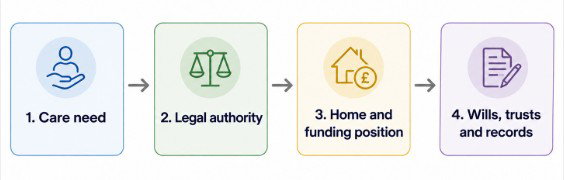
This is not a self-assessment checklist. It is a reminder that the care-fee question rarely stands alone.
In many cases, the safest answer is not “do this document”. It is “let’s work out which professional needs to deal with which part of the problem".
What Fern Wills & LPAs can help with
Fern Wills & LPAs can help with the estate-planning and document side of later-life planning, including:
- Wills and Will reviews;
- Mirror Wills and single Wills;
- Property Life Interest Trusts and other Will-based trust options;
- Lasting Powers of Attorney;
- LPA reviews and practical activation guidance;
- severance of joint tenancy where appropriate;
- secure document storage;
- Letters of Wishes;
- Life & Legacy Logs;
- practical records for attorneys and executors;
- introductions to trusted advisers where the issue sits outside our work.
We do not sell lifetime “home protection trusts” as an off-the-shelf care-fee solution.
That is deliberate.
Some trusts are valid and appropriate in the right circumstances. But selling a trust mainly as a guaranteed way to avoid care fees can be misleading and risky.
When specialist advice is needed
Specialist care-fee, benefits or legal advice may be needed where:
- the local authority has included the home and the family thinks it should be disregarded;
- a relative aged 60 or over, disabled relative or dependent child lives in the property;
- someone moved into the property before or after care started and the timing matters;
- the family is considering transferring the home or large sums of money;
- deprivation of assets is alleged or likely to be raised;
- there is a deferred payment agreement;
- the person has high nursing or healthcare needs;
- NHS Continuing Healthcare may apply;
- there is a dispute with the local authority, care home or family members;
- the sums involved are large;
- the person’s capacity is uncertain;
- there is no LPA and urgent decisions need to be made.
Fern Wills & LPAs can still help with Wills and LPAs in those situations, but the care-fee advice itself may need a specialist.
Cases
“Mum owns the house, but Dad still lives there”
A family asks whether their mother’s home will be sold to pay care fees because she has moved permanently into residential care. The first question is not simply “who owns the house?” It is also “who lives there, and what is their legal relationship to her?”
If her spouse or civil partner still occupies the property as their main or only home, the property may need to be disregarded in the financial assessment. That does not mean every other asset is ignored. It means the home itself may not be treated in the way the family feared.
For Fern, the linked estate-planning point is to check whether Dad has his own Will and LPAs, whether Mum has valid LPAs, and whether the family records are clear enough for attorneys and executors.
“My son is over 60 and has always lived with me”
A client says her adult son lives in the house and has done for many years. She is worried that if she ever enters care, he may lose his home.
This is not something to answer casually. A relative aged 60 or over may be relevant to the property-disregard rules, but the facts still matter. The adviser needs to know whether the property is the son’s main or only home, how long he has lived there, and whether the local authority accepts the position.
Fern’s role would not be to conduct the care-fee assessment. It would be to identify the issue, avoid giving casual wrong advice, and check the estate-planning documents around it.
“The family wants to transfer the house now”
A daughter asks whether her mother should transfer the house to the children before care is needed.
That question needs caution. If avoiding care fees is a significant purpose, the local authority may later argue deprivation of assets. The timing, health position, care needs and reasons for the transfer all matter.
A safer Fern conversation would usually focus on proper Wills, LPAs, ownership review, document storage, and whether specialist care-fee advice is needed before any transfer is considered.
“There is a Will, but no LPA”
A client has a carefully drafted Will, but no Lasting Powers of Attorney. The family thinks the Will is enough because it names the children as executors.
That is a misunderstanding. Executors act after death. Attorneys act during lifetime.
If care decisions, bank paperwork, care-home contracts, property insurance, bills or benefits need dealing with while the person is alive, the Will does not give the family authority. This is often where delay and stress arise.
In that situation, LPAs may be the more urgent planning document.
“The house is protected in the Will, but the survivor now needs care”
A couple made Wills years ago with a trust after the first death. The survivor now needs care, and the children assume the trust means the whole house is safe.
That may be wrong. A Will trust may protect the first person’s share, depending on the ownership and wording. It does not automatically remove the survivor’s own assets from a care-fee assessment.
The right review is practical and document-led: how was the home owned, did the trust actually arise, were the trustees appointed, were records kept, and what does the surviving spouse still own?

What is a property disregard in a care-fee assessment?
A property disregard means the value of the home is ignored for the care-fee financial assessment, usually because specific rules apply. Common examples include where a spouse or civil partner still lives there, or where certain qualifying relatives occupy the property as their main or only home. The facts still need checking carefully.
Will the council take my house if I go into care?
Not automatically. The home may be taken into account in some cases, but it may also be disregarded in others. The answer depends on the care arrangement, the financial assessment, who owns the home, who lives there and whether any disregard applies.
Is the home ignored if my spouse still lives there?
In many cases, yes. If a spouse or civil partner still occupies the home as their main or only home, this can trigger a mandatory property disregard. The full facts should still be checked.
What if an adult child lives in the home?
It depends. A relative aged 60 or over, a disabled or incapacitated relative, or a child under 18 may be relevant to the disregard rules. The local authority may need to look carefully at whether the property is that person’s main or only home and when they started living there.
Can I give my house away to avoid care fees?
This is risky. If avoiding care fees is a significant reason for the transfer, the local authority may treat it as deliberate deprivation of assets. Specialist advice should be taken before transferring a home or large assets where care may be foreseeable.
Does a Property Life Interest Trust protect against care fees?
A Property Life Interest Trust can help with survivor protection and keeping the first person’s share of the home on track for the chosen beneficiaries. Any care-fee effect is secondary and not guaranteed. It should not be sold or understood as a simple care-fee avoidance device.
Are LPAs more important than Wills for care planning?
They do different jobs. A Will deals with what happens after death. An LPA deals with who can help make decisions during lifetime. If care decisions, bank access, property paperwork or health decisions may be needed, LPAs are often essential.
Should I ask for a local authority assessment?
Often, yes, if care needs are becoming significant. Avoiding assessment because of fear about the house can lead to missed support and poor decisions. If the property or funding position is complicated, take specialist advice alongside the assessment process.
Does Attendance Allowance depend on savings?
No. Attendance Allowance is not means-tested. It depends on care or supervision needs, not on savings. Many families miss it because they assume benefits are only for people with low income.
Sources and further reading
For Fern Wills & LPAs articles:
- Property Life Interest Trust (PLIT)
- Home Protection Trusts: Caution on Asset Protection Trust claims
- Top 30 FAQs About Lasting Powers of Attorney
- What is the best way to activate and use your LPA online?
- Attendance Allowance: who can claim and how it works
- Will & LPA MOT
- Care Advisors & Home Care Providers
For official guidance:
- Care and support statutory guidance
- Social care charging for care and support 2026 to 2027
- Attendance Allowance
- NHS Continuing Healthcare
This article is general information only, not individual advice.
If you’d like help applying this to your circumstances, we can guide you through the options.
Next steps
If care fees, Wills, LPAs and the family home are starting to overlap, the next step is usually a short estate-planning review rather than a guess about care fees. A Will & LPA MOT can check whether your documents still fit the situation and whether specialist care-fee advice is needed alongside them.
Fern Wills & LPAs can review your Wills, LPAs, property ownership and records, and help you decide what needs updating before the situation becomes urgent.