Nil Rate Band Discretionary Trusts (NRBDTs)
Last verified: August 2026 (England and Wales)
Most people do not need a trust simply because it sounds tax-efficient. However, the way assets pass on the first death can make a substantial difference.
For an unmarried couple, poor planning can mean that one partner’s allowances cannot be used effectively. For a remarried family, valuable allowance history may be lost. For an estate near the £2 million Residence Nil Rate Band taper threshold, passing everything to the survivor can reduce the allowance available later.
These are some of the situations in which a Nil Rate Band Discretionary Trust can still earn its place.
Quick-read summary
A Nil Rate Band Discretionary Trust, usually shortened to NRBDT, is a trust created by a Will. It is designed to receive assets up to the ordinary Inheritance Tax Nil Rate Band available when the person dies. The ordinary Nil Rate Band is currently £325,000.An NRBDT uses the first deceased person’s available Nil Rate Band. It does not preserve that same allowance so it can also be transferred to the survivor.
Its main benefit is that the trust assets do not normally become part of the survivor’s estate. The trustees also retain flexibility over who benefits, when they benefit and how the money or property is used.
An NRBDT is no longer the automatic choice for every married couple. It may still be valuable for unmarried couples, remarried families, estates close to the Residence Nil Rate Band taper threshold, or families who need trustee flexibility.
In one sentence: an NRBDT does not create an extra tax allowance. It uses an existing allowance on the first death while keeping the trust assets separate from the survivor’s estate.
Quick glossary: terms used in this article
Nil Rate Band (NRB): the part of an estate that is charged to Inheritance Tax at 0%. It is currently £325,000, although earlier gifts or transfers can affect how much is available.
Trust: a legal arrangement in which trustees hold or manage money, property or investments for other people, known as beneficiaries. The assets do not simply pass outright to one person with no continuing conditions.
Will trust: a trust created by someone’s Will when they die.
Trustees: the people legally responsible for managing the trust assets, making permitted decisions and acting in the beneficiaries’ interests.
Discretionary: the trustees can choose which of the potential beneficiaries receive money or other benefits, when they receive them and how much they receive. No beneficiary has an automatic fixed entitlement unless the trustees create one.
Residence Nil Rate Band (RNRB): a separate additional Inheritance Tax allowance that may apply when a qualifying home is inherited by direct descendants. It is not the same as the ordinary Nil Rate Band, and putting “Residence Nil Rate Band” in a trust’s name does not secure the allowance.
Immediate post-death interest (IPDI): this identifies who receives the present right to use or enjoy property immediately after the death. For example, a partner given an immediate right to live in a home may have the present interest, while the children who receive the property later have only the future interest.
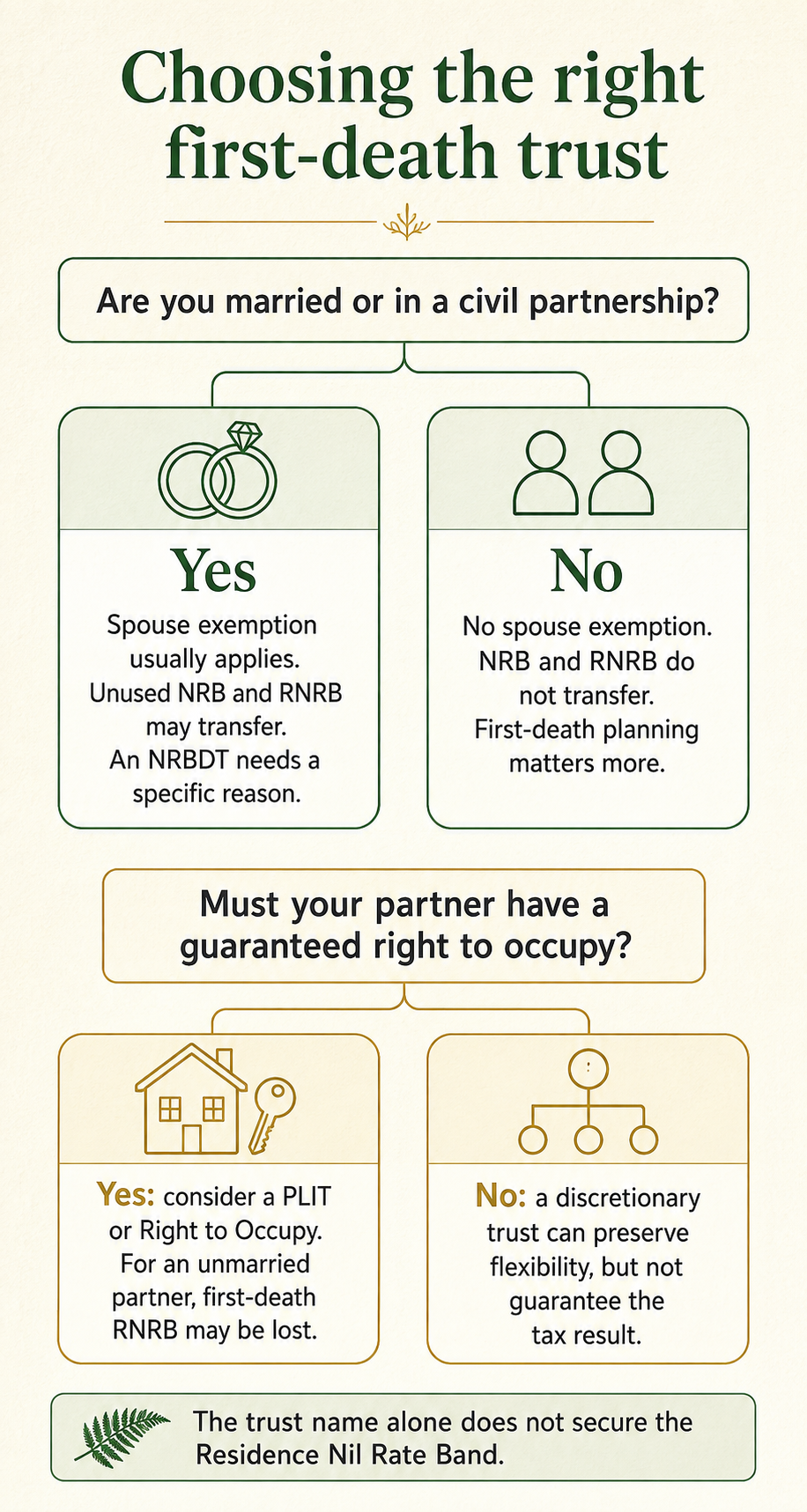
First question: are you married or in a civil partnership?
The tax starting point is different for married couples and civil partners compared with unmarried couples. This distinction should be considered before choosing a trust.
| Relationship | Inheritance Tax starting point |
| Married or civil partners | Transfers between spouses or civil partners are generally exempt from Inheritance Tax. Unused NRB and RNRB can normally be claimed on the survivor's later death. An NRBDT therefore needs a specific planning reason. |
| Unmarried partners | There is no spouse exemption and unused NRB or RNRB cannot transfer between the partners. Each partner has their own allowances, so first-death planning can matter much more. |
Special rules can apply where either spouse or civil partner has an international or long-term residence history. Those cases need specialist tax advice.
What is an NRBDT?
An NRBDT is usually created by a Will and starts on death. The Will identifies a class of possible beneficiaries, often including the survivor, children and later descendants. The trustees decide whether, when and how income or capital is used. No beneficiary has an automatic entitlement unless the trustees make an appointment. A Letter of Wishes normally guides the trustees. It might ask them to treat the survivor as the primary beneficiary during their lifetime, while preserving flexibility for children or other family members. The Letter of Wishes guides rather than binds the trustees. The trust may support the survivor through capital payments or properly documented loans. A loan remains an asset of the trust and may be an allowable debt in the survivor's estate only if it is genuine, enforceable and properly evidenced. It must not be treated as informal bookkeeping.
What does IPDI mean?
Immediate post-death interest does what it says on the tin. It asks who receives the present right to use or enjoy the property immediately on death. For example, if a Will gives a partner the right to live in a home for life or for a fixed period, the partner may receive the immediate interest. The children who inherit later have the future interest, not the immediate one. A genuine discretionary NRBDT starts differently. No individual has an automatic present right because the trustees decide who benefits. Trustees may later create or appoint an interest, but the timing and terms matter for Inheritance Tax and RNRB.
Can an NRBDT solve the PLIT or Right to Occupy RNRB problem?
Not automatically. It changes the balance between certainty and flexibility.
- If the partner must have an enforceable right to occupy, a Property Life Interest Trust or Right to Occupy may provide the required security. For an unmarried partner, that immediate interest can mean the first deceased's home is not inherited by their direct descendants for RNRB purposes.
- If occupation is strongly preferred but not guaranteed, a discretionary trust may allow the trustees to consider the circumstances after death. That flexibility can preserve a route to a qualifying appointment, but the trustees must act properly and the desired tax result cannot be promised in advance.
- An appointment from a Will discretionary trust made within two years may, where the statutory conditions are met and before a qualifying interest in possession has already subsisted, be treated for Inheritance Tax as if the Will had made that gift on death.
This is why the practical question remains: is the partner's occupation a must-have legal right, or a strong preference entrusted to the trustees? The answer may affect both family security and the RNRB opportunity. For the full comparison, read Right to Occupy or Discretionary Trust: Which Is Better?.
When can an NRBDT still help?
1. Unmarried couples
Unmarried partners cannot transfer unused NRB or RNRB between them. An outright gift can use the first partner's NRB merely to move the value into the survivor's estate, where the same value may be exposed again on the later death. Example: John and Jane are not married. They each own £300,000, and John has children from an earlier relationship. If John leaves his £300,000 outright to Jane, no IHT is due on his death because his estate is within his NRB. Jane then owns £600,000. If she later leaves it to John's children, they are not her direct descendants and her estate has only her own ordinary NRB. On these simplified figures, £275,000 is taxable and the IHT would be £110,000. If John's Will instead places £300,000 into an NRBDT, his NRB is used on his death. Jane can be a potential beneficiary, but the trust fund does not normally form part of her estate. Jane still owns £300,000, which is within her own NRB. The family has used both partners' allowances across the two deaths rather than attempting to transfer an allowance that the law does not permit unmarried partners to transfer.
| Unmarried-couple point: The NRBDT does not create a spouse exemption. It uses the first partner's own NRB and keeps the trust value separate from the survivor's estate, subject to proper administration. |
2. Married couples and the RNRB taper
The RNRB is reduced by £1 for every £2 that an estate exceeds the £2 million taper threshold. Passing everything to the survivor can therefore increase the survivor's estate and reduce the RNRB available on the second death. Current thresholds are £325,000 for the ordinary NRB and £175,000 for the RNRB. They are fixed at those levels through the 2030/31 tax year. A qualifying married couple or civil partnership may have up to £650,000 of ordinary NRB and £350,000 of RNRB on the second death, but only where the conditions are met. Example: a married couple has a combined estate of £2.4 million, including a qualifying home that will pass to their children.
- Without an NRBDT, the survivor's estate is £2.4 million. The full £350,000 RNRB is reduced by £200,000, leaving £150,000. With £650,000 of ordinary NRB, the simplified IHT is £640,000.
- With a £325,000 NRBDT on the first death, the survivor's estate is £2.075 million. The first deceased's ordinary NRB has been used by the trust, so it is not also transferable. The survivor has their own £325,000 NRB. The £350,000 RNRB is reduced by £37,500, leaving £312,500. The simplified IHT is £575,000.
On these static assumptions, the estimated saving is £65,000, not the value of the trust itself. The trust also retains £325,000 outside the survivor's estate. Actual results depend on ownership, growth, lifetime gifts, reliefs, debts, the home, trust administration and future law. From 6 April 2027, most unused pension funds and pension death benefits will be included in the IHT estate. Death-in-service benefits from registered pension schemes are excluded. Pension changes may push more estates towards the taper threshold, but the pension and Will planning must be reviewed together. See also Residence Nil Rate Band and £1 Million Tax-Free: When Does It Really Apply?.
3. Previous marriages and unused NRBs
A survivor who has been married or in a civil partnership more than once may have unused NRB from more than one deceased spouse or civil partner. However, the total transferable increase available on any one death is capped at 100% of the current NRB. Where both members of a remarried couple bring unused allowance from earlier relationships, first-death NRBDT planning may allow the first person's own NRB and an available transferred NRB to be used on that death. The later survivor may then use their own NRB and the allowance available from their earlier spouse. Across the two estates this can sometimes use four NRBs rather than allowing part of the available history to be lost. The exact result depends on the earlier Wills, chargeable gifts, estate values and evidence needed for the transfer claims. This is document-led planning, not a standard clause that should be inserted without checking the history.
4. Wait-and-see family planning
An NRBDT can give trustees time to consider the survivor's security, children's needs, vulnerability, divorce or creditor risks, and whether capital should be retained, loaned or appointed. This can be useful where the family wants flexibility rather than an immediate fixed gift. The same flexibility is also the main limitation. A beneficiary cannot insist that the trustees follow a non-binding Letter of Wishes. If a particular right is essential, a discretionary trust may be the wrong structure.
5. Where a discretionary trust is planned on the second death
If the family already expects a discretionary trust to continue after the second death, a separate first-death NRBDT may divide the family wealth between settlements created by different testators. This can affect future 10-year and exit-charge calculations. It is not safe to say that every trust simply receives a fresh £325,000 allowance. The calculation can depend on the identity of each settlor, previous chargeable transfers, related-settlement rules, same-day additions, later additions and trust values. The structure requires specialist tax and trust administration advice.
An NRBDT is not automatically an RNRB trust
The ordinary NRB and the RNRB are different allowances. Calling a clause a Residence Nil Rate Band Discretionary Trust does not make the RNRB available. For RNRB, a qualifying home must be closely inherited by the deceased's direct descendants. A home left in an ongoing discretionary trust will not automatically satisfy that test. A qualifying appointment to a direct descendant within the statutory period may be treated as taking effect on death, but that is a post-death decision requiring specialist advice. For married couples and civil partners, stepchildren can be direct descendants for RNRB. For unmarried couples, one partner's children are not the other partner's stepchildren merely because the couple lived together for many years.
Property ownership matters
A beneficial joint tenant's share normally passes automatically to the surviving owner and does not pass under the Will. If a defined share is intended to fund an NRBDT, the owners will commonly need to hold as tenants in common so that the share can pass under the Will. That does not mean severance is automatically right. The ownership, mortgage, survivor's security, available investments and RNRB route all need to be considered together. Read Severance of Tenancy for the ownership distinction.
Tax charges and administration
An NRBDT is normally within the relevant property regime. Depending on the figures and history, the trustees may face:
- a 10-year anniversary charge of up to 6%;
- proportionate exit charges when capital leaves the trust;
- Income Tax and Capital Gains Tax on trust income or gains;
- valuation, record-keeping, trustee decision and tax-return work; and
- Trust Registration Service requirements.
A Will trust is generally excluded from TRS registration for the first two years after death if it holds only estate property. If it continues beyond that point, or becomes taxable earlier, registration may be required. Trustees should obtain advice rather than assume the trust is exempt. A fund within the available NRB and with no complicating history may have little or no periodic charge, but that is not a guarantee. Investment growth, additions and the settlor's chargeable-transfer history can change the calculation. For the practical cost and tax framework, read How Much Does a Will Trust Cost to Set Up and Run?.
Alternatives to compare
An NRBDT should be compared with the job the family actually needs done:
- an outright gift to a spouse or civil partner, using the spouse exemption and preserving unused transferable allowances;
- an outright first-death gift to children or other beneficiaries, where immediate ownership is acceptable;
- a Property Life Interest Trust or Right to Occupy, where the survivor must have an enforceable right;
- a Flexible Life Interest Trust, where an immediate interest and later trustee flexibility are both required; or
- a broader discretionary Will trust, where flexibility and protection matter more than fixed entitlement.
Use Choosing Your Family Trust as the wider comparison guide.
What Fern can and cannot do
Fern Wills & LPAs can identify the Will-planning questions, explain the available Will-trust structures and draft an agreed trust into a Will. Fern does not accept trustee appointments, create standalone lifetime trusts, calculate the final tax liability, register or administer trusts, or guarantee a tax saving. Where post-death appointments, tax calculations, trust registration or ongoing administration are required, Fern can help organise the relevant information and introduce an appropriate specialist. You remain free to choose your own adviser. See the current Protection Packages for Fern's fixed-fee Will-trust options.

Does an NRBDT actually save Inheritance Tax?
Not automatically. An NRBDT does not create an extra tax allowance. It normally uses the Nil Rate Band available on the first death.
The potential benefit is that the trust assets, together with any later growth, do not normally become part of the survivor’s estate. Whether that produces a tax saving depends on the family’s circumstances, estate values, ownership, other allowances and how the trust is administered.
Are NRBDTs only useful for married couples?
No. They can sometimes be more important for unmarried couples.
Married couples and civil partners can generally transfer unused Nil Rate Band and Residence Nil Rate Band allowances between them. Unmarried partners cannot. An NRBDT can therefore help use the first unmarried partner’s own Nil Rate Band while keeping the trust assets separate from the survivor’s estate.
Can the surviving partner still benefit from the trust?
Potentially, yes. The surviving partner can be included as one of the possible beneficiaries. The trustees may be able to make payments, provide properly documented loans or allow the partner to benefit in another way permitted by the trust.
However, a discretionary beneficiary cannot demand money or insist that the trustees follow a Letter of Wishes.
If the partner must have a guaranteed right to remain living in the home, a Property Life Interest Trust or Right to Occupy may be more appropriate. That greater security can have different Residence Nil Rate Band consequences, particularly for unmarried couples.
Does calling it a Residence Nil Rate Band Discretionary Trust secure the RNRB?
No. The name of the trust does not secure the Residence Nil Rate Band.
The allowance depends on a qualifying home being closely inherited by the deceased’s direct descendants. A qualifying appointment by the trustees within the statutory period may sometimes be treated as taking effect on death, but the conditions and timing must be checked carefully.
What happens to an NRBDT after the person dies?
The trustees must identify the trust assets, decide how the trust will be used, keep proper records and deal with any tax or registration requirements.
A Will trust holding only estate property is generally excluded from Trust Registration Service registration during the first two years after death. If it continues beyond that period, or becomes taxable earlier, registration may be required.
An NRBDT should therefore be chosen because it performs a worthwhile job for the family, not because it sounds like a tax-saving shortcut.
An NRBDT can provide valuable protection and flexibility, but it is not automatically tax-free or cost-free to operate.
Considering an NRBDT, or already have one in your Will? Download our one-page guide, Your Nil Rate Band Discretionary Trust. It summarises what the trust does, the principal tax charges that may arise, registration and record-keeping responsibilities, and when trustees may need professional help.
For a fuller explanation of realistic registration, administration and professional costs, including quiet years and more active “event years”, read How much does a Will trust cost to set up and run?.
When the trust begins: an NRBDT is created by a Will and takes effect following death. The familiar 20% lifetime trust entry charge does not normally apply merely because the NRBDT begins. The Inheritance Tax position is instead calculated as part of the deceased’s estate.
The trust is normally designed to receive no more than the ordinary Nil Rate Band available on that death. Earlier gifts, previous transfers and the rest of the estate can affect how much allowance remains.
Ten-year charges: an NRBDT will usually fall within the relevant-property trust regime. An Inheritance Tax charge of up to 6% may apply at each ten-year anniversary. It is not an automatic 6% charge on the whole trust. The value of the trust, the available Nil Rate Band, earlier transfers and other technical factors affect the calculation.
Exit charges: an Inheritance Tax exit charge can sometimes apply when money or property leaves the trust. The charge may be lower than 6% or may be nil, depending on the value, timing and history of the trust.
Income Tax: if the trust receives rent, interest, dividends or other taxable income, the trustees may need to pay Income Tax and submit a tax return. For the 2026/27 tax year, accumulation and discretionary trusts generally pay 45% on most taxable income and 39.35% on dividend income.
A payment of trust capital is not automatically an income payment. Trustees should identify what is being distributed before deciding how it is taxed.
Capital Gains Tax: Capital Gains Tax can arise if trustees sell or transfer an asset that has increased in value. For 2026/27, most trusts have an annual exempt amount of £1,500 and trustees generally pay Capital Gains Tax at 24% on taxable gains above the available exemption. Relief may sometimes be available.
Registration and administration: a Will trust is generally excluded from Trust Registration Service registration for the first two years after death, unless it becomes taxable earlier. If it continues beyond that period, registration will usually need to be considered.
Trustees may also need to keep records, document decisions, obtain valuations, complete tax returns and take professional advice. Some trusts have quiet years with little or no expense. Costs are more likely when property is sold, money is distributed, tax reporting is required or a ten-year anniversary approaches.
These figures are current for the 2026/27 tax year and may change. They are intended to identify the questions that trustees may need to consider, rather than calculate the tax due in a particular case.
Conclusion
NRBDTs are no longer an automatic recommendation for every couple, but they still have a valuable role where there is a real planning reason.
- For unmarried couples, they can use the first partner's own NRB while keeping the trust value outside the survivor's estate.
- For remarried families, they can help use allowance history that may otherwise be capped or lost.
- For estates near the £2 million RNRB taper threshold, they can reduce the survivor's estate, although the first NRB used by the trust cannot also be transferred.
- For families needing flexibility, they allow trustees to respond to circumstances after death.
| The decision: Use an NRBDT because it performs a clear job for the family, not because it has a tax-planning label. The Will, asset ownership, relationship status, direct descendants and likely administration must all fit together. |
References to spouses and marriage in this article include civil partners and civil partnerships.