Making a Will when capacity is uncertain
Last verified: August 2026 (England & Wales)
Quick-read summary
A diagnosis of dementia, memory problems, brain injury or another condition does not automatically prevent someone from making a Will.
The legal question is whether the person has testamentary capacity for the Will they are making at the relevant time. Someone may have difficulty with other decisions and still have sufficient capacity to make a Will.
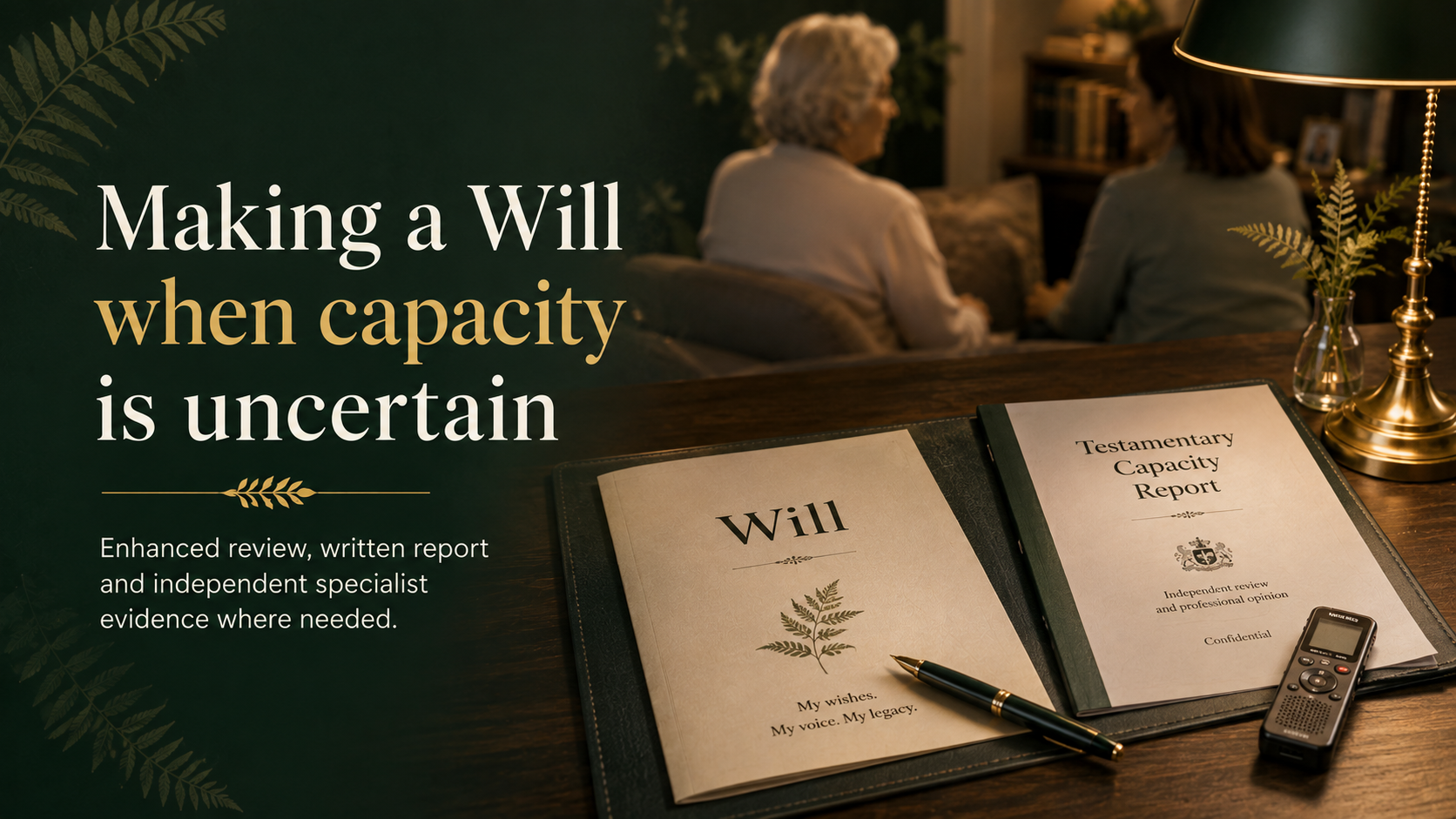
Where there is a genuine concern, Fern Wills & LPAs may recommend an enhanced testamentary-capacity Will service rather than treating the matter as an ordinary Standard Will appointment. The enhanced service includes a longer professional review and a formal written testamentary-capacity report. It is not a fee for a guaranteed “yes” outcome.
In some cases it may be more appropriate to obtain independent specialist evidence first. If that specialist evidence supports testamentary capacity and Fern is then satisfied that it can properly take the person’s instructions, Fern’s normal Standard Will fee would usually apply rather than the enhanced-review fee. The specialist’s own fee is separate.
If you are unsure which route is appropriate, contact Fern before booking. A short preliminary conversation can usually establish the sensible next step without pretending to decide capacity over the telephone.
The process in one minute
- Start with a short preliminary conversation so Fern can understand the circumstances and decide which appointment route appears proportionate.
- If there is no material capacity concern, use the ordinary Standard Will service.
- If Fern needs a more detailed professional process, use the enhanced testamentary-capacity Will service.
- If independent clinical evidence is the better starting point, you may go to an independent specialist first.
- Will instructions always come from the person making the Will. Family can help prepare factual details, but cannot give the Will instructions.
- After an enhanced review, Fern may proceed, stop because it cannot safely proceed, or recommend independent specialist evidence before deciding.
Can someone still make a Will after a dementia diagnosis?
Often, yes. A diagnosis is important background information, but it is not an automatic legal finding that the person cannot make a Will.
Capacity is specific to the decision being made and can vary over time. A person who needs help with some financial or day-to-day decisions may still understand the particular decisions needed to make a Will. The important question is what the person understands and can decide at the relevant time, not the label attached to a diagnosis.
That is why Fern does not use a simple pass/fail label based on age, diagnosis, appearance or somebody else’s opinion. Where there is a genuine concern, the process becomes more careful and more evidence-focused.
What does testamentary capacity mean?
Testamentary capacity is the legal capacity required to make a valid Will.
Under the current law in England and Wales, the person making the Will needs to understand the essential nature and effect of what they are doing. In practical terms, this means being able to understand matters such as:
- that they are making a Will which will take effect on death;
- the broad nature and extent of the property and assets they are dealing with;
- the people who might reasonably expect to be considered and the effect of including or excluding them; and
- the contents of the Will they are approving.
Perfect memory is not the test. Nor does somebody need to be able to manage every aspect of their finances independently. The question is whether they can make this particular testamentary decision.
Why might Fern recommend an enhanced review?
Most Will clients do not need an enhanced testamentary-capacity review. It is used where there is a genuine reason to slow the process down, explore the client’s understanding more carefully and create a stronger contemporaneous record.
Examples may include:
- a dementia diagnosis, significant memory problems or a condition that may affect decision-making;
- confusion which appears to vary from day to day or at different times of day;
- a serious illness, brain injury or medication issue that may affect understanding;
- a substantial later-life change to an existing Will, particularly where the change is difficult to explain;
- an exclusion, unequal gift or family situation where a later challenge is realistically foreseeable; or
- something during the instruction process which gives a genuine reason to question whether the person understands the Will decisions being made.
None of these points proves that capacity is lacking. They are reasons to use a more careful process rather than assume the answer either way.
What happens before an appointment is booked?
Fern may first have a short preliminary conversation to understand the circumstances. That conversation is not itself a testamentary-capacity assessment. Its purpose is to decide which of three routes appears the most sensible starting point.
These are starting routes. They are different from the possible outcomes if Fern later carries out an enhanced review.
Route 1: Standard Will service
Where there is no genuine reason for an enhanced capacity process, the ordinary Standard Will service remains the appropriate route.
Route 2: Fern enhanced testamentary-capacity Will service
Where Fern considers that a more careful process is needed, the enhanced service provides additional appointment time, a detailed review of the person’s own understanding and instructions, fuller contemporaneous evidence and a formal written testamentary-capacity report. If Fern is satisfied that it is appropriate to proceed, preparation of the Will within the agreed scope is included.
Route 3: Independent specialist assessment first
In some circumstances, independent specialist evidence may be the better starting point. You can also choose that route if you would prefer independent evidence before Fern undertakes a Will appointment.
The specialist charges separately for their assessment and report. If their opinion supports testamentary capacity and Fern is then satisfied that it can properly take the person’s instructions, Fern’s Standard Will fee would usually apply rather than the enhanced-review fee. A specialist opinion is important evidence, but it does not compel Fern to proceed if concerns remain during the Will instruction process.
What happens during Fern’s enhanced review?
The Will instructions must come from the person making the Will, often called the testator. Family members can help with practical arrangements and factual background, but they cannot tell Fern who should receive what, who should act, or what the Will should say.
The enhanced review gives more time to explore the client’s own understanding, instructions and reasoning. Fern keeps detailed contemporaneous notes and prepares a formal written testamentary-capacity report recording the review and conclusion.
The purpose is not to diagnose a medical condition. It is to decide whether Fern is professionally satisfied that it is appropriate to accept the Will instructions and proceed.
Practical adjustments may also help. For example, a quieter appointment, the client’s preferred time of day, glasses, hearing aids or other normal communication support may make it easier for the person to demonstrate what they understand without somebody else taking over the decision.
How can family members help without taking over?
Family members can be very helpful, particularly where the person making the Will is elderly, unwell or becomes tired easily. The key distinction is simple: factual information can be prepared in advance, but the Will instructions must come directly from the testator.
A relative can, and preferably should where practical, help Fern prepare basic administrative information before the appointment. This can save a significant amount of appointment time that would otherwise be spent asking the client to wait while information is typed into the file.
Useful factual information may include:
- full names, addresses and contact details;
- dates of birth or ages where relevant;
- basic family relationships;
- correct spellings of names; and
- other straightforward factual details Fern asks for before the meeting.
Information supplied by a relative is treated as unverified background information, not as the client’s Will instructions. Fern still asks the client the relevant questions directly and checks the factual information against the client’s own understanding.
This is deliberately a cross-check, not a prompt.
For example, if a family member has provided the name and address of a person who may be relevant, Fern will still ask the client open questions about who they want to appoint or benefit and why. Fern does not simply tell the client the answer previously supplied by somebody else.
Relatives must not provide instructions about who is to receive what, when or why.
They must not choose executors, beneficiaries, gifts or exclusions for the client.
Those decisions must come from the testator.
In short: relatives can help Fern prepare the facts. They cannot provide the Will instructions.
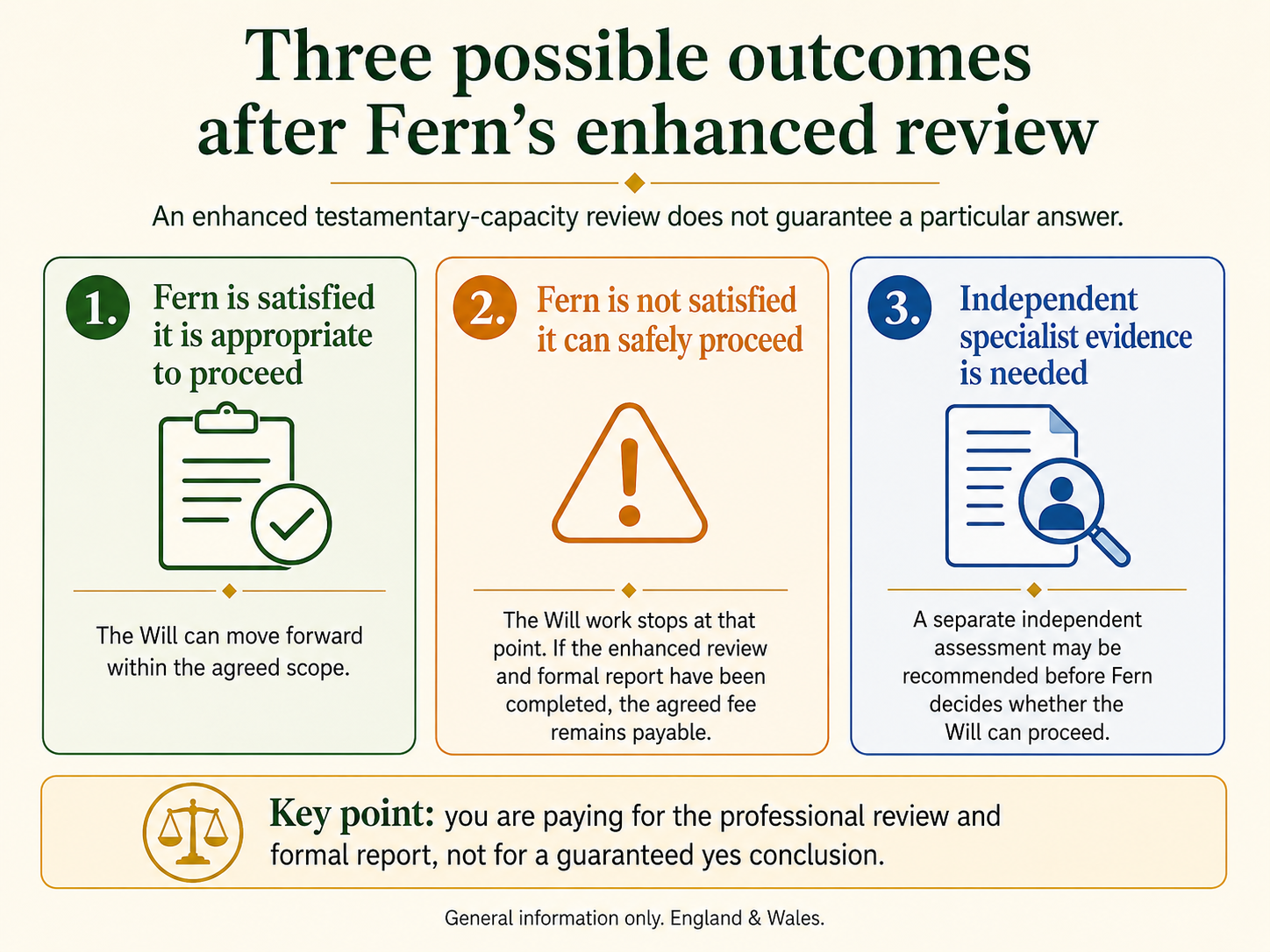
There are three possible outcomes after Fern’s enhanced review
1. Fern is satisfied it is appropriate to proceed
The Will can move forward within the agreed scope. The enhanced fixed-fee service includes preparation of the Will where Fern is satisfied that the instructions can properly be accepted.
2. Fern is not satisfied it can safely proceed
Fern will not prepare a Will simply because a family wants one completed. If the review leaves Fern unable to accept the instructions with appropriate professional confidence, the Will work stops at that point.
If the enhanced review and formal report have been completed, the agreed enhanced-service fee remains payable in full. You are paying for the professional review and report, not for a guaranteed “yes” conclusion. If the matter stops before the agreed stage has been completed, charges may still be payable for work already carried out under the Client Care Letter and Terms of Business. This is essential to protect the client and beneficiaries from accusations that the Will writer was incentivised to provide a positive outcome.
3. Fern pauses and recommends independent specialist evidence
Some cases are genuinely borderline or raise questions that should not be decided by a Will writer alone. Fern may then pause the Will process and recommend an independent specialist assessment before deciding whether it can proceed.
The specialist service is separate from Fern’s enhanced review. No specialist fee is incurred without prior agreement. If suitable specialist evidence is obtained and Fern is then satisfied it can proceed, preparation of the Will remains within the original enhanced service provided the agreed scope has not otherwise changed.
What are you paying for?
It is a separate fixed-fee Will service for a matter that requires substantially more professional work, consultation and risk.
The agreed fee covers the enhanced testamentary-capacity review, the additional appointment and evidence-gathering work, a formal written testamentary-capacity report and, where Fern is satisfied that it is appropriate to proceed, preparation of the Will within the agreed scope.
Once the enhanced testamentary-capacity review and formal report have been completed, the agreed fixed fee for that service is payable even if Fern cannot then prepare the Will or recommends independent specialist evidence. The fee is for carrying out and recording the agreed professional review, not for guaranteeing a particular conclusion.
Any independent specialist assessment is a separate professional service and may involve an additional fee. That cost is explained and agreed before the specialist is instructed.
Current prices are shown in Fern’s Services & Fees information and confirmed in writing before an appointment is booked. This article deliberately explains the process rather than fixing a price that may change over time.
Independent specialist assessments
Where independent evidence is appropriate, Fern may suggest an independent specialist rather than trying to make a clinical judgement itself.
One specialist Fern has used is Jodie Brookes RN, founder of Brookes Care Solutions Ltd. Jodie is a Registered Nurse, Independent Mental Capacity Assessor and Expert Witness who undertakes independent testamentary-capacity assessments and reasoned professional reports.
Jodie acts independently of Fern Wills & LPAs. There is no commission, referral fee, reciprocal arrangement or other financial incentive between the two businesses. Her assessment and professional opinion are entirely her own, her fees are separate from Fern’s fees, and neither business has any commercial interest in the conclusion she reaches.
Brookes Care Solutions Ltd: www.brookescaresolutions.co.uk | 0330 090 4511 | hello@brookescaresolutions.co.uk
Why both layers of evidence may be worthwhile
A recent case involved an elderly client with a dementia diagnosis who wanted to make a Will containing sensitive family decisions. There was a realistic prospect that the Will might later be challenged.
I took the client’s instructions privately and carried out my enhanced testamentary-capacity process. This included detailed contemporaneous notes, a formal written report and sometimes an audio recording of the instruction meeting, so that the client’s wishes and reasons were preserved in their own words rather than reconstructed later from somebody else’s recollection.
Because of the circumstances and the likelihood of a future challenge, independent specialist evidence was also proportionate. An independent registered-nurse assessor met the client separately, carried out her own assessment and produced her own reasoned professional report.
The two pieces of evidence performed different jobs. My records documented the Will instructions, the client’s reasoning and what I observed during the Will-writing process. The independent specialist brought a separate clinical and professional assessment.
Neither assessment could guarantee that nobody would challenge the Will. What they created was a substantially stronger contemporaneous evidence trail showing what the client wanted, why they wanted it and how their testamentary capacity had been considered at the time.
In a straightforward Will that level of evidence would usually be unnecessary. In a case where a serious family dispute is realistically foreseeable, the additional work and cost may be proportionate to the risk.
Why this is not a pass or fail test
Capacity is not a judgement about intelligence, age or whether somebody has made a decision that other people agree with. The question is whether the person can understand and make the particular Will decisions required at the relevant time.
The responsible outcome can therefore be “yes, proceed”, “no, Fern cannot proceed”, or “the position is not clear enough without independent evidence”. An inconclusive result is still a professional conclusion. It does not mean that the review or report was not completed.
Frequently asked questions
Does dementia automatically mean someone cannot make a Will?
No. A diagnosis does not automatically remove testamentary capacity. The person’s actual understanding of the Will decisions at the relevant time is what matters.
Can someone lack capacity to manage money but still make a Will?
Yes, that is possible. Capacity is decision-specific. The ability needed to make a Will is not identical to the ability needed to manage every aspect of day-to-day finances.
Can a son or daughter give Fern the Will instructions?
No. Will instructions must come from the testator. A relative can help prepare factual information such as names, addresses, contact details and dates of birth, but cannot decide who receives what, who acts as executor or what the Will should say.
Why does Fern ask relatives for factual details if it must take instructions directly?
Because pre-typing straightforward factual information can save a tired or unwell client from spending valuable appointment time waiting while names, addresses and other details are entered. Fern still checks the information with the client and obtains every substantive Will decision directly from them.
Do I still pay if Fern decides it cannot proceed with the Will?
Yes, once the visit has been conducted, the agreed fixed fee for that service is payable. This is explained before the appointment is booked. If the matter stops before an agreed stage has been completed, the normal Client Care Letter and Terms of Business provisions apply. This is essential to protect the client and beneficiaries from accusations that the Will Writer was incentivised to provide a positive outcome in the report.
Can I go straight to an independent specialist?
Yes. In some circumstances that may be the most proportionate route, and you can also choose it if you would prefer independent evidence first. The specialist’s fee is separate. If the specialist supports testamentary capacity and Fern is then satisfied that it can properly take the person’s Will instructions, Fern’s Standard Will fee would usually apply rather than the enhanced-review fee.
What if independent specialist evidence is needed after Fern’s review?
Fern will explain that before anything further is arranged. The specialist’s fee is separate. Fern does not charge a second ordinary Will fee simply because specialist evidence was required, provided the Will later proceeds within the original agreed enhanced-service scope.
Does a specialist opinion guarantee that Fern will make the Will?
No. Specialist evidence can be important, but Fern must still be satisfied that it can properly accept the client’s instructions and proceed within its own professional role.
What happens if the person cannot make a Will?
Fern cannot prepare a Will for somebody who does not have the required testamentary capacity. There are separate legal routes that may sometimes be relevant where a person cannot make their own Will, but those routes are outside Fern’s Will-writing service.
A short technical note
The current law for a person making their own Will in England and Wales uses the common-law testamentary-capacity test associated with Banks v Goodfellow. The Mental Capacity Act 2005 applies to many other capacity decisions and to the Court of Protection’s statutory-Will jurisdiction, but it has not yet replaced the common-law test for a person making their own Will.
The Law Commission recommended reform in 2025 so that the Mental Capacity Act test would become the single test. That recommendation has not yet been implemented, so this page follows the current law.
Next steps
If there is no genuine capacity concern, the normal starting point is the Standard Will service.
If there is a real concern about understanding, memory or decision-making, tell Fern before booking so the appropriate appointment route can be discussed from the outset.
Standard Will Service |Enhanced Testamentary Capacity Will Service | Contact Fern Wills & LPAs
This article is general information only, not individual advice.
If you would like help applying this to your circumstances, Fern Wills & LPAs can explain the Will-planning options and the appropriate appointment route.