Helping a loved one: manage bills, save money, simplify admin and keep clear records

Last Verified: August 2026 (England & Wales)
Helping an older parent, relative or friend with their household bills can uncover savings, reduce unnecessary administration and make important services easier to manage.
The safest approach is not simply to find the cheapest supplier. It is to check what the person actually uses, what support they may qualify for, what contracts or equipment rely on the existing arrangements, and whether a change will be simpler and safer in practice.
This guide covers benefits, council tax, energy, water, broadband, telephones, television packages, insurance, subscriptions and recurring payments.
It also explains the checks that matter before changing a digital landline, broadband connection or any service used by a pendant alarm, monitored alarm or emergency telephone.
If you are acting as an attorney under a Property and Financial Affairs Lasting Power of Attorney, you should also keep a proportionate record of significant changes and why they were in the donor’s best interests.
Before you change anything
Involve the person
If the person can make the decision, support them to do so.
Explain the available options clearly and obtain their agreement before changing suppliers, contracts, payment methods or important household services.
Check your authority
Being a relative or “next of kin” does not automatically give you authority to manage another person’s money.
If you are acting formally, check the authority given by the registered Property and Financial Affairs Lasting Power of Attorney, deputyship order or other lawful arrangement.
Protect essential services
Do not cancel or switch a telephone, broadband, energy, insurance or alarm service until you know what depends on it and what will replace it.
A cheaper arrangement is not a genuine saving if it disconnects an alarm, removes necessary insurance, creates confusion or leaves the person unable to call for help.
Use four questions
For each proposed change, ask:
- Cheaper: will it reduce the real monthly or annual cost?
- Simpler: will it reduce bills, passwords, renewal dates or telephone calls?
- Safer: will essential support, insurance and emergency communication continue?
- Clearer: can you show what was checked, what changed and why?
Start with one review sheet
Gather the latest household bills together with at least three months of bank, credit card and debit card statements.
Also check PayPal, Apple and Google accounts where relevant. Some recurring payments will not appear as direct debits or standing orders.
For each service, record:
- the current supplier;
- the monthly or annual cost;
- the payment method;
- the contract or renewal date;
- what the service is actually used for;
- any action needed;
- the estimated saving;
- where the evidence is kept;
- the date it should next be reviewed.
Keep quotations, comparison results, confirmation emails and important call notes with the review sheet.
Download the household bills review checklist.
1. Check benefits, council tax and TV Licence support
Start by checking whether the person is missing financial support or a reduction that could lower their household costs without changing supplier.
Attendance Allowance

Attendance Allowance may help someone who has reached State Pension age and needs help or supervision because of a disability or health condition.
It is not means-tested. Income and savings do not affect the award.
The person does not need to employ or pay a carer. What matters is whether they reasonably need help or supervision, including with personal care, medication, safety or during the night.
Keep a copy of any application, supporting information and decision letter.
For a fuller explanation, see Attendance Allowance: who can claim and how it works.
Pension Credit
Pension Credit provides extra income for some people over State Pension age who are on a lower income.
Do not assume that someone cannot qualify because they own their home or have some savings. Check the current rules or use an approved benefits calculator.
Even a small Pension Credit award may be important because it can provide access to other support.
Could the TV Licence be free?
A free TV Licence may be available where:
- the licence holder is aged 75 or over; and
- the licence holder, or their partner living at the same address, receives Pension Credit.
It is not granted automatically. An application must be made.
Check the council tax position
Council tax should be reviewed whenever the person’s household, health or living arrangements change.
Check whether any of the following may apply:
- a single person discount where only one adult is counted;
- Council Tax Reduction because of a lower income;
- a severe mental impairment disregard;
- an exemption or reduction after a permanent move into a care home or elsewhere to receive care;
- a disabled band reduction where the home contains qualifying space or adaptations needed by a disabled resident.
The precise rules and application process depend on the local council. Contact the council responsible for the property rather than assuming the existing bill remains correct.
Keep the evidence
Record:
- what was checked;
- whether an application was made;
- what evidence was supplied;
- the outcome;
- any change in income or council tax;
- when the position should next be reviewed.
2. Review energy bills, payment method and support

Energy bills should be reviewed even where the existing payment appears affordable.
Check:
- who supplies the gas and electricity;
- the current tariff;
- how the bill is paid;
- whether meter readings are accurate and up to date;
- whether there is credit or debt on the account;
- whether the monthly payment still reflects likely use;
- whether another available tariff or payment arrangement would be better;
- whether the Warm Home Discount or other support may apply.
Check the payment method
Some older customers still receive quarterly bills and pay by cash, cheque or another standard-credit method.Energy price-cap rates vary according to the payment method. Paying by direct debit may cost less than paying after receiving a standard-credit bill.Do not change the payment method automatically.
First check:
- whether the person has a suitable bank account;
- whether they can afford a regular monthly payment;
- whether the proposed direct debit is reasonable;
- whether accurate meter readings have been used;
- whether the account has accumulated excessive credit or debt.
A monthly direct debit should still be reviewed. It should not simply continue unchanged for years.
Check energy support
Check whether the Warm Home Discount or another supplier support scheme may apply.
Eligibility rules can change, so do not rely solely on an award made in a previous year.
Register for priority support where appropriate
The energy supplier and local electricity network operator each operate a Priority Services Register.
Additional help may be available where someone is older, disabled, has a long-term health condition, relies on medical equipment, has communication needs or may be particularly vulnerable during an interruption to supply.
Support may include:
- accessible bills and communications;
- help with meter readings;
- nominated-contact arrangements;
- advance notice of planned power cuts where possible;
- additional support during an interruption.
Keep confirmation of any registration with the household records.
Record the outcome
Record:
- the old tariff and payment method;
- the new arrangement, if changed;
- the cost before and after;
- any account credit or debt;
- support requested or awarded;
- the evidence retained;
- the next review date.
Do not judge the outcome only by the quoted monthly payment. Compare the tariff, payment method, likely annual cost and practical support provided.
3. Review broadband, phone and television services
Broadband, landline, mobile and television packages can continue for years without anyone checking whether they still match the person’s needs.
Review the whole package, not just the headline monthly price.
Check:
- the current monthly cost;
- the contract end date;
- any exit fee;
- which services are actually used;
- unused channels, data allowances and add-ons;
- whether a landline call bundle is still needed;
- whether the person is paying for a television package or set-top box while watching only free-to-air channels;
- whether separate broadband, telephone, mobile and television arrangements are creating unnecessary bills and administration.
Check whether a social tariff applies
Some people receiving Pension Credit, Universal Credit or certain other benefits may qualify for a lower-cost broadband or telephone social tariff.Social tariffs work in broadly the same way as ordinary packages but are intended to make essential communications more affordable.
Check eligibility with the provider before renewing or changing the account.
Check the landline call bundle
Ask whether the person still makes chargeable calls from the landline.
They may be paying for:
- inclusive evening or weekend calls;
- an anytime call package;
- international calls;
- voicemail or other calling features.
Do not remove a call package merely because mobile phones are available. First check how the person actually communicates and whether they can confidently use an alternative.
Check television packages and equipment
Review:
- paid channel packages;
- sports, film or entertainment add-ons;
- extra television boxes;
- equipment or service charges;
- streaming subscriptions;
- services that duplicate one another.
A household may be paying for a substantial television package while regularly watching only channels available through free-to-air services such as Freeview or Freesat.
Check what is genuinely used before renewing the contract.
Protect alarms and essential equipment
Before changing broadband or telephone arrangements, establish whether anything depends on the existing line or router.
This may include:
- a pendant alarm;
- a monitored care alarm;
- a burglar alarm;
- medical or monitoring equipment;
- a lift or entry system;
- an emergency telephone;
- other equipment connected to the telephone line or broadband.
Some newer systems use broadband, Wi-Fi or a mobile signal. Older systems may still rely on the previous telephone arrangement.
Contact the alarm or equipment provider before changing or disconnecting anything.
Will the telephone work during a power cut?
Most digital landline services depend on the broadband router and mains electricity. They may stop working during a power cut unless suitable backup or an alternative calling method is available.
Check whether the person:
- relies on the landline to contact emergency services;
- has a charged and usable mobile telephone;
- receives a reliable mobile signal at home;
- needs battery backup or another resilience arrangement;
- has informed the telephone provider about any vulnerability or dependency.
Do not complete a switch until essential communication and alarm arrangements have been protected.
4. Could Utility Warehouse make the household bills simpler?

Once the current costs are gathered in one place, compare both the price and the amount of administration involved.
Several reasonable services can still create:
- separate bills and payment dates;
- several customer-service contacts;
- different contract and renewal dates;
- multiple passwords and online accounts;
- a greater risk that a payment, renewal or important message is missed.
Utility Warehouse is one option worth comparing.
It can bring energy, broadband, mobile and insurance into one account and one bill.
Why consolidation may help
The possible benefit is not limited to price.
Bringing suitable services together may mean:
- fewer suppliers to contact;
- fewer bills and direct debits to check;
- fewer passwords and online accounts;
- clearer monthly records;
- less administration for the customer, family member or attorney;
- access to bundled prices where the selected services qualify.
This may be particularly useful where an older person is finding household administration difficult or someone else is beginning to help manage their affairs.
Compare the whole arrangement
Utility Warehouse will not be the right answer for every household.
Before switching, compare:
- the total current monthly or annual cost;
- the services the person genuinely uses;
- the proposed Utility Warehouse quotation;
- contract lengths and any exit fees;
- whether quoted prices later change;
- telephone, alarm and broadband dependencies;
- vulnerable-customer or accessibility support;
- the insurance cover provided, not only its price;
- whether consolidation genuinely makes the arrangements easier to manage.
Do not compare only the quoted monthly direct debit. Check the underlying services, terms and likely annual cost.
Ask about the energy payment arrangement
Utility Warehouse offers different ways of managing energy payments.
Depending on the arrangement, customers may pay monthly in arrears for the energy used or use a Budget Plan that spreads expected annual costs across regular monthly payments.
Ask which arrangement applies to the quotation and which would be easier for the person to understand and afford.
Obtain a quotation without assuming every service must move
The quickest way to establish whether Utility Warehouse may help is to compare a quotation with the person’s current bills.
The link below takes you to a short Fern-branded form. Adrian Croft will then contact you personally to discuss the available services and help you compare the proposed arrangement.
Find out more about Utility Warehouse here.
Disclosure: Fern Wills & LPAs may receive a referral payment if you choose to use this Utility Warehouse link. This does not increase the price quoted to you, and you remain free to compare providers and choose any supplier.
Keep the comparison
Retain:
- the old bills;
- the quotation;
- any exit-fee information;
- the services compared;
- confirmation of what was switched;
- the first new bill;
- a short note explaining why the change was made.
This gives the person, family or attorney a clear record of the cost and practical reasons for the decision.
5. Review water bills and available support
Households generally cannot shop around between water suppliers in the same way as they can for energy or broadband.
That does not mean the bill cannot be reduced.
Would a water meter help?
Check whether the property is already metered.
For some households, particularly those with fewer occupants or lower water use, a meter may reduce the bill. For others, especially where essential water use is high, it may not.
Ask the water company to explain or estimate how metered charges may compare with the existing bill.
Also check:
- whether meter readings appear reasonable;
- whether there may be a leak;
- whether the household is being charged correctly;
- whether water-saving devices or advice are available;
- when the bill was last reviewed.
Check the water company’s social tariff
Water companies offer social tariffs for eligible customers who are struggling to afford their bills.
The name, qualifying rules and reduction vary between companies. Eligibility may depend on income, benefits, household circumstances or the proportion of income being spent on water.
Do not assume the person will be told automatically. Ask the water company what reduced-bill schemes are available.
Could WaterSure apply?
WaterSure may help certain customers who:
- have a water meter;
- receive a qualifying means-tested benefit; and
- have high essential water use because of a qualifying medical condition or household circumstances.
Where it applies, the scheme limits the amount charged.
Check the current rules directly with the water company.
Ask about other support
The water company may also offer:
- affordable payment arrangements;
- debt-support schemes;
- payment matching or hardship funds;
- alternative bill formats;
- nominated-contact arrangements;
- extra support for customers in vulnerable circumstances;
- help where someone is temporarily unable to manage the account.
Tell the company about any disability, health condition, communication difficulty, bereavement, financial hardship or other circumstance affecting the person’s ability to manage the account.
6. Review insurance without cancelling protection blindly

Insurance policies can continue for years without proper review.
Check whether the person has:
- home insurance;
- contents insurance;
- car insurance;
- appliance cover;
- mobile phone insurance;
- travel insurance;
- old life, accident or health policies.
The aim is not to cancel everything.
Check whether cover is duplicated, outdated, too expensive, no longer needed or missing altogether.
For example:
- if someone no longer drives, car-related costs may need reviewing;
- if they have moved into care, the home insurer may need to know that the property is unoccupied;
- if valuable items remain in the home, contents insurance may still be important;
- appliance cover may still be charged for items the person no longer owns.
Record what was reviewed, what was retained or cancelled, and why.
The cheapest policy is not always the right policy. Cover, exclusions, excesses and the person’s ability to obtain help when making a claim also matter.
7. Look beyond direct debits and standing orders

Small recurring payments can build up.
Review:
- bank statements;
- credit card statements;
- debit card transactions;
- PayPal payments;
- Apple subscriptions;
- Google subscriptions;
- streaming services;
- magazine subscriptions;
- app purchases;
- gym memberships;
- insurance add-ons;
- maintenance plans;
- duplicate payments;
- services the person no longer uses.
Some recurring payments hide in plain sight because they appear as ordinary card transactions rather than direct debits.
For each payment, establish:
- what it is;
- who authorised it;
- whether the service is still used;
- whether cancelling it affects anything else;
- how much it costs each month and year;
- whether cancellation has been confirmed.
Be careful with charitable donations.
If you are acting as an attorney, do not assume that you can cancel or change the person’s donations without considering their wishes, previous pattern of giving and your legal authority.
8. Keep a short record of what changed
You do not need to write a long explanation every time an ordinary bill is paid.
For a routine review, keep:
- the old bill or statement;
- any quotation or comparison;
- confirmation of a change or cancellation;
- the new monthly or annual cost;
- a short note explaining the practical reason;
- the next review date.
If you are acting as an attorney, the ordinary spending record shows what happened.
A fuller Best Interests Decision Note is more appropriate where a decision is substantial, sensitive, unusual or reasonably likely to be questioned.
That distinction avoids recording the same transaction twice without a clear reason.
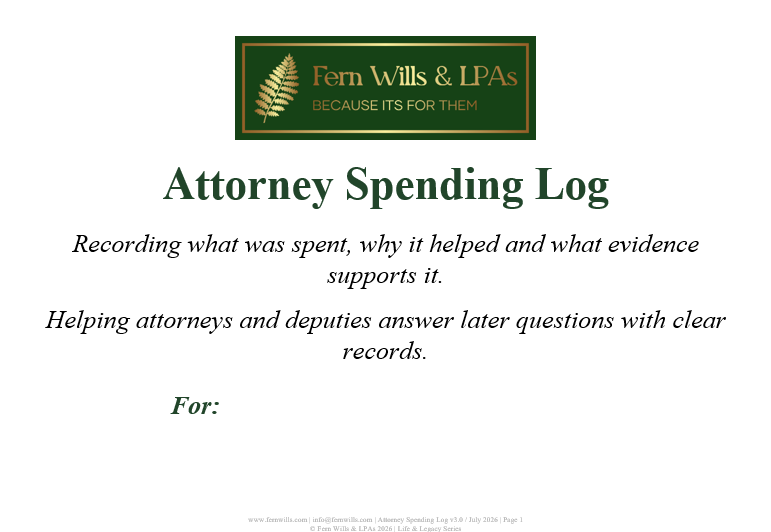
The Attorney Spending Log in Fern’s Life & Legacy Logs series provides a structured place to record bills, payments, services changed, evidence retained and significant best-interests decisions.
Find out more about Fern’s Life & Legacy Logs
The practical result
A successful household-bill review may produce:
- lower monthly costs;
- financial support that had previously been missed;
- fewer suppliers and renewal dates;
- clearer payment records;
- safer telephone and alarm arrangements;
- fewer unwanted subscriptions;
- better evidence for a family member or attorney;
- a clear date for the next review.
The best result is not merely the cheapest one.
It is an arrangement that is affordable, understandable, safe and practical for the person whose bills are being managed.
Need help getting organised?
Fern Wills & LPAs helps clients put practical estate-planning arrangements in place, including Wills, Lasting Powers of Attorney and Life & Legacy planning documents.
A good Lasting Power of Attorney is not simply a signed legal document. It should also make life easier for the people who may later need to help.
Fern Wills & LPAs is based on the Leicestershire, Warwickshire and Northamptonshire border, meeting clients locally and working by telephone or video across England and Wales where suitable.
This article is general information only, not individual advice.
If you would like help applying it to your circumstances, we can guide you through the options.