Foreign Property and Assets in Your UK Will

Last verified: April 2026 (England & Wales)
An England & Wales Will can cover foreign property or other overseas assets, but whether it should do so depends on the countries involved, how the assets are owned and any existing Wills. The useful starting point is a coordinated plan, with each document doing an agreed job.
A separate local Will may make administration easier in some countries. It is not automatically required. What matters is that the documents work together, do not accidentally revoke one another and take account of the law that governs inheritance.
This article explains the England & Wales side. France, Spain and Romania are examples; other countries can need the same care. Scotland and Northern Ireland also have separate legal systems, so “UK Will” is not one uniform set of rules.
For the nationality and residence question, read Do you need to be a UK citizen or resident to make a Will?.
The quick read
- Identify every relevant country, asset and existing Will before deciding the document structure.
- One coordinated Will or separate Wills may be appropriate. The number of documents is a planning decision.
- A Will’s validity, the rules about who inherits, and tax and administration are separate checks.
- Fern helps with England & Wales Will planning. Overseas legal and tax questions belong with an appropriate specialist.
Foreign assets include more than a holiday home
An overseas flat or house is an obvious reason to review your planning. Foreign bank accounts, investments and business interests can also need attention, even where you own no land abroad. The ownership arrangements and the institution holding the asset can affect what happens after death.
Tell each adviser about the whole picture. A document that works in one country may still leave gaps, overlap with another Will or make the overseas administration harder.

One Will or separate Wills
Separate Wills can allow each adviser to deal with a defined part of the estate and local administrative requirements. In another case, one Will may be suitable. Neither approach removes the need to consider the other country’s law.
Where more than one Will is used, the advisers must agree which assets each document covers and check the revocation wording. Revocation means cancelling an earlier Will. A broad cancellation clause in a later document can undermine planning made elsewhere.
An England & Wales Will may therefore need carefully defined scope and wording preserving a separate foreign Will. Those provisions require coordinated drafting. Do not add wording or make handwritten changes to your signed Will.
When specialist advice matters
Overseas advice is particularly useful where you own foreign property, already have a foreign Will, live abroad, have more than one nationality, or have family or business arrangements that connect the estate to another legal system.
The adviser should consider the applicable inheritance law, local administration and any tax consequences. A second Will does not by itself settle those questions. Equally, dual nationality alone does not mean that an otherwise straightforward England & Wales Will becomes difficult.

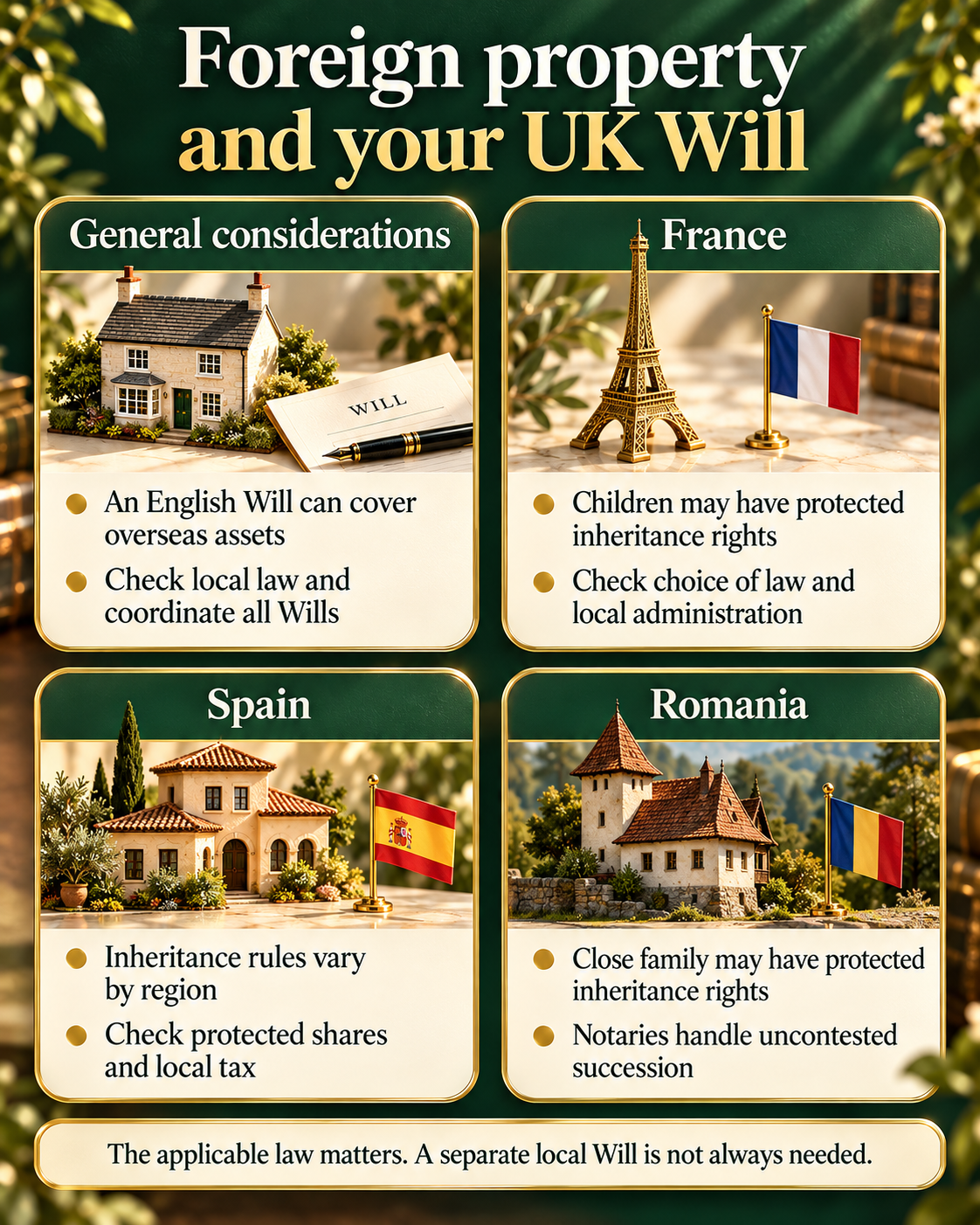
France Spain and Romania
These examples show why the country matters. They are background to England & Wales planning, rather than advice on an individual overseas estate.
France. An owner of French property should obtain French advice on the inheritance position and local administration. Reserved inheritance rights, which protect certain family members, and the effect of any choice of law need careful assessment. An English Will should not be assumed to settle everything.
Spain. Inheritance law varies between parts of Spain. Existing Spanish documents, where you live, nationality and the relevant regional rules can all affect the advice. The England & Wales and Spanish advisers should agree how the planning fits together.
Romania. Romanian property or an existing Romanian Will can require local input on inheritance rights and administration. For Romanian nationals settled in England whose assets are all here, nationality alone does not create a need for a Romanian Will. Relevant overseas connections should still be disclosed.
Three different legal questions
Formal validity asks whether a Will meets the applicable formal requirements. The Wills Act 1963 provides several routes by which a Will may be recognised as properly executed. Formal validity does not settle every question about its effect or who inherits.
Succession means the rules governing inheritance. In participating European countries, habitual residence, broadly where a person’s life is normally based, is an important starting point. A permitted choice of the law of a nationality held may also matter. These rules can be relevant to British nationals even though the UK did not participate in the EU Succession Regulation. Specialist advice is needed on the appropriate law and the effect of a choice.
Administration and tax remain separate. Local authorities, notaries, registries or financial institutions may require additional documents or procedures. Choosing an inheritance law does not choose the tax rules. From 6 April 2025, UK Inheritance Tax treatment of overseas assets moved to a long-term UK residence basis. Obtain individual tax advice, including on any continuing exposure after leaving the UK and possible double-tax relief.
Examples of how the planning fits together
These illustrative situations show the questions to resolve. They are not promises of a particular legal or tax outcome.
British and Spanish national living in Spain. An existing Spanish Will may leave an England & Wales property requiring separate attention. The advisers should establish the existing Will’s scope and coordinate any additional Will, including the effect of nationality and residence.
Brazilian couple living in England. With their home and other assets in England, their nationality alone does not prevent England & Wales Wills. Any overseas documents or continuing legal connections should be identified at the outset.
English couple with a French holiday home. Their English Wills remain important. French advice helps establish what should happen to the holiday home and whether a separate document would help, with both advisers checking the combined plan.
UK resident with a Spanish apartment. A separate Spanish Will may simplify the local arrangements, but it should be considered alongside the English Will. Two documents are useful only when their coverage and wording are coordinated.
Romanian nationals settled in Warwickshire. Where their house and savings are in England, the England & Wales planning may be straightforward. Romanian property, an existing Romanian document or other relevant connections would add questions for local advice.
UK resident with overseas accounts and investments. Foreign financial assets also belong in the discussion. Their ownership, location and provider requirements can affect whether the English Will is sufficient or local input is useful.

Can an English Will cover foreign property?
It can, but recognition, inheritance rights and local administration must be considered. Covering an asset in the wording does not establish that the chosen approach will work well in the other country.
Do I always need a second Will?
No. The country, assets, existing documents and practical administration determine whether one coordinated Will or separate Wills are suitable.
Can one Will cancel another by mistake?
Yes. Each adviser should know about the other Will, and the documents’ scope and revocation wording must be coordinated.
What if I live abroad but own property in England or Wales?
You can still need England & Wales Will planning. Your residence, nationality, existing Wills and the overseas legal position should be considered together.
What if I am not British and all my assets are here?
Nationality alone does not prevent an England & Wales Will. The separate citizenship and residence article explains that starting point.
Does this only apply to France Spain and Romania?
No. They are examples. Similar questions arise in other countries, although their legal and administrative rules differ.
Does Fern provide foreign tax or succession advice?
Fern helps with the England & Wales Will-planning side and identifies where overseas input is needed. An appropriate specialist must advise on foreign law, local administration and individual tax consequences.
Take the next step
If you own overseas assets or already have a foreign Will, tell me at the start of our conversation. I can explain the England & Wales Will-planning work Fern can help with and identify where advice from another country is needed.
Contact Fern about your Will planning. Please mention the countries involved and whether you already have any Wills.
Related reading: Do you need to be a UK citizen or resident to make a Will?
This article is general information only, not individual advice.