Choosing an Executor: what they do and how to pick the right one

Last verified: March 2026 (England & Wales)
Choosing an executor is one of the most important decisions in your Will.
This page is for people making or reviewing a Will in England and Wales who want to choose the right person, avoid common mistakes, and keep things practical for the family later on.
If you are unsure who to appoint, the next step is a short conversation about your family, your estate, and what is likely to work in real life.
The best executor is not always the person who feels most “fair” on paper. It is the person most likely to get the job done properly when the time comes.
Quick-read summary
- An executor is responsible for dealing with your estate after death.
- The role can include finding the original Will, applying for probate, collecting in assets, paying debts and tax, and distributing the estate.
- The best executor is usually someone trustworthy, steady, organised, and realistic about the job.
- Family is often the right starting point, but not always.
- In some cases, it is better to appoint family and build in the option of professional help later, rather than locking the estate into a professional appointment from day one.
- It is sensible to name at least one replacement executor.
- Executor choices should be reviewed over time. Someone suitable today may be older, unavailable, unwell, estranged, or no longer the best practical choice when the time comes.
- If you appoint more than one executor, check whether they are still likely to work together. Executors do not need to be friends, but they do need to communicate and make practical decisions.
- A short conversation with your chosen executor in advance is usually far better than surprising them later.
- Executors may need to check gifts made in the seven years before death. Clear lifetime-gift records can prevent confusion, delay and inaccurate reporting.
If you are making or reviewing your Will and are unsure who to appoint, the next step is a short call to sense-check the options.
Fixed-fee Will planning. England & Wales. Reviews available. Professional indemnity cover.
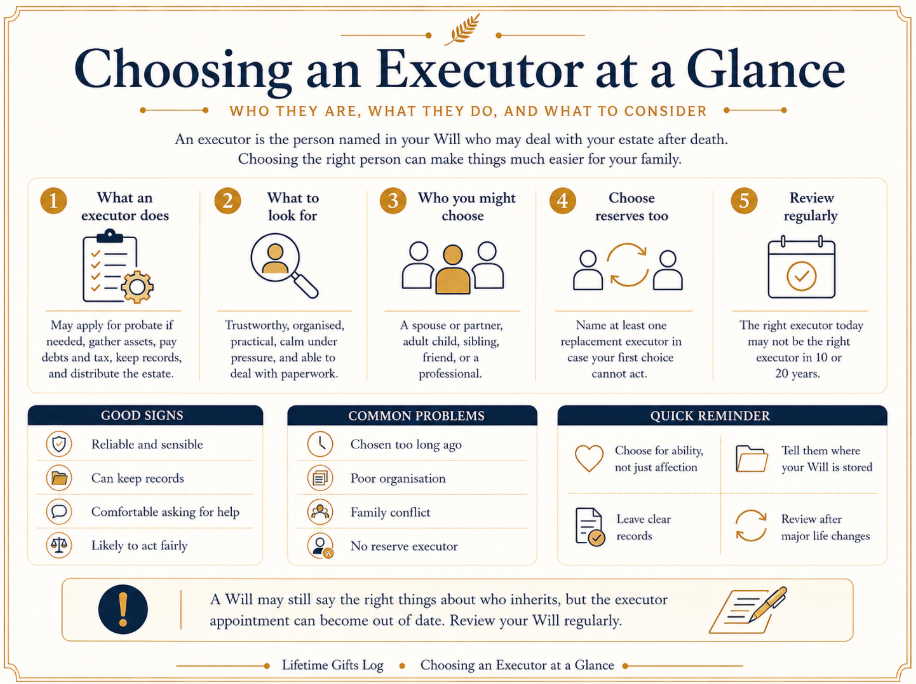
What an executor actually does
In simple terms, your executor is the person who carries out your Will.
That usually means:
- locating the latest original Will and any codicils
- dealing with the first practical steps after death
- valuing the estate
- applying for probate if required
- collecting in assets
- settling debts and liabilities
- dealing with inheritance tax paperwork where needed
- distributing the estate to the beneficiaries
- keeping proper records throughout
Just as importantly, an executor does not have to do every technical step personally. Many families sensibly keep the executor appointment within the family, then use professional Executor Support for the probate application, estate accounts, property sale, tax paperwork, or other specialist stages if the work becomes too heavy.
What makes a good executor
The best executor is not always the closest relative or the person most likely to feel honoured.
A good executor is usually someone who is:
Trustworthy
They may be handling money, paperwork, family expectations, and sensitive decisions.
Organised
Executors have to work through forms, statements, deadlines, and practical steps. Someone who avoids paperwork may struggle.
Calm under pressure
Executors often act during a period of grief, uncertainty, or tension. A steady temperament matters.
Able to communicate
They may need to deal with banks, HMRC, probate professionals, insurers, and family members. Good communication can reduce stress and avoid disputes.
Realistic about their time
They do not need to be an expert, but they do need enough time and energy to take the role seriously.
Sensible with money and admin
They do not need to be an accountant, but they should be comfortable dealing with figures, statements, and basic financial records.
You are not choosing the person you love most. You are choosing the person most likely to cope well with responsibility.
Will your executors still be right in 10 or 20 years?
When you appoint executors, you are choosing people based on the position now. But they may not need to act for many years.
If you are 55 today and appoint someone of a similar age, they may be 75 or older by the time they are needed. There is nothing automatically wrong with that. Many people remain perfectly capable, organised and practical well into later life.
The point is not age by itself. The point is whether your executors are still likely to be willing, able and available when the time comes.
When reviewing your Will, ask:
- Are my executors still alive, willing and capable?
- Are they still healthy enough to deal with paperwork, property, banks, investments and beneficiaries?
- Do they still get on with each other well enough to act together?
- Have any of them moved away, become unwell, become estranged, or become unsuitable?
- Should I now add a younger executor, such as an adult child, nephew, niece or trusted family member?
- Would a professional executor or professional support be useful as a fallback?
- Have I left enough records so my executors can work out what I own, what I owe, and what gifts I have made?
A Will may still say the right things about who inherits, but the executor appointment can become out of date. That is one reason regular Will reviews matter.
Your estate may not have changed very much, but the people you chose to deal with it may have changed completely.
Do your executors still get on well enough to act together?
If you appoint more than one executor, they do not have to be close friends. They do not even have to have a warm personal relationship. But they do need to be able to communicate, make decisions and deal with the estate in a practical way.
This can become a problem where a Will was made many years ago. People who got on well at the time may later fall out, lose contact, move away, become unwell, or no longer be suitable to act together.
When reviewing your Will, ask:
- Do my executors still speak to each other?
- Could they work together calmly if my estate needed to be dealt with?
- Would one executor be left doing all the work while another remained legally involved?
- Would disagreement between them delay probate, property sales, tax reporting or distributions?
- Should I replace one executor, add a younger executor, appoint a reserve executor, or consider professional support?
Executors do not need to be friendly, but they do need a workable process. A business-like approach can be enough: agree the documents, list the assets, identify the debts, check whether probate is needed, record decisions in writing, and keep beneficiaries updated.
If there is likely to be serious disagreement between executors, it is better to address that while reviewing the Will rather than leave the problem for your family after death.
Could your executors reconstruct lifetime gifts?
Executors may need to do more than list the assets you own when you die. They may also need to check whether you made significant gifts during your lifetime.
For Inheritance Tax purposes, gifts made in the seven years before death can matter. This can include money, property, land, buildings, personal possessions, stocks and shares, or selling something for less than it was worth.
That can be difficult for executors if there are no clear records. They may have to check old bank statements, ask family members, review transfers, and work out whether gifts were occasional, regular, exempt, or potentially relevant for Inheritance Tax.
When reviewing your Will, ask:
- Have I made significant gifts in the last seven years?
- Have I helped children or other family members with deposits, loans, cars, house costs, business support or regular payments?
- Have I kept a note of what was given, when, to whom and why?
- Would my executors know where to find that information?
- Would a Lifetime Gifts Log or Finance Log make their job easier?
A one-year review of bank statements may not be enough. If there have been significant lifetime gifts, executors may need to look back over the previous seven years and keep proper records of what they found.
This does not mean every small birthday present becomes a problem. It means larger gifts, repeated gifts, gifts involving property or shares, or gifts where you continued to benefit from the asset should be recorded clearly.
Family, friend, or professional?
There is no universal right answer.
Family or friends
This is often the best place to start. In many families, a trusted relative or friend can do the job perfectly well.
That can work especially well where:
- the family gets on reasonably well
- the estate is fairly straightforward
- the chosen executor is practical and willing
- there is no obvious risk of conflict
A professional executor
In some cases, a professional executor can be helpful.
That may be because:
- the family dynamics are difficult
- the estate is complex
- there is likely to be conflict
- nobody suitable is available
- or the client wants continuity and neutrality
That said, it is a mistake to think the only choices are “family does everything” or “a professional takes over from day one”.
A blended approach
Often the most sensible answer is a middle ground.
A trusted family member can still be appointed as executor, but with the expectation that they can use professional Executor Support if needed for the probate application, estate accounts, property sale, tax paperwork, or other technical stages. That keeps control with the family while giving them somewhere to turn if the work becomes too heavy, too technical, or too time-consuming.
In some cases, a professional may still be appropriate as a reserve or co-executor. The key point is that support should usually be available as an option, not forced as the starting position.
This usually gives families the best balance of control, practicality, and cost awareness. Executor Support
Should your Will writer or solicitor be your executor?
Some providers encourage clients to appoint them as executor from the outset.
It may sound convenient. They know the Will. They know the process. They can step in later.
But that can also create a conflict of interest and remove choice from the family at the very point when they are most vulnerable.
At Fern Wills & LPAs, we do not appoint ourselves as your primary executor. Our view is that families should usually remain in control, with professional help brought in only if and when it is genuinely needed.
Professional help can be useful. Being locked into it from the start is a different matter.
Co-executors and replacement executors
You do not have to appoint just one executor.
Two can work well, especially where they have different strengths. For example, one may be practical and local, while another knows the family finances well.
Too many executors can slow things down. Every extra person adds another layer of coordination. In most cases, one or two executors is enough.
It is also wise to name at least one replacement executor. Circumstances change. Someone may die first, lose capacity, move abroad, or simply not want the job when the time comes.
A good Will should allow for that.
What if my children live abroad or are too busy?
This is a common concern.
Distance or a demanding career does not automatically make someone the wrong choice. The better question is whether the Will is structured sensibly around the reality.
Sometimes the right answer is still to appoint the child you trust most, but to build in flexibility so they can bring in help if needed. In other cases, it is better to appoint a local relative or add a reserve.
The aim is not perfection. It is to make the role workable.
Talk to your chosen executor first
A short honest conversation now is usually much better than an unpleasant surprise later.
You do not need a dramatic meeting. A simple conversation is often enough:
“I’m updating my Will and would like to ask if you would feel comfortable acting as my executor. It would involve dealing with the estate, paperwork, and practical steps after my death. You would not be expected to know everything in advance, and support can be brought in if needed. Would that feel manageable?”
That sort of conversation often reveals useful things early. Someone may be willing but worried about time. Someone else may prefer not to do it. You may also discover practical issues such as distance, health, family tension, or whether they would feel more comfortable using professional support rather than handling the entire process alone. It is much easier to deal with that now than after death.
Executors and trustees are not always the same thing
People often use the terms loosely, but they are not always identical.
An executor deals with the estate administration after death where there is a Will.
A trustee looks after assets held on trust. Sometimes the same person is both executor and trustee. Sometimes they are not.
If there is no Will, the person dealing with the estate is usually called an administrator rather than an executor. In day-to-day conversation people often blur those terms, but the distinction matters.
For a straightforward Will, the executor / trustee distinction may not matter much in practice. For trust Wills, children’s trusts, property trusts, or more complex planning, it can matter a great deal. The Will should make the structure clear.
When a Will includes a trust, it is worth thinking about trustee suitability separately. A trustee may need to balance competing beneficiaries, deal with property, follow a Letter of Wishes, take advice, keep records, and make decisions over time. The best executor for the immediate estate administration is not always the best long-term trustee. Where a surviving partner, children from different relationships, guardians, or vulnerable beneficiaries are involved, that choice should be considered carefully rather than assumed.
Executors and digital assets
Executors increasingly deal with more than paper files and bank accounts.
Many estates now include:
- email accounts
- cloud storage
- online banking access points
- subscriptions
- digital photographs
- social media accounts
- online business tools
- cryptocurrency or digital investments
- domain names and online income streams
That does not mean your executor needs to be a tech expert. But it does mean they need enough clarity and support to identify what exists and what needs dealing with.
A separate record of your assets, accounts, and key practical information can make the role much easier.
What good planning looks like
Good executor planning usually means:
- choosing the right person, not the most obvious one
- keeping the number of executors sensible
- naming at least one replacement
- building in flexibility for professional support if needed
- being realistic about the complexity of the estate
- making sure the executor knows where the original Will is stored and how to obtain it quickly
- keeping a secure written record of key assets, liabilities, policies, subscriptions, and practical contacts
- using a Letter of Wishes and sensible document storage arrangements where they would make the job easier
- thinking through any likely tension between the people appointed.
If you want a practical guide to what your executor will actually need later, see What to leave behind to make life easier for your executor. It covers the original Will, storage, records, digital details, and practical guidance that can make the job much easier for the person dealing with your estate.
An executor does not need to know everything today. They need to be the sort of person who can deal with the job when it arrives.
Cases
The “fair” choice that was not practical
Margaret named both daughters as joint executors because she wanted to be fair. In reality, one daughter was organised and local, while the other avoided paperwork and often delayed decisions. On review, Margaret appointed the practical daughter as main executor and kept the other involved in a different way. The plan became clearer and more workable.
The son living abroad
Philip wanted to appoint his eldest son, who lived overseas. That was still the right choice for family reasons, but the Will was structured so professional support could be brought in if the practical side became too heavy. That kept control in the family without pretending geography did not matter.
The blended family with tension beneath the surface
A remarried client initially wanted to appoint one child from each side of the family as joint executors “to keep the peace”. In practice, the relationship was already strained. A clearer structure, plus a reserve option, reduced the risk of conflict later.
The trusted friend who was not good with admin
A client wanted to appoint his oldest friend because he was loyal and kind. On discussion, it became obvious that the friend hated paperwork and would probably feel overwhelmed. The client instead chose a more practical relative, while keeping the friend involved informally.
The widow who wanted to avoid burdening her children
Susan’s children were loving and responsible, but both had demanding jobs and young families. Rather than assuming they would cope somehow, she appointed one child as main executor, named a reserve, and built in flexibility for outside help if needed. That gave reassurance without locking the estate into permanent professional control.

What does an executor do?
An executor administers the estate after death. That may include locating the original Will, valuing assets, applying for probate, paying debts and tax, keeping records, and distributing the estate in line with the Will.
Does an executor have to act?
No. A named executor does not have to take the role on. If they do not want to act, the correct route depends on what stage the estate has reached and whether they have already started dealing with it, so it is better to deal with that promptly.
Who deals with the estate if there is no Will?
If there is no Will, the estate is usually dealt with by an administrator rather than an executor. The estate is then administered under the intestacy rules.
Can an executor also be a beneficiary?
Yes. That is very common. A spouse, child, or other beneficiary can also be an executor.
Can my executor be a witness as well?
Being an executor does not by itself prevent someone witnessing a Will. But if that person is receiving a gift under the Will, or is the spouse or civil partner of someone receiving a gift, they should not be used as a witness. In practice, it is safer to use independent witnesses.
Can an executor claim expenses?
Lay executors are not usually paid for their time, but they can usually recover reasonable out-of-pocket expenses of administering the estate. Keeping receipts and a simple running record is sensible from day one.
Does holding an LPA make someone the executor?
No. A Lasting Power of Attorney works while the donor is alive and ends on death. From that point, the executors or other personal representatives take over.
Does my executor have to do everything alone?
No. A family executor can remain in control while using professional Executor Support for the whole process or only for the stages that are technical, time-consuming, or high risk.
What if my executor lives abroad?
They may still be suitable, but the practicalities need thinking through carefully. In some cases, a reserve appointment or a plan for professional support makes the arrangement more workable.
Should I appoint a professional executor?
Sometimes, yes. But many families are better served by appointing the right family executor and keeping professional support available as a sensible middle ground rather than the automatic default.
This article is general information only, not individual advice.
If you would like help applying this to your circumstances, we can guide you through the options.
Next steps
Fern Wills & LPAs can help you work out:
- who is best suited to the role
- whether one or two executors is sensible
- whether a replacement should be added
- whether family appointment plus professional Executor Support is the sensible middle ground
- whether your Will, Letter of Wishes, and document storage arrangements actually support the plan in practice
If you are making a new Will, the next step is a short call to confirm your aims and the people you are considering. We then prepare draft Wills for you to review and guide you through signing and safe storage.
If you already have a Will, a Will MOT can review whether the named executors are still right, whether the structure is still workable, and whether anything should be tightened now before it causes avoidable stress later.