Why Lasting Powers of Attorney matter for carers and their loved ones

Last verified: July 2026 (England & Wales)
Quick-read summary
The Office of the Public Guardian has highlighted why Lasting Powers of Attorney matter for carers and the people they support.
There are estimated to be over five million unpaid carers in England and Wales. Many are already helping with appointments, medication, care arrangements, bills, benefits, banks, utilities and day-to-day decisions.
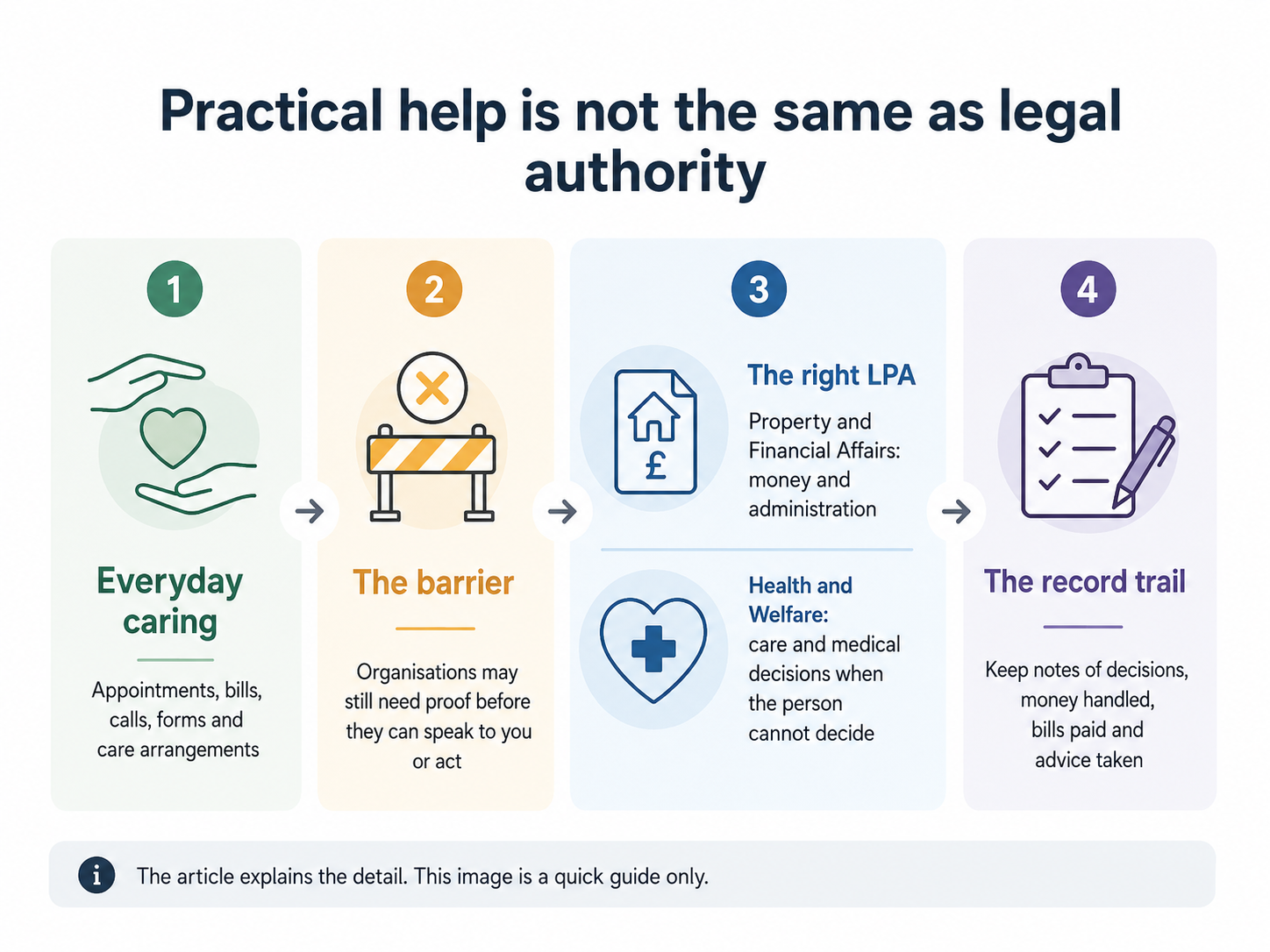
But practical help is not the same as legal authority. Without a registered Lasting Power of Attorney (LPA), a spouse, adult child, relative or friend can still run into barriers when speaking to banks, care providers, GP practices, hospitals, local authorities or other organisations.
A properly prepared LPA gives trusted attorneys clearer authority to help or act where the law allows. It can make family support calmer, clearer and easier before a crisis makes everything harder.
There are two main types:
- A Property and Financial Affairs LPA can cover money, bills, bank accounts, pensions, benefits and property. It can be used once registered, with the donor’s permission.
- A Health and Welfare LPA can cover care, medical treatment, daily routine, care-home decisions and life-sustaining treatment. It can only be used when the donor cannot make the relevant decision for themselves.
If you are caring for someone, or someone may need to care for you, an LPA is not just paperwork. It is practical authority for real-life support.
At Fern Wills & LPAs, I help people put clear LPA arrangements in place properly, with the right people appointed and the right safeguards considered.
Practical checklist — triggers for carers
You may need to explore an LPA if:
• you are helping with banking, bills, benefits, pensions, utilities or care invoices;
• the person you support has a diagnosis or symptoms that may affect decision-making, such as dementia, stroke, brain injury or a serious mental-health episode;
• medical teams, care providers or social services already ask for your input;
• there is hospital discharge planning, a care-home move, a care-package review or a Continuing Healthcare assessment;
• unpaid bills, frozen accounts, online banking problems or locked utility accounts are becoming an issue;
• you need to speak formally to DWP, the local authority, GP surgery, hospital, bank, pension provider or care provider;
• several family members or carers are involved and nobody is quite sure who can decide what;
• an existing LPA is out of date because an attorney has died, moved away, lost capacity, fallen out with the family or is no longer suitable;
• you are relying on work-arounds, such as phoning as the person, signing for them, or trying to manage accounts without proper authority;
• you are worried about what would happen if the main carer became ill, unavailable or exhausted.
The earlier these triggers are spotted, the more likely it is that the person can make their own LPA while they still have the required understanding.

What to consider
Authority versus assumption: without an LPA, organisations can refuse to deal with you even if you are the spouse, adult child or main carer.
When each LPA applies: a Property and Financial Affairs LPA can be used once registered if the donor has allowed that and still agrees while they have capacity. A Health and Welfare LPA can only be used when the donor cannot make the relevant decision themselves.
Duties and accountability: attorneys must act in the donor’s best interests, keep proper records, avoid conflicts of interest and be able to justify decisions if the Office of the Public Guardian or Court of Protection asks questions.
Records matter: attorneys should keep notes of important decisions, money handled, care arrangements, reimbursements, gifts, family payments, bills paid and advice taken.
Voices from the front line
Alison (Carer)
“With regard to the issue of dealing with service providers on behalf of your loved one, the single biggest help by far is having an LPA in place. When my mum died suddenly and my siblings and I took on Dad’s care, having an LPA was invaluable — without it a stressful situation would have been ten times worse. I have an LPA for myself as well, even though I hope it won’t be needed for a good few years yet!”
Sarah’s experience
We recently helped a client — we’ll call her Sarah — who was caring for her mum after a stroke. With an LPA in place, she could handle the bills, talk to the GP, and organise care packages quickly. Without it, every step would have required extra forms, delays, or even a court application.
Jazz’s example
Jazz supported her mother by helping with weekly shopping. When her mum’s health declined, having an LPA allowed Jazz to manage not just groceries but also online orders, utility bills, and access to care funding without hitting bureaucratic walls.
Ruth Duffin, Public Guardian and CEO of the Office of the Public Guardian
Ruth Duffin, Public Guardian and CEO of the Office of the Public Guardian, has described LPAs as a way for people to take control of their future and provide lasting reassurance for carers and their loved ones.
Carers UK has also highlighted the reassurance an LPA can give unpaid carers, because it can provide legal authority to support and act in the best interests of the person they care for if that person can no longer make decisions for themselves.
That is the key practical point. Many carers are already doing the work. An LPA can make the authority clearer.
”Emily Holzhausen CBE, Director of Policy and Public Affairs at Carers UK
“For unpaid carers, having an LPA in place can bring vital reassurance, knowing you have the legal authority to support and act in the best interests of the person you care for, if they’re ever unable to make decisions for themselves. Talking about future care, finances or medical wishes can be difficult and overwhelming. But having those discussions early can make a real difference for carers, providing clarity when it’s needed most.”
Jenny (Carer)
“My husband and I discussed everything when he first had a diagnosis. We recorded his wishes and put an LPA in place before he lost the capacity to make decisions. It gives me such peace of mind; I know what he would want, and it means the family and professionals are also aware, therefore, there are no problems.”

Can a paid carer be an attorney?
It is usually not a good idea because of conflict-of-interest risks. A family member, trusted friend or suitable professional adviser is usually a better route. If the only possible attorney is connected to paid care, take advice before proceeding.
Does “next of kin” give me legal rights?
No. Hospitals and banks may ask who the next of kin is, but it carries no legal authority. Only an LPA (or a court order) provides that.
If my loved one still has capacity, can I use a Health & Welfare LPA?
No. These only come into effect once the donor has lost capacity.
Do I need an LPA if I’m already a DWP appointee?
Being an appointee only covers benefits. You’ll need an LPA for wider financial matters like bank accounts or property.
What if there’s no LPA in place?
You may need to apply for deputyship through the Court of Protection, which is usually slower, more expensive and more restrictive than having an LPA in place in advance.
Can I name more than one attorney — and must they agree?
Yes, and we strongly recommend that you do. You can appoint attorneys jointly (must agree on every decision), jointly and severally (they can act together or separately), or a mix for different decisions. We’ll help you choose the safest structure for your situation.
Can my attorney start helping with money before capacity is lost?
Only if the LPA expressly allows use while the donor still has capacity; otherwise they must wait.
What records should attorneys keep?
Attorneys should keep clear records of important decisions, money handled, bills paid, advice taken, gifts or family payments, reimbursements and any concerns raised. Good records protect the donor and the attorney.
Fern Wills & LPAs can also provide practical record-keeping tools through the Life & Legacy Logs range, including the Attorney Spending Log, where a family wants extra structure for attorney spending, care arrangements or important documents.
What happens if an attorney behaves improperly?
The Office of the Public Guardian or the Court can investigate, require information, and in serious cases remove an attorney. Best-interests decisions and good record-keeping are your safeguards.
How do I get started properly?
Contact Fern Wills & LPAs. We set up both LPAs with the right safeguards and manage OPG registration so it’s valid when you need it.
Related Fern guides and practical tools
If this article is relevant to your family, these may also help:
- Appointing Attorneys in a Lasting Power of Attorney: how to choose the right people, use replacements and avoid an LPA that fails in practice.
- What gifts can attorneys make?: a practical guide to gifts, family payments and why records matter.
- Life & Legacy Logs: practical record-keeping tools for attorneys, deputies, executors and families.
- Lasting Powers of Attorney: Fern’s fixed-fee LPA service and what happens next.
Optional reading: technical notes
- Legal framework: LPAs are governed by the Mental Capacity Act 2005.
- Who can be an attorney: Must be over 18, with mental capacity.
- Registration fee: the Office of the Public Guardian registration fee is currently £92 per LPA, with reductions or exemptions available in some circumstances.
- Registration: an LPA must be registered with the Office of the Public Guardian before it can be used.
- Timeline: The OPG typically takes 8–10 weeks to process.
- Carer’s rights: Carer’s Assessments under the Care Act 2014 & Carer’s Leave (since April 2024) allows up to 1 week of unpaid leave per year.
Sources & further reading
Next steps
LPAs are not just legal paperwork. For carers and families, they can be the difference between practical support that works and practical support that gets blocked.
Fern Wills & LPAs can help you:
- decide who should act as attorney;
- choose whether you need one or both types of LPA;
- think through safeguards, preferences and practical concerns;
- prepare the documents clearly; and
- handle the registration process with the Office of the Public Guardian.
If you are already caring for someone, or you want to make things easier for the people who may one day care for you, contact Chris Watts at Fern Wills & LPAs for a clear, practical discussion.