Where can families find dementia support in Market Harborough, Rugby and nearby areas?
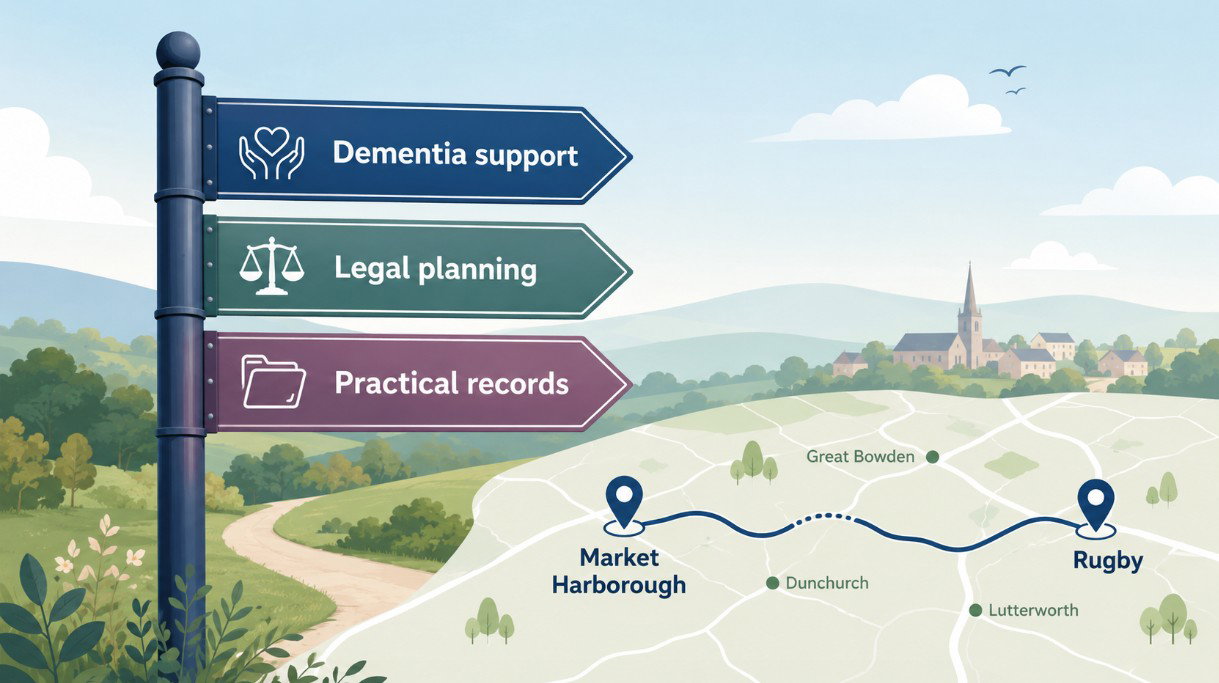
Last verified: June 2026 (England & Wales)
Where should a family start when dementia, memory loss or changing capacity has become part of daily life?
Usually, the answer is not one single service. A family may need medical advice, local support, carer guidance, legal planning, practical record keeping and time to understand what is changing.
This guide brings together useful dementia support for families in Market Harborough, Rugby and nearby areas. It also explains where Lasting Powers of Attorney (LPAs), Wills and family records can fit into the wider picture.
Quick-read summary
If someone is showing possible symptoms of dementia, the starting point is usually their GP. If there is an urgent safety or medical risk, use NHS 111 or 999 as appropriate.
For Market Harborough and the surrounding area, Dementia Harborough is a useful local charity signpost for people affected by dementia and their carers.
For Rugby and Warwickshire, Warwickshire County Council’s Living Well with Dementia information, Alzheimer’s Society Dementia Connect and Age UK Coventry & Warwickshire are sensible places to check.
National support is also available from the NHS dementia care and support pages, the Alzheimer’s Society Dementia Support Line and the Dementia UK Admiral Nurse Dementia Helpline.
Legal planning is separate from care support, but it often sits alongside it. LPAs, Will reviews, attorney guidance and practical records can make life easier for the whole family.
Start with health and care support
Dementia is not ordinary forgetfulness. It is a group of symptoms linked to diseases that affect the brain. Different types of dementia can affect people differently, but common early signs can include memory loss, confusion, changes in communication, difficulty with familiar tasks, mood changes or getting lost in time and place.
If you are worried about yourself or someone close to you, the usual first step is to speak to the GP. A diagnosis, or even an assessment process, can help a family understand what support may be available and what needs planning.
Dementia is also common enough that most families should treat it as a practical planning issue, not a rare event. Alzheimer’s Research UK estimates that around 982,000 people were living with dementia in the UK in 2024, with the figure expected to rise to around 1.4 million by 2040.
Local support in Market Harborough and Harborough District
For families in Market Harborough and nearby villages, Dementia Harborough is a sensible local starting point.
Dementia Harborough is an independent registered charity supporting people affected by dementia in Market Harborough and the surrounding areas. Its activities include a Dementia Café, Singing for Memories and trips, giving people living with dementia and their carers opportunities to meet others, share time together and stay connected locally.
This type of support matters because dementia affects the whole family. The person with dementia may need company, routine and reassurance. A spouse, adult child or carer may need somewhere to ask questions, speak to people who understand, and avoid feeling that everything has to be managed alone.
Specialist dementia coaching: Empatia Dementia
For families who need individual support beyond general signposting, Empatia Specialist Dementia Coaching is a strong option to consider.
Empatia is led by Amy Kerti, a Dementia Specialist Nurse and Mental Health Nurse with over 20 years’ experience across clinical care, education, research and dementia-service development. Her work focuses on helping families understand what is happening, reduce distress, improve communication and plan ahead in a way that feels manageable.
This sits alongside, not instead of, medical advice, local-authority support or legal planning. Fern Wills & LPAs can help with Wills, Lasting Powers of Attorney and practical records. Empatia can help with the specialist dementia coaching and family-support layer around those decisions.
Amy offers in-person support across Northamptonshire and South Leicestershire, with online support available more widely. You can find out more through Empatia Specialist Dementia Coaching.
Support in Rugby and Warwickshire
If you are nearer Rugby or elsewhere in Warwickshire, useful starting points include:
Warwickshire County Council: Living well with dementia
Alzheimer’s Society Dementia Connect
Age UK Coventry & Warwickshire
Dementia support changes by area, funding and availability, so always check current details directly with the provider. A GP surgery, social prescriber, local council, memory clinic or carer-support organisation may also be able to signpost to current local groups.
Support across Leicestershire, Rutland and Northamptonshire
Families do not always live neatly inside one local area. A person may live in Market Harborough, have children in Rugby, attend appointments in Leicester, or have carers coming from Northamptonshire.
For Leicestershire and Rutland, useful starting points include:
Age UK Leicester Shire & Rutland Dementia Support Service
Leicestershire County Council dementia support directory
For Northamptonshire, useful starting points include:
Northamptonshire Healthcare NHS Foundation Trust Admiral Nursing Service
Northamptonshire Carers dementia care advice
If you are not sure which area applies, start with the person’s GP, local council or the national helplines below.
National dementia support
National services can be useful if local support is full, unclear, or hard to access.
NHS dementia care and support explains diagnosis, care, support and practical next steps. If you are worried about your own memory, or someone else’s memory, the NHS route is usually to speak to the GP first. If there is immediate danger, use 999.
Alzheimer’s Society Dementia Support Line can provide dementia information and support. The support line is 0333 150 3456.
Dementia UK Admiral Nurse Dementia Helpline gives access to dementia specialist Admiral Nurses. The helpline is 0800 888 6678.
Alzheimer’s Research UK dementia statistics gives wider information on dementia prevalence, impact and research.
Where legal and practical planning fits in
Care support and legal planning are different things, but families often need both.
A dementia diagnosis does not automatically mean someone has lost mental capacity. Capacity is decision-specific and time-specific. A person may still be able to make some decisions for themselves, even if they need help with others.
That matters because LPAs can only be made while the person still has the required understanding to make them. Once capacity has been lost for the relevant decision, the family may need to consider a Court of Protection route instead, which can be slower and more expensive.
Practical planning may include:
putting Property and Financial Affairs and Health and Welfare LPAs in place;
reviewing an existing Will to check whether it still reflects the person’s wishes;
making sure attorneys know how and when they can act;
keeping records of which banks, care providers, GP surgeries, utilities and other organisations have been told about an LPA;
keeping clear notes of spending made on behalf of the person;
making sure key documents are stored safely and can be found when needed.
For more detail on the LPA service, see Lasting Powers of Attorney.
If an LPA has already been registered and the family now needs to use it, see What is the best way to activate and use your LPA online?.
If the family needs practical record-keeping tools, see Life & Legacy Logs. These include the LPA Activation Log for recording which organisations have accepted the LPA, the Attorney Spending Log for spending and best-interest notes, and other practical records for family administration.
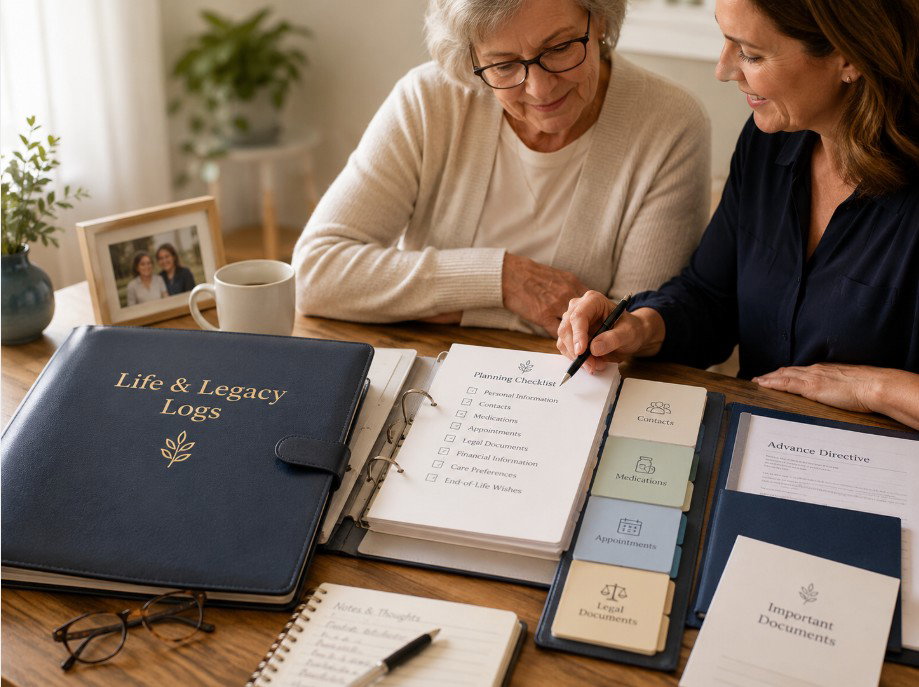
NOTE: Image for illustration only. Actual logs may differ.
How Fern Wills & LPAs can help
Fern Wills & LPAs does not provide clinical dementia care, medical advice or social-care assessments. Those should come from the right health, care or local-authority professionals.
What we can help with is the legal and practical planning around incapacity, family authority and future decision-making.
Chris holds a Level 2 Certificate in the Principles of Dementia Care, which helps inform the way Fern supports families dealing with capacity, LPAs and later-life planning. The aim is to keep the process careful, patient and well recorded, especially where memory concerns, family pressure or uncertainty are part of the picture.
We can help with:
preparing LPAs while the person still has capacity to make them;
reviewing whether existing LPAs and Wills still fit the family situation;
explaining how attorneys can use a registered LPA in practice;
providing practical Life & Legacy Logs for LPA activation, attorney spending records and family administration;
identifying when a medical opinion, care professional, solicitor or other specialist may be needed.
How this works in real life
“Mum is managing most things, but bills and appointments are starting to slip.”
A daughter notices that her mother is repeating conversations, missing letters from the bank and becoming anxious about appointments. The family speaks to the GP and starts looking for local support.
Because they live near Market Harborough, they check Dementia Harborough and also look at national support from the Alzheimer’s Society and Dementia UK. If they later need more individual help with communication, distress or family strain, they can consider specialist dementia coaching as a separate support layer.
At the same time, they check whether LPAs are already in place. If not, they consider whether their mother still understands the choices well enough to make them. They also start a simple record of important accounts, care contacts and who has been told about what.
No one part solves everything. The value is in joining the support together before a crisis forces rushed decisions.

Dementia support, LPAs and family planning frequently asked questions
Is dementia the same as losing mental capacity?
No. Dementia and mental capacity are linked, but they are not the same thing. Capacity depends on the specific decision and the person’s ability to understand, retain, weigh and communicate the relevant information at the time.
Can someone make an LPA after a dementia diagnosis?
Sometimes, yes. A diagnosis does not automatically prevent someone from making an LPA. The question is whether they still have the required mental capacity to understand and make that particular decision. If there is doubt, extra care, records or medical input may be needed.
Does being “next of kin” let me deal with banks, care providers or doctors?
Not usually. “Next of kin” is not the same as having legal authority. For finances, property and many practical organisations, a registered Property and Financial Affairs LPA is often needed. For health and welfare decisions, a Health and Welfare LPA may be needed if the person cannot make that decision themselves.
Should attorneys tell every organisation about the LPA straight away?
Not always. It is often better to start with the organisations that matter most: bank, pension provider, GP surgery, care provider, council, utilities and insurance. Keep a simple record of who has been told, what proof they needed and whether any follow-up is outstanding.
Are local dementia charities the same as legal advisers?
No. Local charities and support groups can be invaluable for emotional support, activities, carer guidance and signposting. Legal planning is a separate layer. A family may need both.
Is specialist dementia coaching the same as medical advice?
No. Specialist dementia coaching can help families understand and manage communication, distress, behaviour changes and planning pressures. Medical diagnosis, treatment and clinical decisions should come from the appropriate health professionals.
Where should we start if everything feels urgent?
If there is a medical or safety emergency, use emergency or NHS routes first. If the issue is legal or practical, start by checking whether valid LPAs exist, where the original documents are stored, and who is appointed to act.
Sources and further reading
Empatia Specialist Dementia Coaching
Warwickshire County Council: Living well with dementia
Alzheimer’s Society Dementia Connect
Age UK Coventry & Warwickshire
Age UK Leicester Shire & Rutland Dementia Support Service
Leicestershire County Council dementia support directory
Northamptonshire Healthcare NHS Foundation Trust Admiral Nursing Service
Northamptonshire Carers dementia care advice
Alzheimer’s Society Dementia Support Line
Dementia UK Admiral Nurse Dementia Helpline
Alzheimer’s Research UK dementia statistics
What is the best way to activate and use your LPA online?
Next step
If your family is dealing with dementia, memory concerns or changing capacity, the first step is to separate the issues.
Health and care questions should go to the right medical, care or support service.
Legal and practical planning questions can often be dealt with through LPAs, Will reviews, attorney guidance and clear family records.
If you would like help working out which planning step comes next, you can send a message to Fern Wills & LPAs.
This article is general information only, not individual advice.
If you’d like help applying this to your circumstances, we can guide you through the options.