What age should children inherit: 18, 21 or 25?

Last verified: July 2026 (England & Wales)
Quick answer
For a modest cash legacy, age 18 is usually the cleanest starting point. Age 21 can be a sensible compromise. Age 25 should be a deliberate protection choice, because the additional years can keep trustees involved for longer and may create registration, tax-record and professional-cost burdens.
The age written in the Will does not, by itself, decide the tax treatment. The result also depends on who has died, whether the beneficiary already has an absolute interest, whether reaching the stated age is a genuine condition, and whether the special bereaved-minor or age 18-to-25 statutory rules apply.
The practical question is therefore not simply, 'Which age sounds safest?' It is, 'What protection is needed, how much is involved, and is the longer trust proportionate?'
Two separate questions must be answered
People often blend together two different decisions:
- At what age should the beneficiary receive control: 18, 21 or 25?
- What legal and tax type of trust will the Will actually create?
The same age can produce different results under different Wills. Good drafting starts with the intended protection and then checks the legal, tax and administrative consequences.
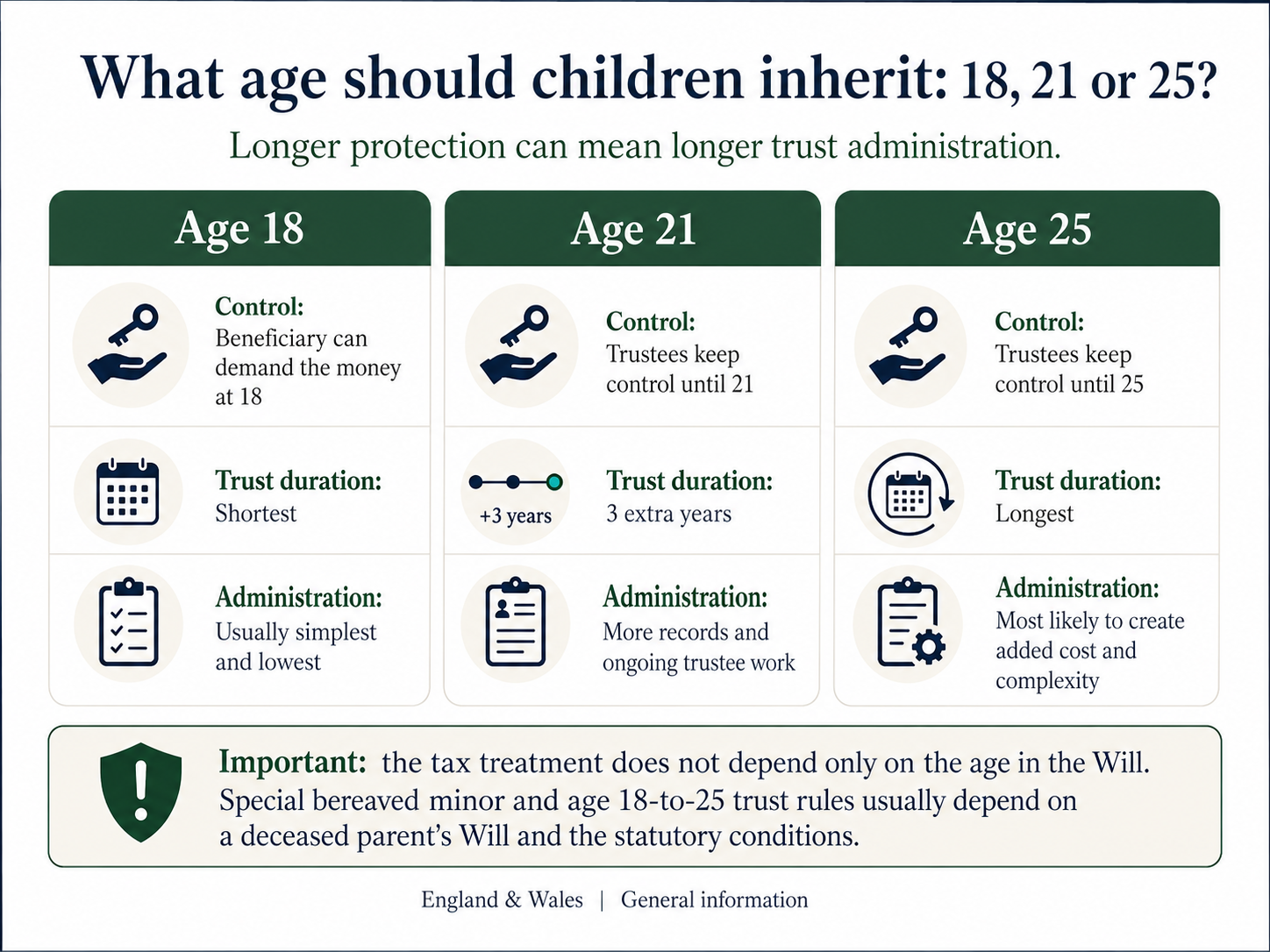
Age 18: usually the simplest route
An absolute gift to someone under 18 normally has to be held for them because a child cannot give a valid receipt. When the beneficiary reaches 18, they can normally take control of the money.
For a modest cash gift, this is often the least expensive and least complicated choice. Trustees can usually use appropriate income or capital for the child's education, maintenance or welfare before 18, subject to the Will and their legal powers.
The trade-off: once the beneficiary is legally entitled at 18, trustees cannot continue withholding the fund merely because they think the beneficiary is not mature enough.
Age 21: a practical compromise
A genuine gift conditional on reaching 21 can give trustees three additional years of control. That may be worthwhile where the inheritance is substantial, the beneficiary is likely to need support, or there is a clear concern about pressure, exploitation or financial maturity.
The wording matters. Merely directing trustees to pay at 21 does not always mean that entitlement is genuinely postponed until 21. A beneficiary may already have an absolute beneficial interest, with payment only deferred. The whole clause must therefore be checked, not just the age.
The trade-off: the trust continues for longer and may require more trustee decisions, records, registration checks, tax work and professional administration.
Age 25: stronger protection, greater administration
Age 25 gives the longest delay of the three common choices. It can be appropriate for a substantial inheritance or where there is a clear, evidence-based protection reason.
It should not be selected automatically. For a modest legacy, the cost and effort of keeping a trust running for several extra years may be disproportionate to the amount protected.
The trade-off: maximum control before 25, but the longest period of trustee responsibility and the greatest potential for registration, tax-record and professional-cost burdens.
The special rules when a parent dies
The expressions 'bereaved minor trust' and 'age 18-to-25 trust' have specific statutory meanings. They do not describe every trust for a young person.
Bereaved minor trust
A qualifying bereaved minor trust will usually arise under the Will or intestacy of a deceased parent, or under a specified compensation scheme. The beneficiary must become absolutely entitled by age 18 and, while under 18, the trust property and income must be used only in accordance with the statutory conditions.
For these rules, a parent can include a step-parent or a person who had parental responsibility immediately before death. Where the conditions are met, the trust receives special Inheritance Tax treatment and is not treated as an ordinary relevant-property trust.
Age 18-to-25 trust
A qualifying age 18-to-25 trust is also a special statutory regime. It is generally limited to a deceased parent's Will or a specified compensation scheme. The beneficiary must become absolutely entitled on or before 25 and must satisfy the statutory income and benefit conditions while the trust continues.
A proportionate Inheritance Tax charge may arise when property leaves the trust after the beneficiary turns 18 and before 25. There is no ordinary ten-year anniversary charge while the special regime applies.
What about grandchildren, nieces, nephews and other young beneficiaries?
A grandparent cannot create the special age 18-to-25 regime merely by saying that a grandchild should inherit at 21 or 25. A genuine age-contingent gift under a non-parent's Will will commonly fall within the ordinary relevant-property trust rules.
There is an important distinction. If the beneficiary is already absolutely entitled and the Will only postpones payment, the arrangement may instead be a bare trust. If the beneficiary must survive to the chosen age before becoming entitled, it is not normally a bare trust.
This is why two Wills that both mention age 21 can produce different ownership, tax and administration outcomes.
Registration, tax records and professional costs
A Will trust that holds only estate property is generally excluded from Trust Registration Service registration for the first two years after death. Qualifying bereaved minor and age 18-to-25 trusts also have specific registration exclusions while their conditions are met. Other ongoing express trusts may need to be registered, even where little or no tax is ultimately payable.
The practical burden can include trustee records, bank or investment administration, tax returns, professional advice and eventual distribution work. For a small fund, those costs may matter more than the tax charge itself.
A standalone cash legacy does not itself use the Residence Nil-Rate Band. If a home or part of the residue is held on trust for direct descendants, the residence allowance requires a separate review of the Will and the estate.
Can trustees pay money to a parent or guardian?
A Will may allow trustees to pay money to a parent or guardian for a child's benefit. This can make practical administration easier, but it does not make the parent or guardian the owner of the inheritance.
The payment is a receipt and administration mechanism. Trustees should still decide that the payment is permitted, use it for the beneficiary's benefit and keep an appropriate record.
What can trustees pay for before the entitlement age?
Depending on the Will and their legal powers, trustees may be able to use income or capital for:
- school, university, books, equipment or educational travel
- training, apprenticeships or tools needed for work
- essential living costs, housing or stability
- health, disability or other welfare needs
Trustees must use their judgement, act within the Will, consider the beneficiary's interests and record significant decisions.
Three practical examples
A modest cash gift. A grandparent wants to leave £5,000 to a 12-year-old grandchild. Age 18 may be the proportionate choice because the extra administration of a longer conditional trust could consume too much of the fund.
A substantial inheritance. A parent expects a child to inherit a substantial share of the estate. Age 21 or 25 may be justified where the protection is genuinely worth the longer trustee involvement.
The same age, different legal result. One Will gives a grandchild an absolute share but says payment should be made at 21. Another gives the share only if the grandchild reaches 21. The age is the same, but the beneficial ownership and tax treatment may be different.
Fern's approach
We start with the purpose of the delay, the likely amount and the beneficiary's circumstances. Age 18 often works well for modest gifts. Age 21 or 25 may be appropriate where the protection is deliberate and proportionate.
When Fern prepares a Will for a parent with children under 18, appropriate bereaved-minor provisions are included as part of the Will where they fit the family circumstances. There is no separate drafting charge for adding those standard protections.
Fern drafts trusts that arise on death within Wills, but does not act as an ongoing trustee or register and administer trusts. Where specialist tax, registration or trust-administration work is needed, we will introduce you to an appropriate specialist. You remain free to choose your own adviser.

Can my child inherit before 18?
Trustees may be able to use money for the child's benefit before 18, but a child cannot normally demand and receipt the fund personally before reaching adulthood.
Is age 25 always safer?
It gives longer control, but it also keeps trustees involved for longer. For a modest gift, the additional administration may be disproportionate.
Is a grandparent's age-25 gift an age 18-to-25 trust?
Usually not. The statutory age 18-to-25 regime is generally tied to a deceased parent's Will or a specified compensation scheme.
Does paying a parent or guardian give them the inheritance?
No. It is a payment and discharge mechanism. The money remains for the child and trustees should keep suitable records.
What happens if the beneficiary is already over the chosen age when I die?
The gift will normally be payable once the estate can distribute it, subject to the precise Will wording and the estate administration.
What happens if the beneficiary dies before the chosen age?
It depends on the wording. If the beneficiary already had an absolute beneficial interest, that interest may form part of their estate. If entitlement was conditional on reaching the age, the Will's substitute-gift provisions may apply.
Next steps
For the wider practical question, read Are your children ready to inherit?.
You may also find What is a trustee and how do you choose the right one?and How much does a Will trust cost to set up and run?useful.
If you would like help deciding what age and trust structure fits your family, Fern Wills & LPAs can review the amount, the beneficiary's circumstances and the whole Will with you.
This article is general information only, not individual legal or tax advice.