Property Life Interest Trust (PLIT): protecting the home for your partner and family
Last Verified: August 26 (England & Wales)
You may want the person you love to remain secure in their home, while also making sure the property eventually passes to your children or other chosen family members.
Leaving the home outright to your partner may give them complete security, but it also gives them complete control. Circumstances can change. They could change their Will, remarry, enter a new relationship or need to sell the property.
Leaving the home immediately to your children creates the opposite problem: your partner may no longer have a secure right to live there.
A Property Life Interest Trust, usually shortened to PLIT, offers a middle path. It can give your partner a protected right to remain in the home, while preserving the whole property or your share of it for the people you have chosen to inherit later.
The arrangement can work whether you own the home in your sole name or jointly with somebody else. The ownership position simply determines whether the whole property or only your share can pass into the trust.
Quick-read summary
- A PLIT is written into your Will and normally begins when you die.
- If you own the home in your sole name, the whole property can potentially pass into the trust.
- If you own it jointly as tenants in common, your individual share can pass into the trust.
- Your partner can be given a secure right to remain in the home.
- The trust can be written to allow sensible changes, such as moving to another property.
- When your partner’s right ends, the property or protected share passes to the people you have chosen.
- Married couples and civil partners have a different inheritance-tax position from unmarried couples.
- The trust will require some administration after death, but it does not automatically mean there will be a professional fee every year.
- A PLIT protects the destination of the property. It does not guarantee protection against every tax charge, care cost, creditor or family disagreement.
You do not need to remember all the legal and tax terminology. The short glossary below explains the expressions used in this article.
Quick glossary
Beneficiary: Someone who benefits from a Will or trust. The people who eventually inherit the property are beneficiaries.
Trust: A legal arrangement under which trustees hold and manage property for the people named in the trust.
Trustees: The people responsible for following the trust terms, keeping appropriate records and making any decisions the Will allows them to make.
Life tenant: The person who has the present right to live in the property or benefit from it. Despite the name, this right does not always have to last for the rest of their life.
Nil-rate band: The ordinary inheritance-tax allowance available to an individual. At the time of writing, it is £325,000.
Residence nil-rate band: An additional inheritance-tax allowance of up to £175,000 where a qualifying home passes to children or other direct descendants. It is often shortened to RNRB.
Immediate post-death interest: The technical tax description for many qualifying life interests that begin immediately following a death. It is often shortened to IPDI. In plain English, it means that one person receives the present benefit of the property, even though somebody else will inherit it later.
Who can use a PLIT?
A PLIT is often used by:
- married couples and civil partners;
- unmarried couples;
- people with children from an earlier relationship;
- sole homeowners who want a new partner to remain in the home;
- couples who want to protect each person’s share for their respective families; and
- homeowners who want to give someone security without leaving the property to them outright.
The correct wording depends on the family, the ownership of the property and what should happen if circumstances change.
How must the home be owned?
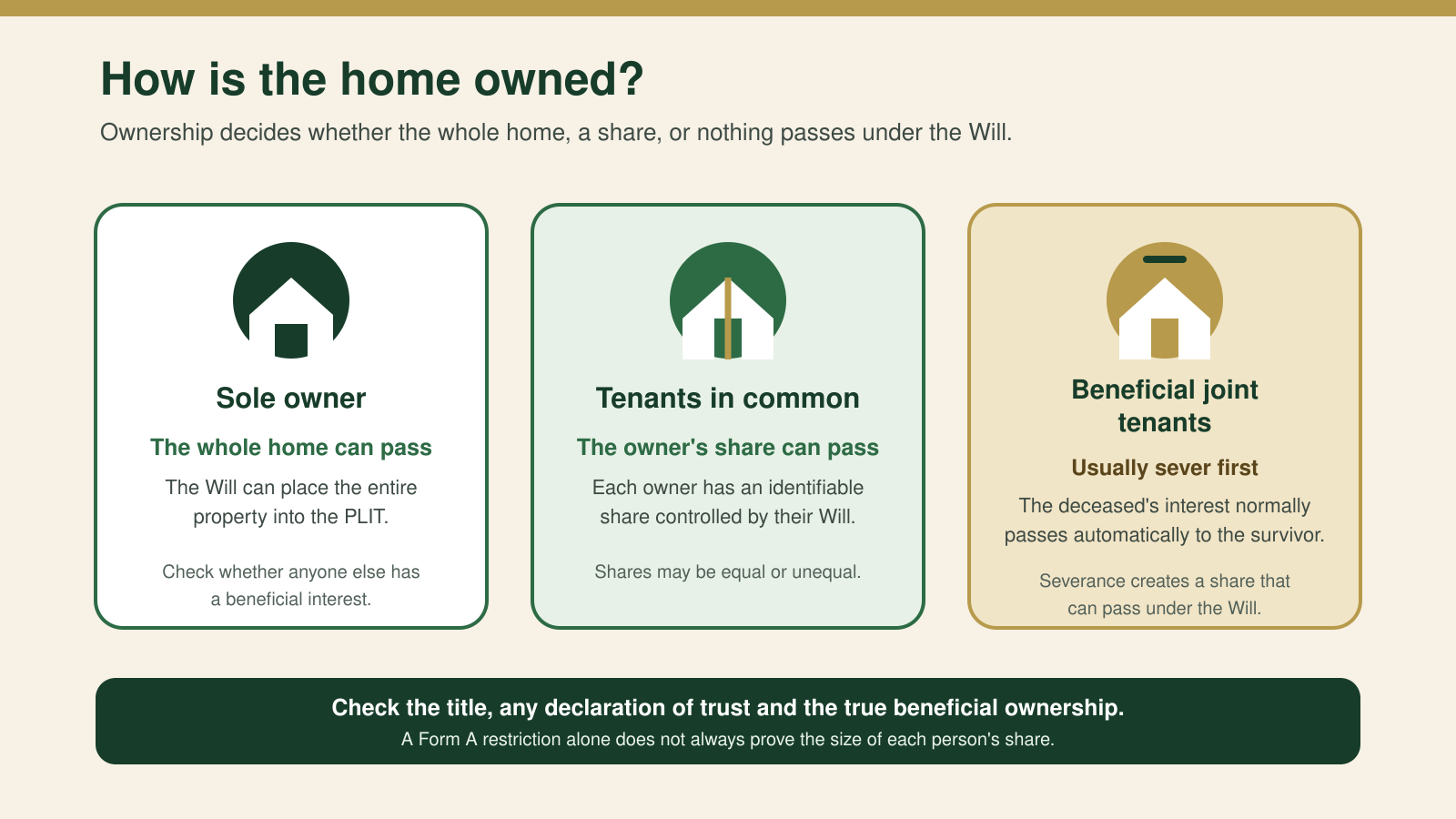
There are three common starting positions.
You own the property in your sole name
If you are the sole legal and beneficial owner, the whole property can potentially pass under your Will into a PLIT.
For example, you might want your unmarried partner to remain there after your death, but ultimately want the property to pass to your children.
It is still important to check whether anyone else has a beneficial interest in the property, even if only one name appears at HM Land Registry.
You own as tenants in common
Tenants in common each own an identifiable share of the property. The shares might be equal, but they do not have to be.
Your share does not pass automatically to the surviving owner. It can pass under your Will into a PLIT.
This is the usual joint-ownership arrangement where each owner wants their share controlled by their own Will.
You own as beneficial joint tenants
With beneficial joint ownership, the deceased owner’s interest normally passes automatically to the surviving owner. It does not pass under the Will.
The joint tenancy will therefore usually need to be severed if an individual share is intended to pass into a PLIT.
A Form A restriction may appear on the registered title after severance. However, the restriction alone does not always prove the size of each person’s beneficial share. The title, any declaration of trust and the surrounding documents should be checked together.
How a PLIT works
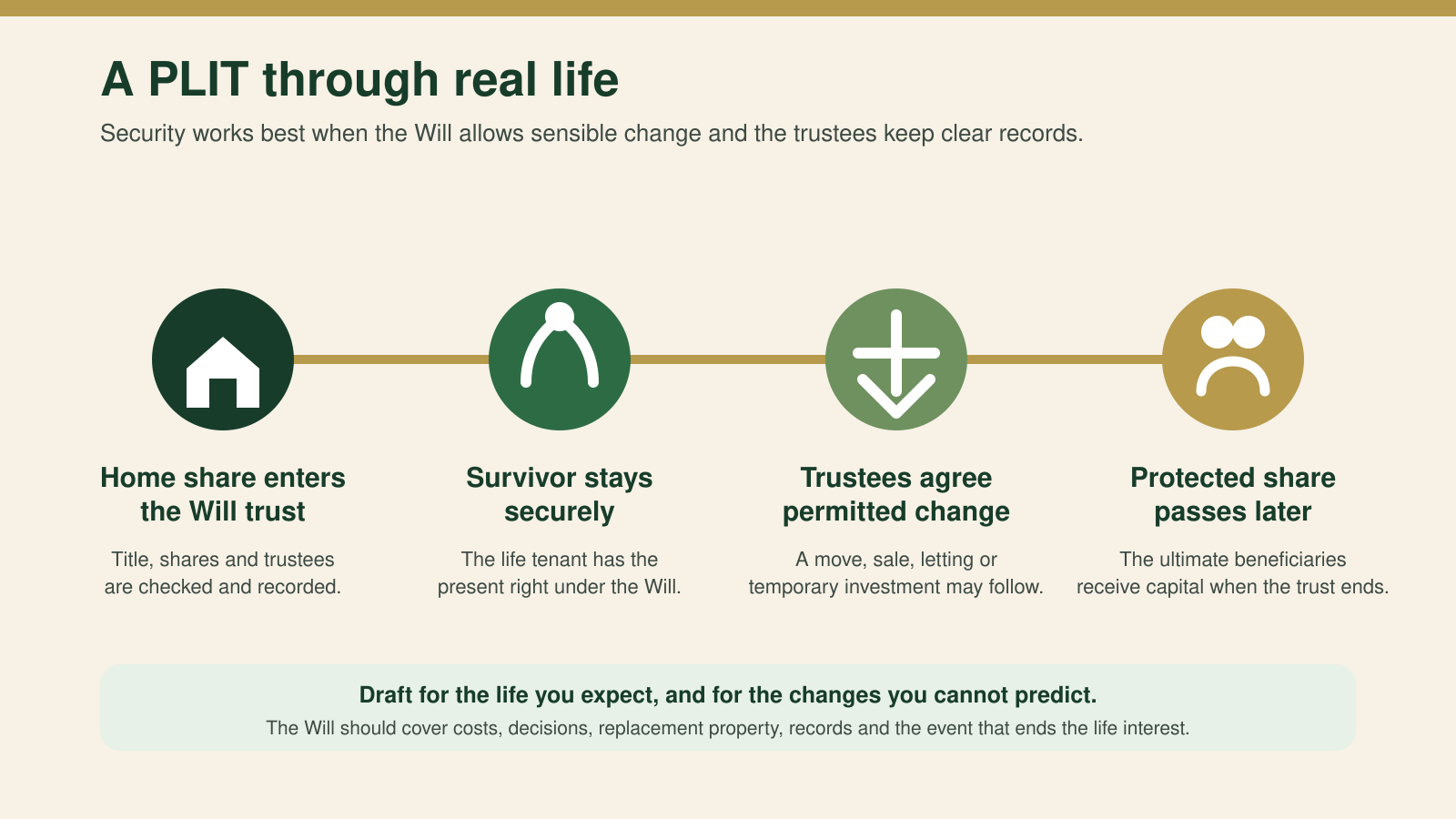
- Your Will creates the trust. It identifies the property or property share, your partner, the trustees, the people who will inherit later and the powers available to the trustees.
- You die. The executors administer your estate and identify the whole property or share that is due to enter the trust.
- Your partner receives the present benefit. They may have a right to occupy the home, together with any other rights granted by the Will.
- The trustees manage permitted changes. Depending on the wording, they may be able to cooperate in a sale, purchase a replacement home, invest unused proceeds or allow the property to be let.
- Your partner’s interest ends. This may happen on their death or on another event clearly stated in the Will, such as permanently leaving the property or formally giving up their right.
- The property or trust fund passes to your chosen beneficiaries. The trustees then deal with the property or money in accordance with the Will.
The Will should also explain who is responsible for insurance, mortgage payments, routine repairs, major improvements and other property costs.
What does the survivor receive?
The survivor does not normally receive the trust property outright. Instead, they receive the rights given to them by the Will.
Those rights might include:
- living in the property without paying rent;
- living there for life or until a specified event;
- requiring the trustees to consider a move;
- occupying a replacement property;
- receiving income if the property is let or money is invested; or
- contributing their own money towards a more expensive replacement home.
The precise wording matters. A basic right to occupy one named property may become impractical if the survivor needs to move, downsize, relocate or enter supported accommodation.
A well-drafted PLIT can allow sensible flexibility without giving away the protection the trust was intended to provide.
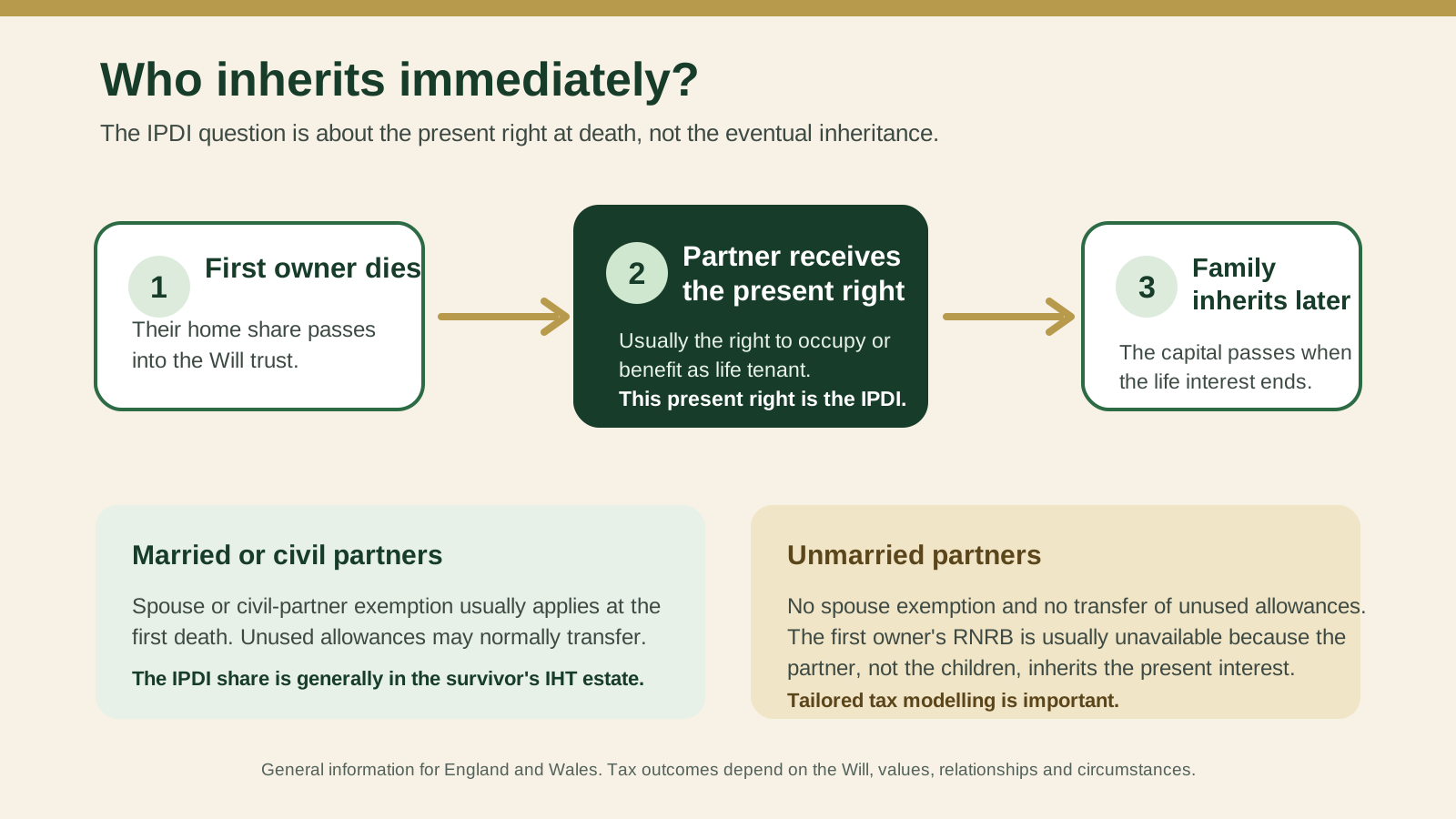
Married couples and civil partners
Transfers between spouses and civil partners are normally exempt from inheritance tax on the first death, subject to the detailed residence and overseas rules.
A qualifying life interest for a spouse or civil partner can normally receive that exemption. This means the property passing into the PLIT may be exempt on the first death even though it is not being left outright.
Any unused ordinary nil-rate band and residence nil-rate band can often be claimed when the surviving spouse or civil partner later dies, provided the relevant conditions are met.
However, the trust property is generally treated as part of the surviving spouse’s or civil partner’s estate for inheritance-tax purposes while their qualifying life interest continues.
The PLIT therefore controls who ultimately inherits the property, but it does not normally remove the property from the survivor’s inheritance-tax estate.
Unmarried couples
Unmarried partners do not receive the general spouse or civil-partner inheritance-tax exemption.
They also cannot transfer unused nil-rate band or residence nil-rate band between them.
This does not mean that a PLIT is unsuitable. It may still be the right way to give the surviving partner housing security while protecting the property for the owner’s children. However, the possible tax cost must be understood.
The value passing into the PLIT may use some or all of the deceased owner’s ordinary nil-rate band. If the value exceeds the available allowances and no other exemption or relief applies, inheritance tax may be payable on the first death.
The residence nil-rate band can present a particular problem. It normally requires a qualifying home to be inherited by the deceased person’s children or other direct descendants. If an unmarried partner receives the present life interest, the children usually inherit later rather than on that first death.
The residence nil-rate band may therefore be unavailable on the first death. It may also be unavailable when the life tenant later dies if the people inheriting the trust property are not also that life tenant’s direct descendants.
This is an area where tailored tax modelling is particularly important. An unmarried couple should not assume that a plan designed for a married couple will produce the same result.
What does a PLIT protect?
The main protection is control over where the property eventually goes.
If the survivor later changes their Will, remarries or forms a new relationship, they do not normally gain the power to redirect the protected property to somebody else.
Subject to the Will terms, the PLIT may also offer protection if the survivor:
- becomes bankrupt;
- is influenced to change their own Will;
- has different beneficiaries from the original owner;
- has a new family or relationship; or
- simply changes their mind about who should inherit.
The survivor’s right to occupy remains protected, while the eventual destination of the trust property remains governed by the original owner’s Will.
What does it not protect against?
A PLIT is valuable, but it is not an absolute shield.
It does not guarantee that:
- the property will never need to be sold;
- there will never be inheritance tax or capital gains tax;
- the property will be ignored in every care-fee assessment;
- the trustees and family will always agree;
- the property value will remain unchanged;
- the mortgage lender will agree to every proposed arrangement; or
- nobody will bring a claim against the estate.
The survivor’s own property share remains their asset. Their life interest may also be relevant for inheritance-tax and other purposes.
The trust should be chosen because it provides the right balance between security and controlled inheritance, not because it has been presented as a way of guaranteeing a particular tax or care-fee outcome.
Can the survivor move home?
Often, yes.
The Will can allow the trustees to sell the original property and use the trust’s share of the proceeds towards a replacement home.
If the replacement is cheaper, the unused trust money can normally remain invested. If the replacement is more expensive, the survivor may be able to contribute their own money.
The ownership proportions must be recorded clearly. If the trust contributes 40% of the purchase price and the survivor contributes 60%, the legal and beneficial records should reflect that arrangement.
The Will should also deal with the possibility that the original property is sold before a replacement is ready. The trust money may need to be invested temporarily while the survivor rents or searches for another home.
Can the property be rented out?
Possibly, if the Will gives the trustees sufficient power and the mortgage, insurance and property regulations permit it.
The trustees will need to consider:
- who will act as landlord;
- who receives the rental income;
- repairs and safety obligations;
- insurance and lender consent;
- income-tax reporting; and
- the possible effect on capital-gains-tax relief.
Letting should not be assumed merely because the trust owns the property.
Two examples
A married couple with children from an earlier relationship
Alex and Morgan own their home equally as tenants in common. Alex wants Morgan to remain secure but wants Alex’s half of the property eventually to pass to Alex’s children.
Alex’s Will places Alex’s half into a PLIT. Morgan can remain in the home, and the trustees can cooperate in a move if the Will permits it.
Morgan cannot redirect Alex’s protected half by changing Morgan’s Will. When Morgan’s life interest ends, Alex’s half passes to Alex’s children.
The qualifying life interest will normally receive spouse exemption on Alex’s death. However, Alex’s half will generally be treated as part of Morgan’s estate for inheritance-tax purposes while Morgan’s life interest continues.
A sole owner with an unmarried partner
Sam owns the whole home in Sam’s sole name. Sam’s partner, Lee, lives there, but Sam wants the property eventually to pass to Sam’s children.
Sam’s Will places the whole property into a PLIT. Lee receives a secure right to remain there, and the Will can allow the trustees to help Lee move to another suitable home.
When Lee’s interest ends, the property or remaining trust fund passes to Sam’s children.
Because Sam and Lee are not married or civil partners, there is no spouse exemption and their unused inheritance-tax allowances cannot transfer between them. The residence nil-rate band may also be unavailable because Lee receives the present interest and Sam’s children inherit later.
The PLIT may still be the right answer, but Sam should understand the likely tax position before signing the Will.
What will it cost?
There are two different cost stages.
Setting up the planning
The PLIT is included in the Will. The initial costs may include:
- advice and preparation of the Will;
- checking the property title;
- severing a beneficial joint tenancy if necessary;
- preparing or reviewing a declaration of trust;
- Land Registry or conveyancing work; and
- specialist tax advice where the values or family arrangements justify it.
Fern’s quotation should state what work is included. Separate conveyancing, tax or Land Registry work may be charged by the relevant professional.
Costs after death
After death, possible costs include:
- probate and estate administration;
- property valuations;
- conveyancing and Land Registry work;
- mortgage or lender requirements;
- Trust Registration Service work;
- trustee meetings and record keeping;
- trust tax returns or accounts;
- advice when the property is sold, let or replaced; and
- advice if trustees or beneficiaries disagree.
There is not necessarily a professional bill every year. A straightforward year in which the survivor continues living in the property may require little external work beyond sensible trustee records and periodic checks.
For broad budgeting only, a quiet year might involve no professional charge or perhaps £0 to £500 plus VAT of specialist support. A year involving a sale, replacement property, tax return, disagreement or significant trustee decision might involve approximately £500 to £2,500 plus VAT, before conveyancing, valuations, insurance, accounting or tax charges.
These are illustrations, not a fixed Fern fee or a promise of what another professional will charge.
For a fuller explanation, see How much does a Will trust cost to set up and run?
You do not need to become a trust-tax expert. The important point is that a PLIT can affect tax differently depending on who receives the life interest and who inherits later.
Inheritance tax
A qualifying life interest created by a Will is commonly treated as an immediate post-death interest.
While that interest continues, the trust property is generally treated as part of the life tenant’s estate for inheritance-tax purposes. The normal ten-year and exit-charge system used for many discretionary trusts is not usually the standard treatment during a qualifying life interest.
Tax may arise on the first death, when the life interest ends or when the life tenant dies. The result depends on the relationship between the parties, the value of both estates, available allowances and the precise trust wording.
Capital gains tax
The trustees will generally start with the property’s market value at the original owner’s death.
If the trust property is occupied as the permitted resident’s only or main home, private residence relief may be available when it is sold. Letting, prolonged non-occupation or another use of the property can change the position.
A qualifying life tenant’s death can also produce a market-value tax rebasing under the detailed rules. Trustees should obtain advice before a sale, transfer or early termination of the life interest.
Income tax
If the survivor simply occupies the property and it produces no income, there may be no trust income to report.
If the property is let or trust money is invested, income tax and reporting may arise. The trustees may need to pay tax, submit a trust return or provide tax information to the life tenant.
Trust Registration Service
A trust created by a Will is generally excluded from Trust Registration Service registration for the first two years after death.
If the PLIT continues beyond that period, it will normally need to be registered unless a specific exclusion applies. If the trust becomes liable for UK tax, earlier registration may be required.
The trustees should obtain advice during the estate administration rather than wait until the two-year period has expired.
Care and support charges
A PLIT should not be presented as a guaranteed way of avoiding care charges.
It may mean that the deceased owner’s property or share never becomes the survivor’s outright asset. However, the survivor’s own share and their rights under the trust remain relevant.
A local authority can consider the facts, ownership, purpose and timing of arrangements when applying deprivation-of-assets rules. The primary reason for using the trust should be the genuine protection and succession objectives discussed with the client.
What happens after death?
The Will creates the trust, but the family still needs to put it into operation.
The usual high-level steps are:
- Locate the signed Will and identify the executors and trustees.
- Obtain a date-of-death valuation of the property.
- Confirm how the property was legally and beneficially owned.
- Administer the estate, including probate and inheritance-tax work where required.
- Identify and record the property or share due to enter the PLIT.
- Deal with the Land Registry title, mortgage lender and insurance.
- Record the survivor’s occupation rights and responsibility for property costs.
- Check the Trust Registration Service and ongoing tax position.
- Keep trustee decisions, valuations, expenditure and correspondence safely.
- Obtain advice before any sale, letting, replacement property or early ending of the trust.
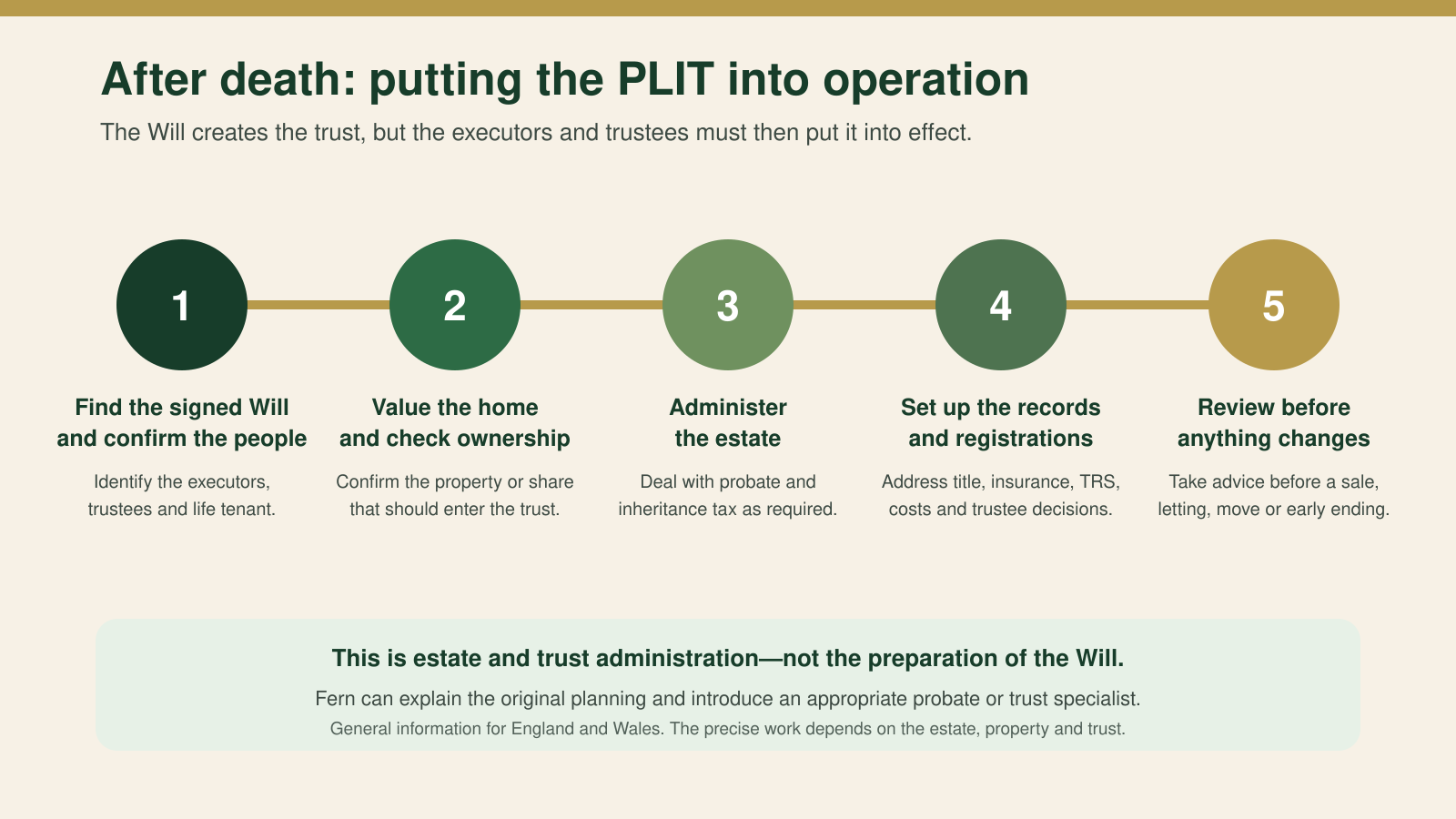
This work is normally dealt with as part of the estate and trust administration. It is separate from the preparation of the Will.
Fern can explain the original planning and provide an introduction to an appropriate probate or trust specialist. Fern does not administer the estate, operate or register the trust, prepare trust tax returns or calculate the eventual tax liability.
Frequently asked questions
Can my partner remain in the home for the rest of their life?
Yes, if that is what the Will says. The Will can also set out other events that end the right, such as permanently leaving the property or formally giving up the interest.
Can my children make my partner leave?
Not simply because they are due to inherit later. The trustees and beneficiaries must respect the life tenant’s rights under the Will.
Can my partner sell the property without the trustees?
Normally not. A sale will usually require the trustees and legal owners to cooperate. The exact position depends on how the title is held and the powers in the Will.
Can the survivor move to a more expensive home?
Possibly. The survivor may be able to contribute their own funds alongside the trust’s money. The ownership proportions and responsibility for costs must be documented carefully.
What happens if the survivor moves permanently into care?
That depends on the Will. Permanent vacation might end the life interest, or the trustees might retain, sell or let the property. The chosen trigger should be discussed while the Will is being prepared.
Who pays for insurance and repairs?
The Will should provide a starting point. Routine occupation costs are often paid by the occupier, while structural work or major improvements may require trustee involvement. Mortgage and insurance conditions must also be followed.
Is the children’s inheritance fixed at the value on the first death?
Usually not. Their entitlement is normally to the trust property or trust share, so its value can rise or fall. A date-of-death valuation is still essential for estate and tax records.
Does the trust have an annual charge?
Not automatically. Some years may require little more than proper records and a basic review. Professional fees are more likely when there is a sale, move, tax return, registration, significant decision or disagreement.
Does every PLIT need to register?
Not immediately. A Will trust normally has a two-year registration exclusion. A continuing PLIT will usually need registration after that, and a taxable trust may need to register sooner.
Can the trust be ended early?
Sometimes, but nobody should assume that it can. The answer depends on the Will, the life tenant’s rights, trustee powers, the beneficiaries’ ages and agreement, and the tax consequences. Legal and tax advice should be obtained first.
Does a PLIT protect against care fees?
It can protect the deceased owner’s succession plan, but it does not guarantee that the property or trust rights will be ignored in a care assessment. It should not be selected or promoted solely as a care-fee avoidance arrangement.
How Fern can help
Fern Wills & LPAs can:
- explore what you want to achieve;
- explain whether a PLIT fits those aims;
- compare it with an outright gift or a simpler right to occupy;
- check whether the home is owned solely, as tenants in common or as beneficial joint tenants;
- prepare the Will and PLIT provisions;
- explain the key advantages, disadvantages and foreseeable costs; and
- introduce you to a conveyancer, probate specialist or tax adviser where separate work is required.
Fern does not accept appointment as trustee, administer estates, operate or register trusts, prepare trust accounts or tax returns, or guarantee inheritance-tax, care-fee, creditor or family-dispute outcomes.
Security now, clarity later
A PLIT is designed to answer two human questions:
Will the person I care about be secure in their home?
And will the property eventually reach the people I have chosen?
A properly planned PLIT can answer both questions, without requiring you or your family to become trust experts.
The next step is to bring your property title, any declaration of trust, an approximate property value, mortgage details and a simple family tree to your Will-planning meeting. Fern can then help you decide whether a PLIT provides the right balance of security, flexibility, cost and control.
This article provides general information for England and Wales. It is not legal, tax, financial or care-funding advice. Tax law, allowances and personal circumstances can change. Tailored advice should be obtained before acting.