Can an attorney sell jointly owned property under an LPA?

Last verified: August 2026 (England & Wales)
Quick-read summary
A registered Property and Financial Affairs Lasting Power of Attorney (LPA) can often allow an attorney to deal with a property owner’s affairs, including a jointly owned home. It does not, however, replace every separate rule that applies to the legal title, the trustees or the sale proceeds.
The important question is not whether a sale always needs two attorneys. It does not. The question is whether the right people can act in the right legal roles. In a straightforward case, a capable joint owner may act alongside a different person who is attorney for the owner who lacks capacity. If the capable owner is also the other owner’s only attorney, one person may not be able to complete the sale simply by signing twice.
The title, beneficial ownership, LPA and proposed transaction should therefore be checked before a sale becomes urgent.
A valid LPA may solve the authority problem without automatically solving every trustee, title or conveyancing requirement.
For the broader explanation of what this type of LPA covers, see our Property and Financial Affairs LPA guide.
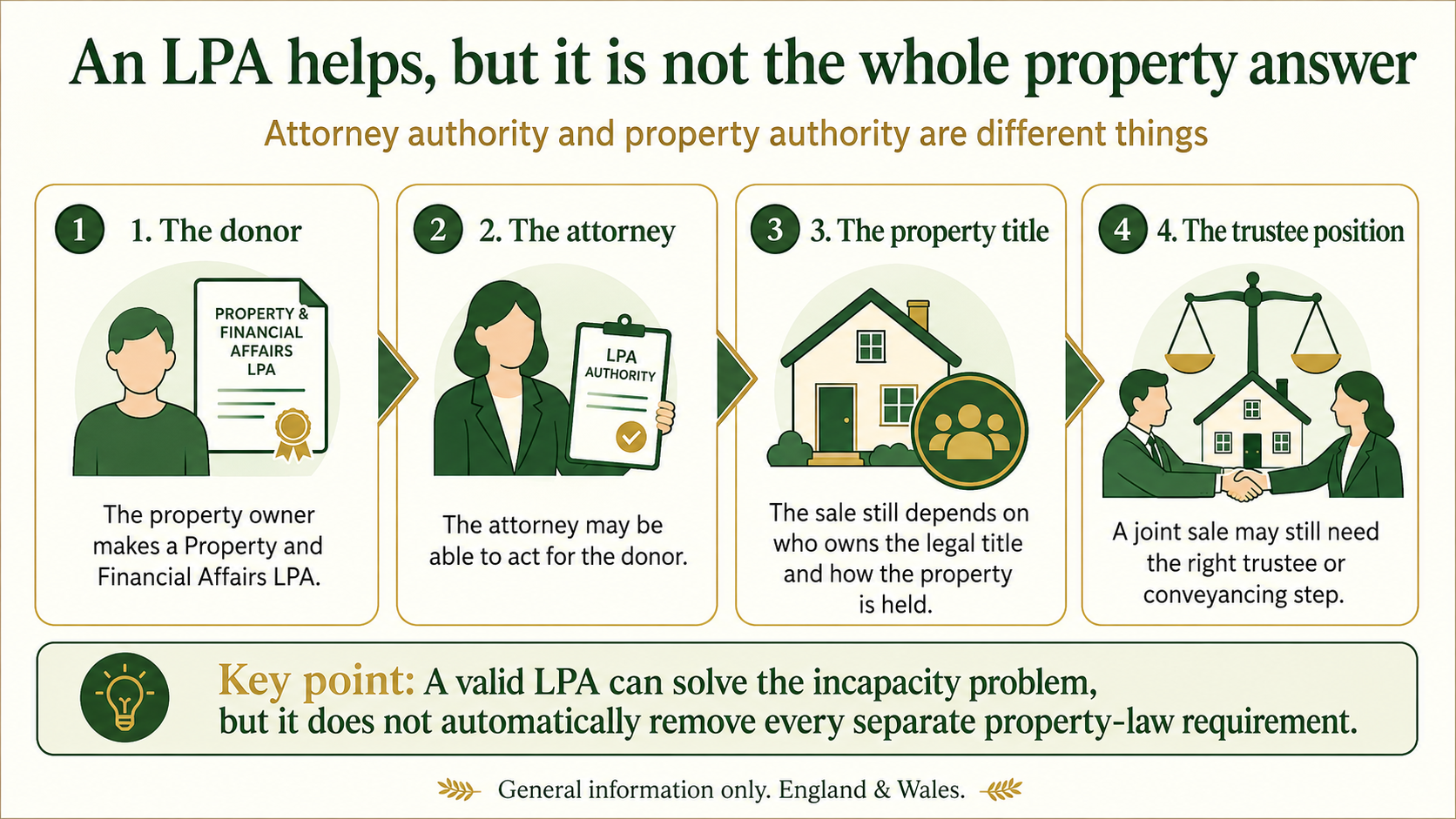
Three separate questions need answering
A property sale involving an owner who lacks capacity can bring together three different legal questions:
1. Who owns the legal title? These are the registered proprietors shown at HM Land Registry.
2. Who has the beneficial interest? These are the people entitled to occupy the property, benefit from it or receive the sale proceeds. Their interests may be held jointly or in separate shares.
3. Who has authority to act? This may be the owner personally, an attorney under a registered LPA, an additional trustee, a deputy or somebody appointed by the court.
These questions overlap, but they are not interchangeable. Appointing an attorney does not make that person a registered owner, and appointing several attorneys does not automatically make them several trustees of the legal estate.
What can a Property and Financial Affairs LPA cover?
A Property and Financial Affairs LPA can authorise an attorney to make, or help the donor make, decisions about money, accounts, investments and property. The LPA must be registered before it can be used.
Depending on the option selected in the LPA, an attorney may be able to act while the donor still has capacity if the donor gives permission. If the donor lacks capacity to make the particular decision, the attorney must act within the LPA, follow the Mental Capacity Act principles and act in the donor’s best interests.
That authority may include a decision to sell the home. The attorney should consider why the sale is proposed, where the donor will live, the donor’s wishes and feelings, affordability, care needs and the other relevant circumstances. The conveyancer must separately confirm that the property title and trustee requirements are satisfied.
Why jointly owned property is different
Property ownership has two layers:
· Legal title: the ownership recorded at HM Land Registry. Where two or more people are registered, they own the legal estate together.
· Beneficial interest: the right to use the property, live in it or receive the sale proceeds. Beneficial interests can be held jointly or in separate shares, for example as tenants in common.
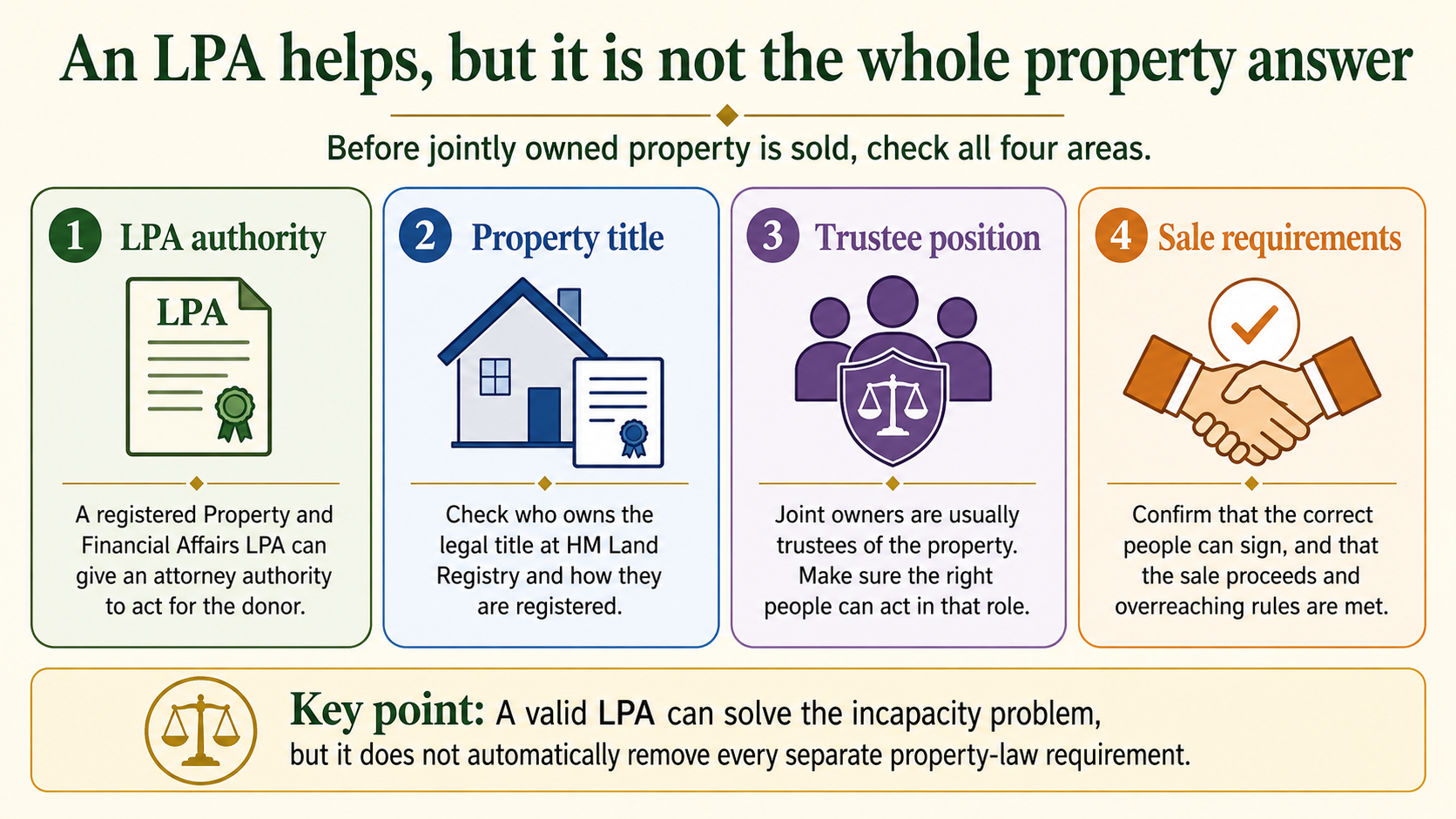
Joint registered owners also hold the legal estate as trustees. A sale may therefore require the conveyancer to consider both the attorney’s authority and the trustees’ ability to give a valid receipt for the sale money.
This is connected with overreaching. In plain terms, overreaching transfers beneficial interests away from the property and into the sale proceeds, so that the buyer can take the property free from those interests. It is one reason why the identity and number of the people completing the transaction can matter.
Does every jointly owned property sale need two attorneys?
No. The requirement is not that every owner must appoint two attorneys.
Where sale proceeds are being paid and beneficial interests need to be overreached, an attorney will generally need to act with at least one other person. That other person might be a capable joint owner, another attorney who is able to act under the LPA, or an additional trustee appointed for the transaction. The correct route depends on the title, the LPA and the facts.
This means that a capable joint owner and a separate attorney for the owner who lacks capacity may often be able to act together. It also means that simply counting the number of attorneys does not answer the property-law question.
Why can one person not simply sign twice?
A common difficulty arises where one joint owner still has capacity and is also the only attorney for the other owner.
That person may have two genuine roles, but they remain one individual. Where the transaction requires an attorney to act with another person so that the sale money is properly received and beneficial interests are overreached, signing once as owner and again as attorney will not ordinarily satisfy the requirement.
An additional trustee may then need to be appointed, or another legally available route may need to be used. The conveyancer should identify the correct route before contracts are exchanged.
Would appointing two attorneys avoid the problem?
It can help, but it is not a universal solution.
Two attorneys who are both able to act may sometimes provide the separate people needed for a transaction. However, two attorneys acting for one proprietor do not automatically become two registered owners or two trustees of the legal estate. The title and the way the attorneys are appointed still need to be checked.
Attorney appointments should therefore be designed for continuity, practical decision-making and the donor’s circumstances, not solely around a simplified “two signatures” rule. Our guide to choosing and appointing attorneys explains the main appointment options and replacement arrangements.
Can a replacement attorney provide the extra signature?
Not merely because another person would be useful for the sale.
A replacement attorney normally steps in only when the original attorney they are replacing has permanently stopped acting for one of the reasons recognised by the LPA rules. A replacement cannot temporarily stand in while an original attorney remains able to act.
The need for an additional trustee in a property transaction is therefore a different question from whether a replacement attorney has become entitled to act under the LPA.
How this can work in practice
David and Helen own their home jointly. Helen later loses capacity to decide whether it should be sold.
Helen has a registered Property and Financial Affairs LPA appointing her sister, Amina, as attorney. Subject to the wording of the LPA and the conveyancer’s title checks, David may be able to act in his own right while Amina acts for Helen. There are two separate people completing the transaction.
The position is different if David is Helen’s only attorney. David cannot assume that he can complete the sale alone by signing once as owner and again as Helen’s attorney. The trustee position may need to be resolved by appointing another person or taking another specialist step.
A further variation arises if Helen is the sole surviving registered owner and the register contains a restriction showing that beneficial interests may still need protection. More specific trustee or court action may then be required.
What if the title contains a restriction or the property is held on trust?
A restriction on the title can indicate that the registered owner or owners hold the property on trust for beneficial owners. A common example is a Form A restriction, often associated with tenants-in-common arrangements, although the restriction does not by itself prove exactly who owns the beneficial interests or in what shares.
A declaration of trust, transfer document, Will trust or other arrangement may also affect the position. The LPA does not override those documents. The conveyancer must check the register and any supporting trust documents before deciding who needs to act.
If the person who lacks capacity is to be replaced as trustee, court permission may sometimes be required, particularly where that person has a beneficial interest in possession. This is a specialist property and Court of Protection issue, not something that should be assumed from the LPA alone.
When might further legal or Court of Protection involvement be needed?
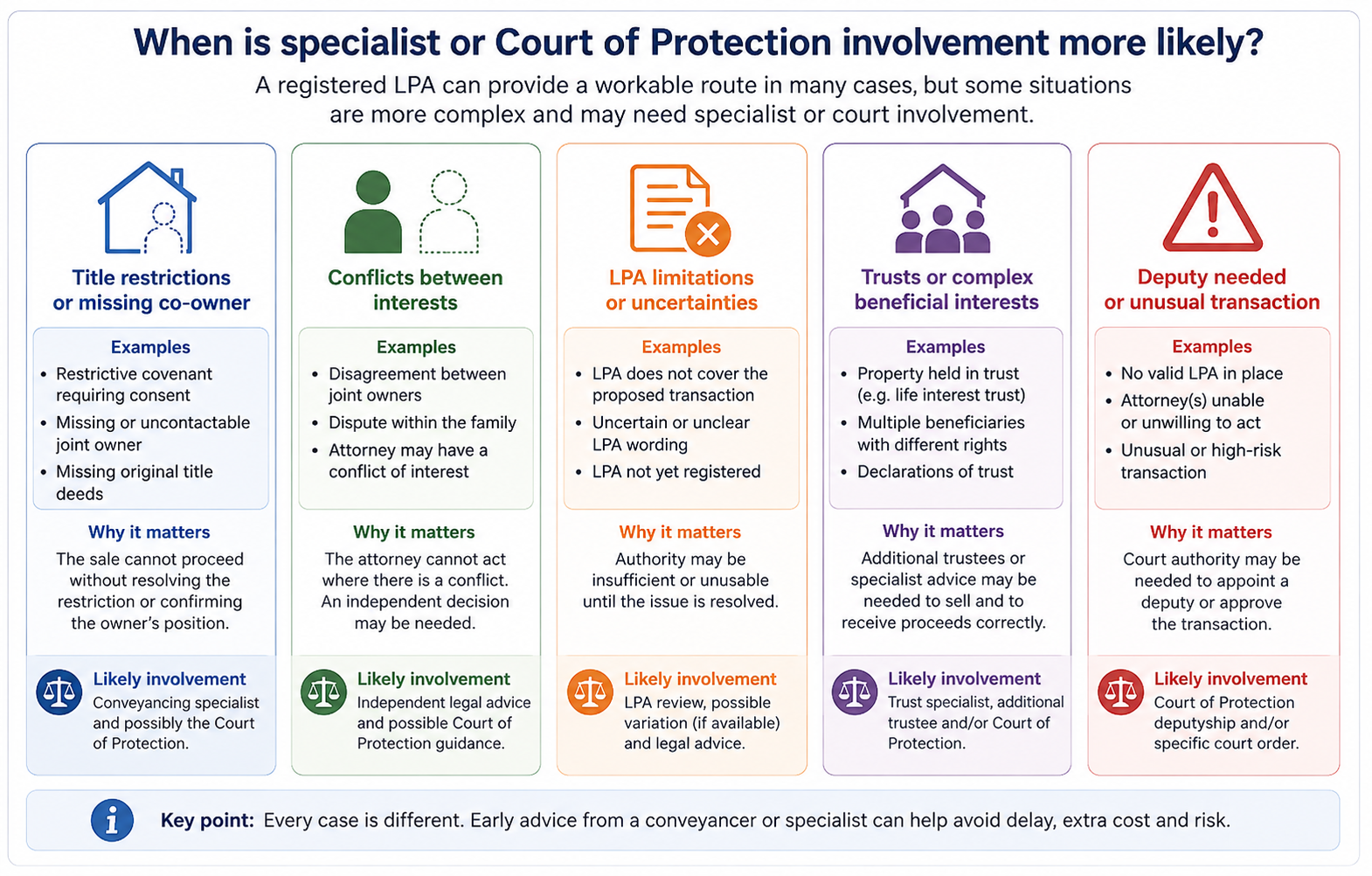
Court involvement is not automatic whenever an owner loses capacity. A registered LPA may provide a workable route. Further legal or court action may nevertheless be needed where:
· there is no valid registered LPA or no attorney who can act
· the available attorney is also the only continuing owner and another person is needed for the trustee side of the sale
· the person who lacks capacity is the sole or sole-surviving trustee
· the title contains a restriction or the beneficial ownership is unusual or unclear
· a deputy’s existing court order does not cover the jointly owned property transaction
· there is a conflict of interest, a proposed sale at an undervalue, a gift element or a dispute
· the ordinary route for appointing or replacing a trustee is not available without the court’s permission
The right response is early diagnosis. A family should not assume that a full Court of Protection application is inevitable, but it should also not assume that the existence of an LPA removes every further step.
Does an LPA override a Will trust?
No. An LPA operates during the donor’s lifetime and ends on the donor’s death. A trust created by the donor’s Will generally begins after death and is then administered by the Will trustees, not by attorneys acting under the LPA.
The LPA, Will and property ownership should still be coordinated during estate planning. Doing so helps identify whether the same home is affected by attorney appointments, severance of joint ownership, title restrictions or a trust that will arise after death.

Do I need two attorneys because I own property jointly?
No. Joint ownership does not automatically mean that you must appoint two attorneys. The appropriate arrangement depends on who owns the property, who you trust to act and how you want decisions made. A later sale may still require a separate trustee or conveyancing step.
Can my spouse or partner be my only attorney?
Yes, but the joint-property position deserves extra thought if that person also owns the home with you. They may have authority under the LPA but may not be able to complete a later sale entirely alone.
Can an attorney sell my home while I still have capacity?
Potentially. The LPA must be registered, its wording must allow the attorney to act, and you must give permission. You remain the decision-maker while you have capacity to make the particular decision.
Can an attorney sell my home after I lose capacity?
Potentially, provided the sale is within the attorney’s authority and is in your best interests. The separate title, trustee and conveyancing requirements must also be satisfied.
Do jointly and severally appointed attorneys solve the whole problem?
No. That appointment can provide useful flexibility under the LPA, and another attorney may sometimes be able to act as the separate person needed for a transaction. It does not automatically remove every trust, title or overreaching issue.
Does a deputy automatically have authority to sell jointly owned property?
No. The deputy must check the court order, and a separate court order may be needed for the sale of jointly owned property. Deputy authority and trustee authority should not be treated as the same thing.
What happens if no LPA was made?
A Court of Protection application may be needed so that somebody can make the relevant decisions or deal with the trustee position. This can add cost, delay and uncertainty at a time when a move may already be urgent.
Plan before a sale becomes urgent
A well-prepared Property and Financial Affairs LPA can make future property decisions considerably easier, but the LPA should be considered alongside:
· the registered legal owners
· the beneficial ownership and any declaration of trust
· the identity of the attorneys
· whether the attorneys act jointly, jointly and severally, or differently for particular decisions
· replacement arrangements
· any restriction on the property title
· the donor’s Will and wider estate plan
Fern Wills & LPAs can identify how your attorney choices fit with your property ownership and wider estate plan, explain the LPA options and help organise the relevant information. The conveyancer handling any future sale must confirm the title, trustee and execution requirements. Where specialist property, trustee or Court of Protection work is needed, we can signpost or introduce an appropriate specialist.
See our Lasting Powers of Attorney service and fixed fees for the available Fern service.
This article is general information only, not individual advice. If you would like help applying this to your circumstances, we can guide you through the options. |