Attendance Allowance
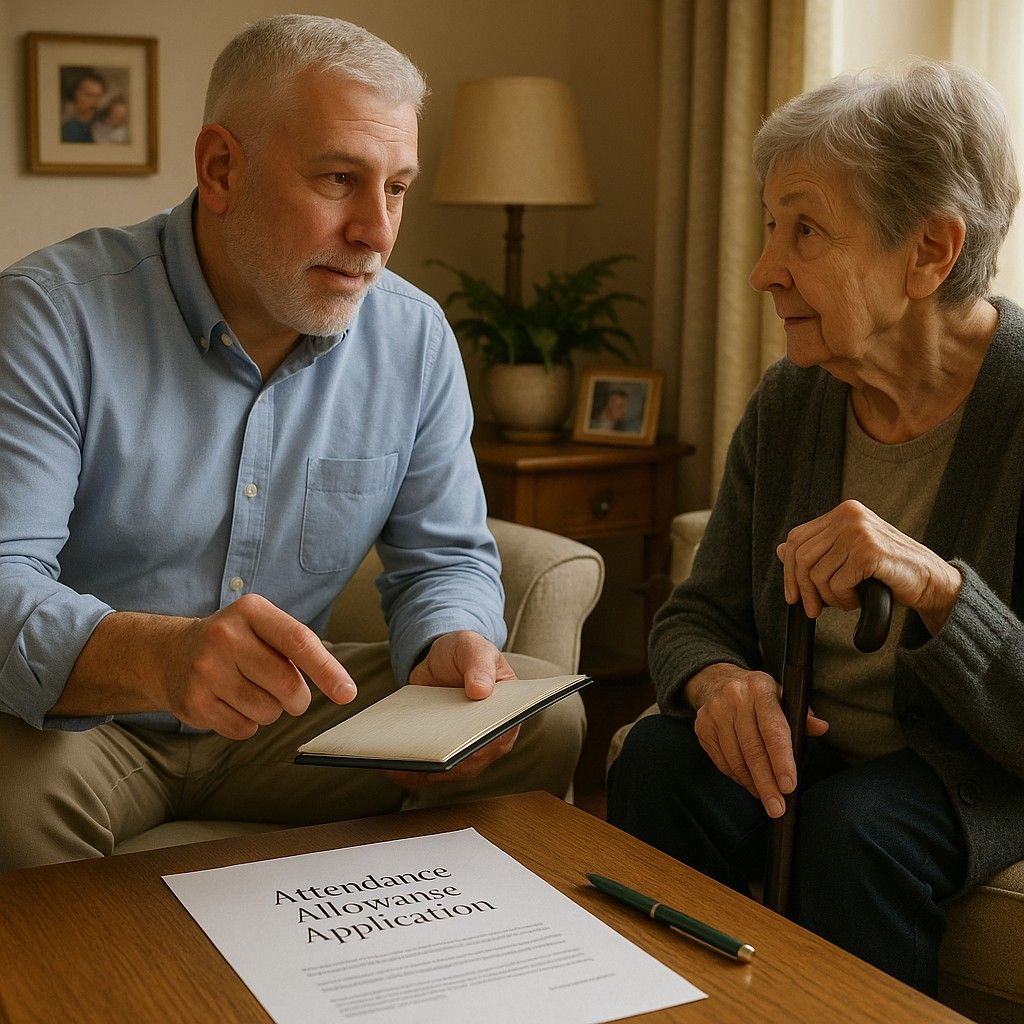
Last verified: July 2026 (England & Wales)
Quick-read summary
Attendance Allowance is a tax-free, non-means-tested benefit for people who have reached State Pension age and need help or supervision because of a disability, illness or health condition.
It is not a Fern Wills & LPAs service. Fern does not give benefits advice or complete Attendance Allowance claims. We include this guide because Attendance Allowance is often missed in later-life planning conversations.
If it may be relevant, Fern can help you separate the issues:
- benefits questions should go to the right benefits adviser or official source;
- legal planning questions may involve Wills, Lasting Powers of Attorney, storage and family records;
- practical family questions may involve care, support, transport, home help and who is actually doing what.
Attendance Allowance may be worth checking where an older person needs help with personal care, supervision, safety, medication, moving around the home, washing, dressing, meals, falls risk, confusion, memory concerns or night-time support.
Why this matters in later-life planning
Attendance Allowance often comes up during Will and Lasting Power of Attorney conversations.
A client may say they are “coping”, but then mention that they struggle to get out of a chair, forget medication, need help washing, avoid going upstairs, rely on family for meals, or feel unsafe at night.
An adult child may be doing more and more: shopping, forms, hospital appointments, cleaning, bills, calls and practical support.
Those facts may raise several different questions:
- Is there a possible Attendance Allowance claim?
- Are Lasting Powers of Attorney already in place?
- Does the person still have capacity to make legal decisions?
- Are family members keeping records of money handled or support provided?
- Does the Will still reflect the current family and care situation?
No one page can solve all of that. The value is in spotting the issue early and directing each part to the right place.
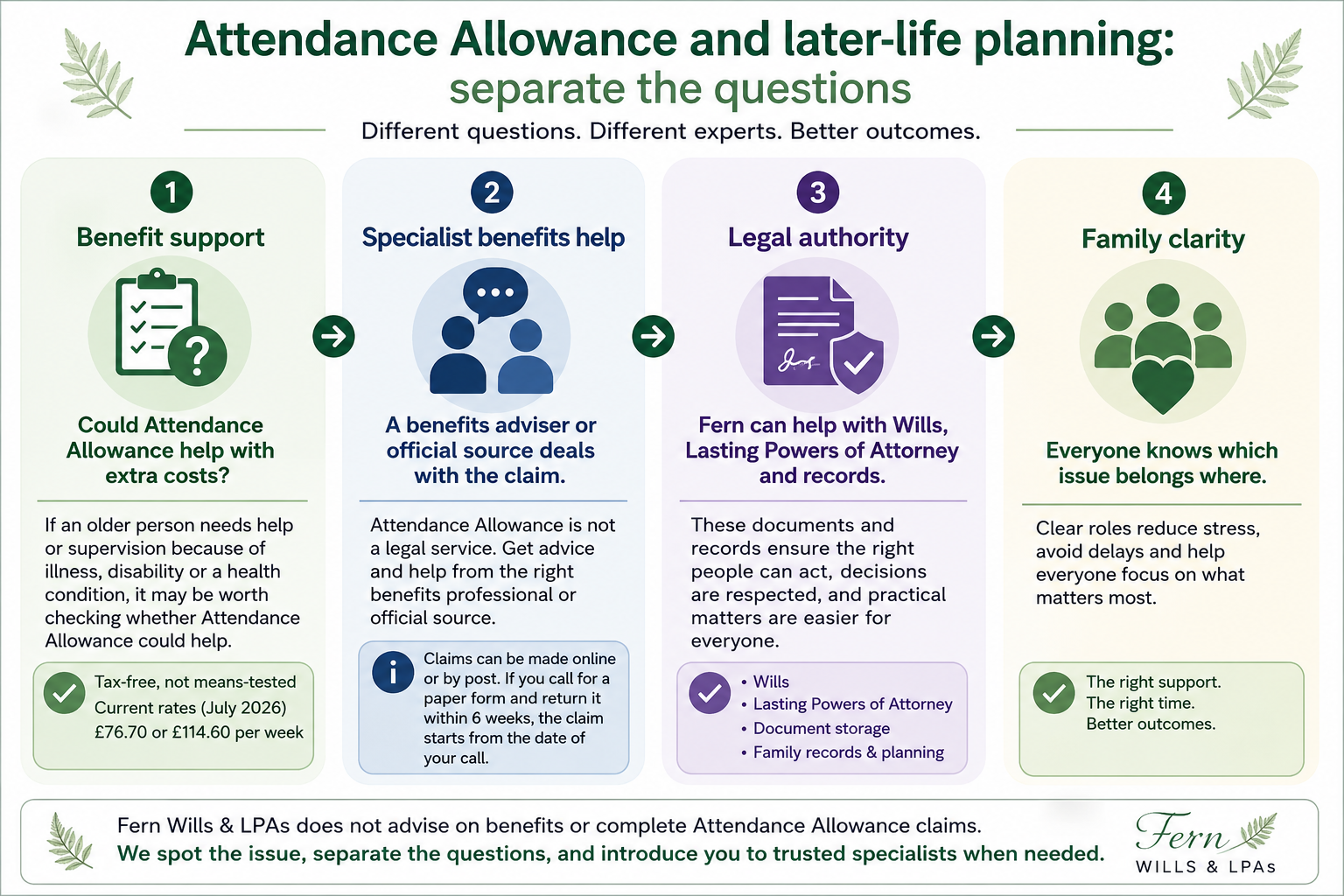
Benefits advice, legal authority and family planning are connected, but they are not the same job.
What Attendance Allowance is
Attendance Allowance helps with extra costs where someone has reached State Pension age and needs help or supervision because of a disability, illness or health condition.
It is not means-tested. Income and savings do not usually stop someone claiming.
It is tax-free.
It is based on the person’s needs, not on whether they already have a named carer.
It does not cover mobility needs.
It can sometimes increase entitlement to other support, such as Pension Credit, Housing Benefit or Council Tax Reduction. That depends on the person’s wider circumstances, so it should be checked carefully.
Current GOV.UK rates are:
- lower rate: £76.70 per week;
- higher rate: £114.60 per week.
Rates can change, usually from April. Always check the current official position before relying on the figures.
Who may be eligible
A person may be eligible if they have reached State Pension age and need help or supervision because of a physical disability, mental disability, illness or health condition.
The need may involve help during the day, at night, or both.
Examples can include needing help or supervision with:
- washing, dressing or using the toilet;
- getting in or out of a chair or bed;
- medication or treatment routines;
- avoiding falls or accidents;
- meals, drinks or eating safely;
- confusion, memory problems or anxiety;
- supervision because the person may be at risk without support.
The person does not have to be receiving all of that help already. The question is about the help or supervision they reasonably need.
In most cases, the need must have existed for at least six months. Different rules apply where someone is nearing the end of life.
This page is written for England and Wales. Different arrangements apply in Scotland and Northern Ireland.
What Attendance Allowance is not
Attendance Allowance is not the same as Carer’s Allowance.
It is not a payment to the family member who helps.
It is not a Will, Lasting Power of Attorney or care-fees planning service.
It is not a guarantee that a claim will succeed.
It is not something Fern Wills & LPAs advises on directly.
Fern can spot that it may be worth checking and, where appropriate, introduce you to someone who deals with Attendance Allowance claims. That adviser will explain their own process, fees and terms.
Why claims can be missed
Many families understate the help being given.
That is especially common where the person does not want to feel dependent, or where a spouse or adult child has quietly built support into daily life.For example:
- “I only help with the bath sometimes.”
- “Dad can dress himself, but I put everything out for him.”
- “Mum takes her tablets, but only if I remind her.”
- “He does not need care, I just pop in every day.”
- “She is fine unless she gets confused at night.”
Those comments can matter. Attendance Allowance is not only about formal carers. It is about the practical help or supervision the person needs because of their condition.
How Fern can help, and where Fern stops
Fern Wills & LPAs does not complete Attendance Allowance forms or advise on benefit entitlement.
What we can do is notice when the issue may be relevant during a wider later-life planning conversation.
For example, while discussing Wills, Lasting Powers of Attorney or family records, it may become clear that someone is struggling at home, relying heavily on family, or missing support that could improve daily life.
With your consent, we can introduce you to a trusted professional who deals with Attendance Allowance claims. That keeps the benefits advice separate from the legal planning.
Fern can then help with the legal and practical planning that sits alongside it, such as:
- preparing or reviewing Lasting Powers of Attorney;
- checking whether the person’s Will still reflects their wishes;
- explaining the role of attorneys;
- helping families think about document storage and retrieval;
- signposting practical record-keeping through Life & Legacy Logs where relevant;
- identifying where other specialist advice may be needed.
Practical checklist before you ask for help
Before speaking to a benefits adviser or checking the official guidance, it can help to think about the person’s real daily needs.
You do not need perfect records, but it is useful to note:
- what the person struggles with during the day;
- what happens at night;
- whether they need reminding, prompting or supervision;
- whether they have falls, confusion, anxiety or safety risks;
- what family members or neighbours are already doing;
- whether the situation has lasted for at least six months;
- whether the person has recently got worse.
This is not about exaggerating. It is about avoiding the opposite problem: describing a difficult daily reality as if everything is fine.
How this links to Lasting Powers of Attorney
Attendance Allowance and Lasting Powers of Attorney are different things.
Attendance Allowance is about financial support where the person has care or supervision needs.
A Lasting Power of Attorney is about legal authority. It lets chosen attorneys make decisions or help manage affairs if the person cannot, or in some cases does not want to, deal with everything themselves.
The two often come up together because the same life situation may raise both issues.
For example:
- someone is still able to make decisions but needs practical support;
- family members are helping with appointments, letters and bills;
- memory problems or confusion are starting to affect daily life;
- the person may need help dealing with banks, utilities, care providers or health services;
- adult children are unsure what they are allowed to do.
If Lasting Powers of Attorney are not already in place, it is better to consider them while the person still has the mental capacity to make them.
Example: Claire
Claire was already managing a lot at home, but ordinary tasks were becoming harder.
During a visit, she tried to get up from her chair to fetch her identification. It was clear that standing and moving around took real effort. She explained that she often needed help around the house, used both hands to push herself up from a chair and relied on a stick to move about.
That raised two separate issues.
The first was practical support. I suggested that she speak to a trusted adviser who deals with Attendance Allowance claims.
The second was legal planning. If someone’s day-to-day needs are increasing, it is also sensible to check whether their Will, Lasting Powers of Attorney and family records are up to date.
Claire later applied for Attendance Allowance and was awarded the higher rate. Her backdated payment helped cover professional support she had chosen, and the ongoing allowance gave her more flexibility in daily life.
The point is not that every case will have the same result. The point is that the issue would probably have been missed if no one had asked the practical questions.
Example: John and Susie
John and his wife Susie were spending a large part of their week travelling to support John’s elderly mother.
They wanted to help, but the constant “in and out” was affecting John’s work and was not sustainable. Their visits were becoming task-based: cooking, cleaning, checking, worrying and dealing with small problems.
I suggested a no-obligation conversation with a trusted Attendance Allowance adviser.
John’s mother applied and was awarded the lower rate. Because the form had been requested by phone and returned within the required time, the claim was backdated to the date of the request.
That support helped shift the family conversation. John and Susie could spend more time simply being with his mother, rather than every visit being dominated by chores and logistics.
Again, this was not legal advice about benefits. It was spotting that a benefits question and a legal-planning question were sitting side by side.
Frequently asked questions
Does Fern Wills & LPAs advise on Attendance Allowance?
No. Fern does not give benefits advice or complete Attendance Allowance claims.
We may notice that Attendance Allowance is worth checking and, with your consent, introduce you to a trusted adviser who deals with claims.
Do you need a diagnosis to claim?
Not necessarily. The issue is the help or supervision the person needs because of a disability, illness or health condition.
A diagnosis may help explain the situation, but the decision is not based only on the name of a condition.
Does having savings stop someone claiming?
No. Attendance Allowance is not means-tested.
Income and savings do not usually stop someone claiming.
Does someone need to have a carer already?
No. The person does not need to have a named carer.
The question is whether they need help or supervision because of their condition.
Does Attendance Allowance cover mobility problems?
No. Attendance Allowance does not cover mobility needs.
However, mobility issues may still be relevant where they connect to personal care, supervision or safety inside daily life.
Can Attendance Allowance affect other benefits?
It can sometimes increase entitlement to other support, such as Pension Credit, Housing Benefit or Council Tax Reduction.
That depends on the person’s circumstances, so it should be checked carefully.
Can someone spend Attendance Allowance however they choose?
Attendance Allowance is intended to help with the extra costs of needing care or supervision. It is not restricted to one specific bill.
Many people use it to make daily life easier, safer or more manageable.
When should families also think about Lasting Powers of Attorney?
If someone is starting to need help with appointments, bills, medication, care arrangements or decisions, it is sensible to check whether Lasting Powers of Attorney are already in place.
Attendance Allowance may help with costs. Lasting Powers of Attorney deal with legal authority. Families often need to consider both.
Next step
If Attendance Allowance has come up during a Will, Lasting Power of Attorney or later-life planning conversation, the first step is to separate the issues.
Benefits questions should go to the right benefits adviser or official source.
Legal planning questions can often be dealt with through Wills, Lasting Powers of Attorney, document storage and clear family records
If you would like help working out which part belongs where, you can contact Fern Wills & LPAs. If Attendance Allowance appears relevant, we can discuss whether an introduction to a trusted benefits-support professional may be appropriate.
This article is general information only, not individual advice.
If you’d like help applying the legal-planning part to your circumstances, we can guide you through the options.